
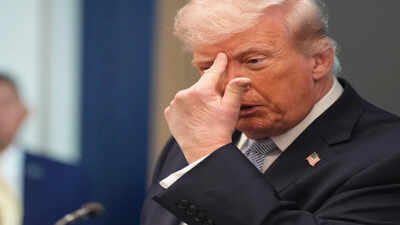
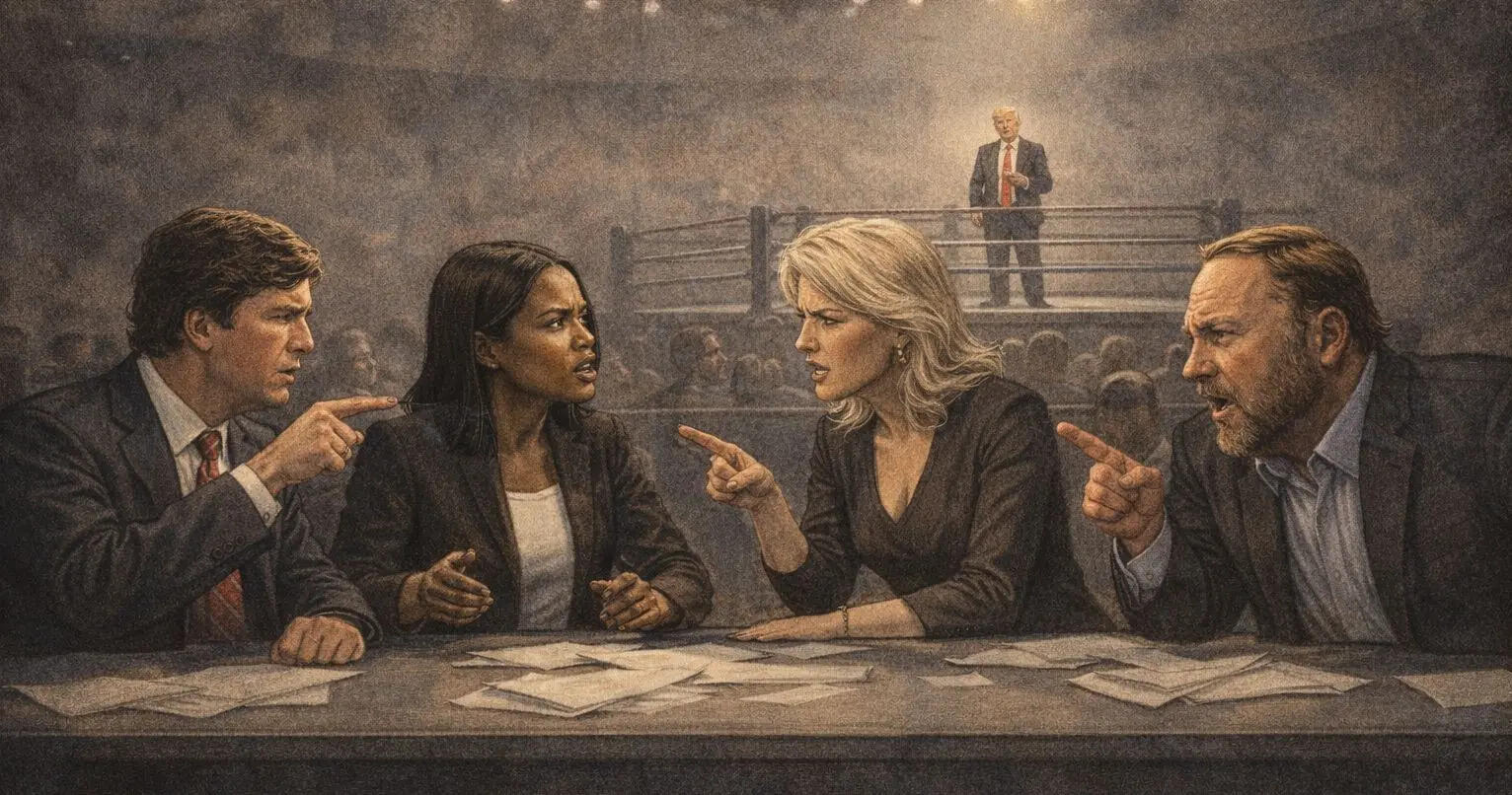
Donald Trump is the first WWE Hall of Famer to make his way to the White House which means that he’s probably familiar with the concept of heels. For those unversed in WWE lore, the heel is an important part of professional wrestling where a supposedly good star turns evil. It’s all part of a script obviously, but even the most hardcore fans were shocked when people’s favourites like The Rock or Stone Cold Steve Austin suddenly turned heel. And now Trump has to deal with heels within his own MAGA ecosystem as Tucker Carlson, Candace Owens, Megyn Kelly and Alex Jones have broken ranks and gone hammer-and-tongs after the MAGA messiah over the Iran war.For nearly a decade, Donald Trump held together a coalition that did not need ideological coherence to function. It brought together voters opposed to foreign wars with others who wanted a more assertive United States, and it allowed both instincts to coexist without ever forcing a resolution. Trump’s rhetoric made that possible. He could criticise past wars while threatening future ones, oppose intervention while projecting strength, and his supporters could choose which version they preferred.That arrangement is now under visible strain.
The Big Picture
The current rupture inside MAGA is not simply about one foreign policy position. It is about who defines the movement when disagreement comes from within.This is not a clash between Trump and traditional Republican hawks or Democratic critics. It is a clash between Trump and figures who have, in different ways, been part of the media ecosystem that amplified him. Their dissent turns what could have remained a policy disagreement into a contest over authority inside the movement itself.
Driving the news
The sequence is straightforward. Trump’s rhetoric on Iran drew criticism from several prominent conservative commentators who warned that his position risked aligning with the kind of interventionist approach he had previously opposed. Instead of ignoring or absorbing that criticism, Trump responded directly and publicly. He named Tucker Carlson, Candace Owens, Megyn Kelly and Alex Jones, and dismissed them in personal terms. What followed was not a contained disagreement but a public escalation. The critics responded in kind, using language that questioned not just Trump’s policy, but his judgement and consistency. The result is a rare moment where multiple influential voices within the same ecosystem are in open disagreement with the central figure of that ecosystem.What Trump actually saidTrump’s statement sets the tone of the conflict.He described his critics as having “low IQs” and said, “They’re stupid people, they know it, their families know it, and everyone else knows it, too.” He added, “They don’t have what it takes, and they never did,” and claimed they had “been thrown off Television, lost their Shows, and aren’t even invited on TV because nobody cares about them.”He called them “NUT JOBS, TROUBLEMAKERS” who would say anything for “free” and cheap publicity. He said their podcasts were “Third Rate” and insisted that “their views are the opposite of MAGA.”
He also defined the movement in his own terms: “MAGA is about WINNING and STRENGTH in not allowing Iran to have Nuclear Weapons. MAGA is about MAKING AMERICA GREAT AGAIN… these people have no idea how to do that, BUT I DO.”He added that he could get them “on my side anytime I want to,” but that he does not return their calls because he is “too busy on World and Country Affairs.”The statement is notable for what it does not contain. There is no direct engagement with the substance of the criticism. The focus is entirely on discrediting the critics and asserting control over the definition of MAGA.What the critics have saidThe responses have been unusually direct. Candace Owens said, “It may be time to put Grandpa up in a home,” signalling a sharp personal break. Alex Jones said Trump had “totally changed the man he once was” and added, “I supported the old Trump who got so many good things done.”Megyn Kelly described the rhetoric as “completely irresponsible and disgusting,” while Tucker Carlson warned that the approach risked pulling the United States into another unnecessary conflict.These responses do not follow a single line of argument, but they converge on one point: that Trump’s current stance is not consistent with what they understood his earlier position to be.Why these voices matterThe significance of this moment lies in who is speaking. Tucker Carlson has been one of the most prominent voices shaping conservative opinion on foreign policy. Candace Owens commands a large, highly engaged digital audience. Megyn Kelly reaches a mainstream conservative viewership that extends beyond the most partisan spaces. Alex Jones represents a segment of the audience that has remained intensely loyal to Trump over the years.When figures from across these different segments express criticism at the same time, it signals a broader internal disagreement rather than an isolated dispute.
The Groypers factor
Beyond these established voices, there is also a younger and more radical current on the right that has been critical of Trump for some time.
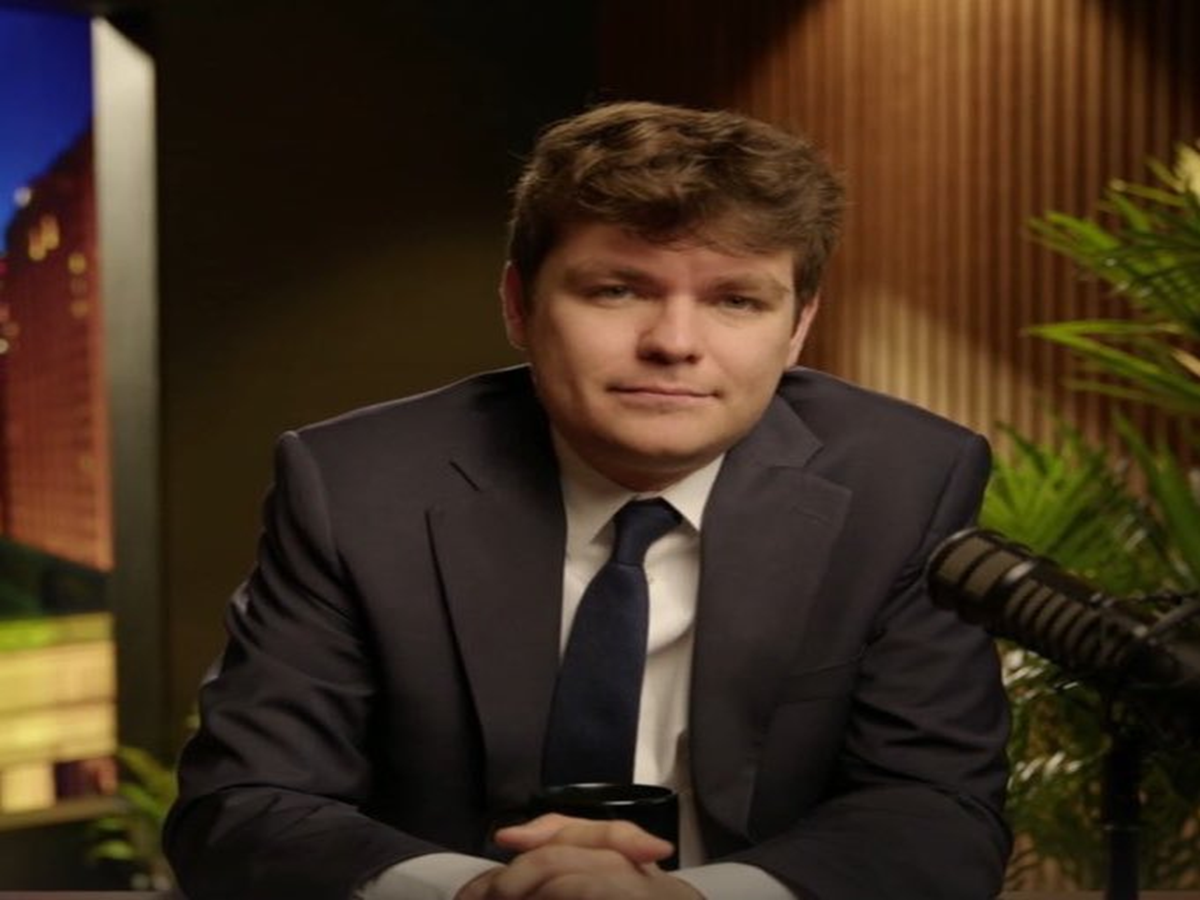
Nick Fuentes
Often referred to as Groypers, this group is associated with online activism and a more hardline interpretation of nationalist politics. Their criticism of Trump is not new, but it has taken on renewed visibility in moments like this. They argue that Trump’s political project did not go far enough and that his actions in office have not matched the expectations he created during his campaign.For them, the current situation is not an exception but an example of a pattern they believe has been present for years.Why they are actually fightingAt its core, this is a disagreement about definition.For years, MAGA allowed different interpretations to coexist. It could be anti-war and assertive at the same time, depending on which part of Trump’s rhetoric one chose to emphasise. That flexibility made the movement expansive, but it also left key questions unresolved.When a real-world situation forces those questions into the open, the lack of a fixed framework becomes visible. The current conflict is one such moment, where different interpretations of “America First” are no longer easily reconciled.What this reveals about MAGAMAGA has functioned more as a coalition than a clearly defined ideology. It has been held together by shared themes and by Trump’s central role within it. That structure allows for internal variation, but it also means that moments of disagreement can become moments of definition. The current episode highlights the extent to which the movement depends on alignment with Trump, rather than on a set of agreed principles.
What happens next
Trump is likely to retain the support of a large portion of his base. That has been consistent through previous disagreements and controversies.At the same time, the present moment indicates that the ecosystem around him is not entirely uniform in its response. The disagreement is public, it involves multiple influential figures, and it touches on a core question about the direction of the movement.For years, MAGA resembled a performance in which roles were understood even when they were not formally defined. What is unfolding now suggests that the lines are less clear.And like any WWE pay-per-view, the match continues, the participants remain in the ring, and the audience watches closely, even as the script begins to look less certain than before.