
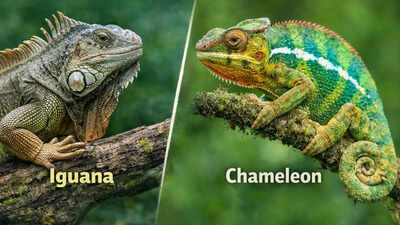
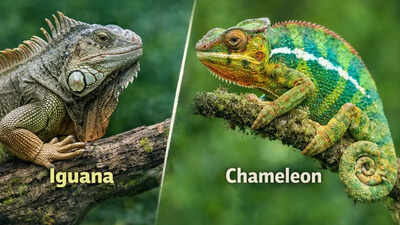
Iguanas and chameleons are referred to as exotic lizards, but they are quite different from one another in terms of looks, behaviour, and biology. Even though they are part of the reptile class, they have survived in completely different conditions and have developed different survival habits. Iguanas are large reptiles that feed on plants, while chameleons are small reptiles known for their ability to change colour and see.Knowing the distinction between an iguana and a chameleon is not just about knowing the two reptiles; rather, it is also about understanding the way these reptiles adapt to the environment around them. By understanding the various features of these reptiles, we can gain more knowledge about the role these reptiles play in the ecosystem.
Size and physical differences between iguana and chameleon
One of the most distinguishing features between these two lizards is their size; iguanas are way bigger than chameleons. They can grow up to 5-6 feet in length, including their tails, while most chameleons do not grow more than 2 feet in length.Iguanas have a long body covered in spines along their backs and a dewlap under their neck. Chameleons have a flattened body, enabling them to move along tree branches.
Where iguanas and chameleons are found
Iguanas and chameleons are located in different parts of the world. Iguanas are found in South America and are thriving in the tropical forests of these countries. Chameleons are mostly found in Africa and Madagascar. A few of them are also found in Asia. Therefore, these two species are not found in the same geographical area and hence do not come into contact with each other.
Iguana vs. Chameleon : How colour change and defence differ
Chameleons are also known for their ability to change their colour, which helps them control their temperature, communicate, and protect themselves from their enemies.Although it is true that the iguana is able to blend with the environment, it is not true that it is able to change its colour like the chameleon. Rather, it relies on its green colour and its strong tails and claws.Differences in vision and eye movement of iguana and chameleonOne of the most intriguing differences is in their vision. The chameleon has independent eye movement. This allows them to see in two different directions simultaneously. This provides them with a nearly 360-degree view. Iguanas do not have independent eye movement but possess good eyesight and are able to see movements, colours, and shapes from a distance.
Iguana vs. Chameleon: Feeding habits and diet comparison
Another important aspect where the two species are different is with regard to their diet. Iguanas are generally herbivorous; they eat leaves, fruits, and flowers. Chameleons, on the other hand, are generally insectivorous. They eat insects with the help of their long tongue, which they use to catch insects from a distance.
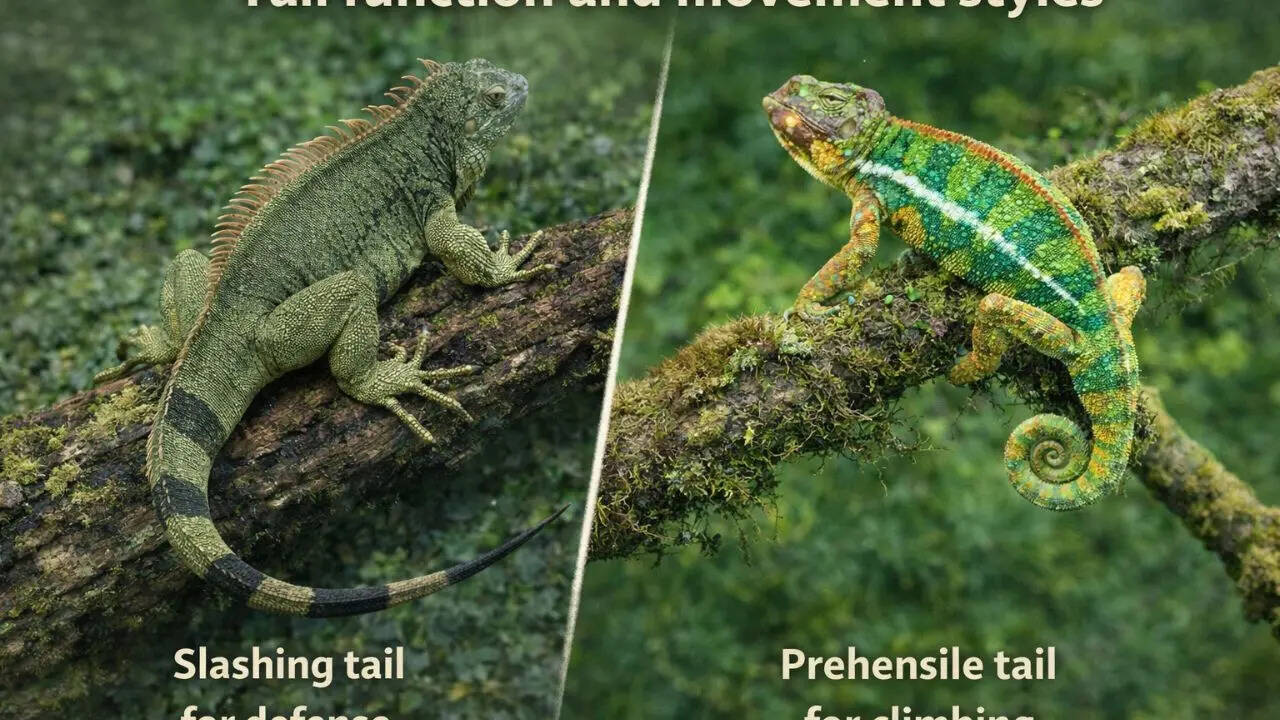
Tail function and movement styles
PC: AI-Generated
The function of the tail varies in these animals. Iguanas have large tails, which help in balancing and defending. If they are threatened by predators, they use these tails to hit the predators. Chameleons have prehensile tails. This means they can hold onto something. Thus, they can climb trees safely.
Lifespan and survival strategies
Iguanas live longer than chameleons. Iguanas live for 15 to 20 years in the wild, while chameleons live for 4 to 8 years. Chameleons rely on stealth and camouflage to survive, while iguanas rely on size, strength, and escape.
How each species adapts to its environment
The difference between iguanas and chameleons demonstrates how species have adapted to their environments over time. Iguanas are designed for power, size, and herbivorous eating habits, while chameleons are designed for precision hunting, camouflage, and tree-dwelling.While both iguanas and chameleons are classified as lizards, they are two very different species with two very different approaches to life in nature. Their size, habitat, behaviour, and survival techniques are all unique and demonstrate a very individualistic approach to adapting to life in nature.