
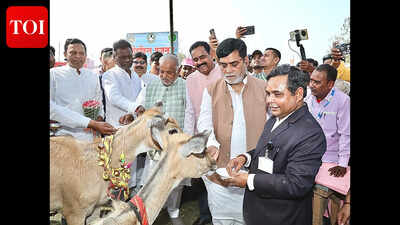
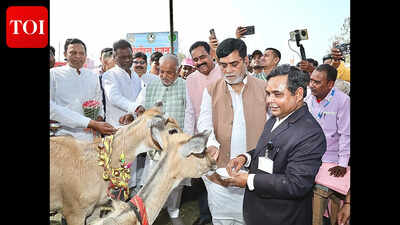
Bhagalpur: In a significant development aimed at addressing human-wildlife conflict, researchers at Bihar Agricultural University (BAU) have successfully demonstrated the domestication of the blue bull, commonly known as nilgai, offering a possible solution to crop damage faced by farmers.Biologically known as ‘Boselaphus tragocamelus’, the nilgai is the largest Asian antelope native to the Indian subcontinent. The animal has long been a concern for farmers because of its tendency to damage standing crops, especially during evening and night hours.The experiment was conducted at Veer Kunwar Singh College of Agriculture (VKSCA), a constituent unit of BAU, by a team led by scientist Suday Prasad under the guidance of director (research) Anil Kumar Singh and monitored by vice-chancellor Duniya Ram Singh.Explaining the process, a scientist said the domestication involves several integrated methods, including a “taming strategy” in which calves are raised by humans and fed cow’s milk. The method also includes behavioural adaptation where nilgai graze alongside cattle, goats and buffaloes in agricultural landscapes. Additional measures include breeding in human-managed farms and castration of males to reduce aggression.The scientist said these methods increase docility and may lead to the animals adapting permanently to farm environments.Referring to the initiative, BAU vice-chancellor Duniya Ram Singh said, “Nilgai can cause 30% to 40% crop loss annually whereas in high-density areas, damage to certain crops can reach up to 70% across the nation.”He added, “Damage occurs through foraging as well as trampling and resting in fields.”Singh said 21 out of 38 districts in Bihar are severely affected by nilgai-related crop damage and the population of the animal in the state is estimated at around 2.96 lakh.Director (research) Anil Kumar Singh said, “Domestication is a non-lethal, science-based strategy to manage crop damage while maintaining ecological balance.”He added that nilgais are officially classified as agricultural pests in several regions and crop losses in severely affected areas can range between 50% and 58%.The experiment suggests that domestication could help reduce crop damage while offering a sustainable alternative to culling, which is often opposed due to religious sentiments associated with the animal.