
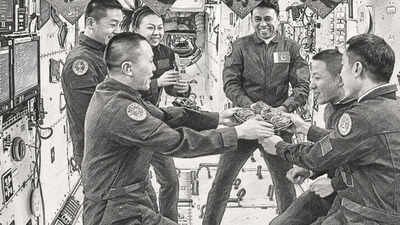
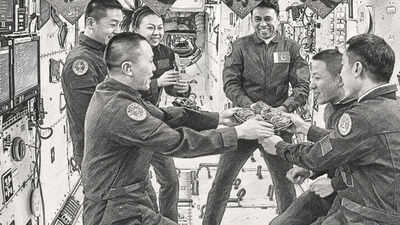
When Pakistan’s first astronaut travelled to China’s Tiangong space station aboard Shenzhou-24, the mission was widely seen as another milestone in Beijing’s expanding space programme. But it also carried a message that went beyond the science and technology of human spaceflight.China was extending its space partnership with Pakistan, offering access to infrastructure, expertise and experience that Islamabad could not independently build at this stage.TOI had flagged this in an edit soon after the mission, arguing that India, too, should consider hosting astronauts from friendly countries. The point was to recognise space cooperation as an instrument of diplomacy and geopolitical influence, not merely a scientific exchange.Chief of Defence Staff Gen NS Raja Subramani’s subsequent remarks have brought an additional dimension to the issue. His warning about the growing China-Pakistan space partnership, and the possibility of Chinese intelligence, surveillance, reconnaissance, navigation and timing capabilities becoming available to Islamabad, underlines why India cannot view this development in isolation.

Chethan Kumar, in Parallax
The security concerns are real. China’s relationship with Pakistan extends across military hardware, technology transfer, nuclear power, infrastructure and communications. The China-Pakistan Economic Corridor has brought Chinese investment into roads, energy projects and ports. Military cooperation includes the JF-17 fighter programme and the Hangor-class submarine project. Space is now becoming another layer of this strategic relationship.But India would be making a mistake if it viewed the development only through the prism of what Pakistan might gain. There is a larger lesson in what China is doing.Beijing is using its space capabilities to build relationships, create dependencies and extend its influence. Its satellites, navigation systems, launch services and now its human spaceflight infrastructure offer partner countries access to capabilities they may not be able to develop independently. Tiangong is not just a scientific facility. It is also becoming a platform for international engagement.This is a dimension of space power that India needs to take more seriously. For decades, India’s space programme has been built around strategic autonomy. It has served the country well. Isro has developed launch vehicles, satellites and increasingly complex missions despite financial and technological constraints. Chandrayaan-3 demonstrated that India could accomplish something few countries had attempted successfully. Aditya-L1 has expanded its scientific ambitions, while Gaganyaan is intended to establish India’s independent human spaceflight capability.But strategic autonomy cannot become another expression for doing everything alone. Nor should self-reliance be confused with keeping others at a distance. In an earlier Parallax, I argued that India should consider sending an astronaut on a longer-duration mission to the International Space Station before its retirement.Shubhanshu Shukla’s Axiom-4 mission offered valuable experience, but a longer stay could expose Indian astronauts and engineers to the operational realities of living and working aboard a space station. This knowledge would be useful as India develops its own Bharatiya Antariksh Station (BAS).The argument was not about compromising indigenous capability. It was about recognising that even the most self-reliant space programmes have learnt from others. The Americans and Russians, despite their Cold War rivalry, found ways to cooperate when it served their interests. India, too, must be pragmatic about acquiring experience, building partnerships and using opportunities that may not remain available indefinitely.The same thinking should inform India’s international outreach. India has already established a record of launching satellites for other countries, sharing remote-sensing data and extending space-related assistance. Its space programme has served development needs and helped build diplomatic relationships. But the next phase requires greater ambition.Could Gaganyaan reserve seats for astronauts from friendly countries? Could India offer opportunities to universities and research institutions across the Global South to fly experiments? Could BAS be designed from the outset to accommodate visiting astronauts, international research and collaborative missions?These are not simply questions about how many foreign astronauts India can accommodate. They are about the kind of space power India wants to become. China’s approach offers an instructive example. By taking a Pakistani astronaut aboard Tiangong, Beijing is giving Islamabad access to human spaceflight experience while strengthening an existing strategic relationship.The visit itself may be short, but the institutional relationships, training and future opportunities it creates could endure. Other countries will also be watching what China can offer them. India has an opportunity to develop a different model. It need not match China’s approach or turn every space partnership into a geopolitical contest.It can offer access to scientific infrastructure, launch services, astronaut training, experiments and eventually its own space station. Such opportunities could be particularly meaningful for smaller countries that lack the resources to establish independent space programmes.There’s a strategic dividend in this. Countries that participate in a programme develop expertise, institutional relationships and an interest in its continuity. They become stakeholders in its success. Over time, this can translate into diplomatic influence and a greater ability to shape international cooperation.This matters because the emerging space order is not going to be determined by technology alone. It will also be shaped by who establishes operating standards, who provides infrastructure, who sets the terms of cooperation and who has the capacity to bring other countries along.In another Parallax, I had argued that an invitation to join someone else’s Moon programme should not be mistaken for having a say in its future. India must eventually move from being a participant in architectures designed by others to becoming one of the countries that helps design them.The same principle applies here. A Bharatiya Antariksh Station that merely demonstrates India’s ability to build and operate a space station would be a significant achievement. One that also accommodates international astronauts, experiments and partnerships could become something more: an instrument of India’s scientific and diplomatic influence.None of this should dilute the security imperative. Gen Subramani’s warning is a reminder that space capabilities have a dual character. The same infrastructure that supports communication, navigation and scientific research can also support military surveillance and operations. India must strengthen its own space-based surveillance, navigation and communication capabilities, and ensure that critical systems remain resilient.But building capabilities to protect national interests is only one part of the task. India must also develop capabilities that others find valuable enough to partner with. The next space race may not be decided simply by who reaches the Moon first, builds the largest station or launches the most satellites. It could be shaped just as much by who builds the strongest networks of cooperation and influence.China appears to understand this. India has the technological foundations, international standing and ambitions to develop its own approach. It now needs the willingness to think beyond its own missions.—Parallax Postscript: A country becomes a space power not just when it can reach orbit, but when others look to it for access, opportunity and cooperation. India has spent decades learning how to reach space. The next challenge is to build something worth sharing.