
Remember the scene from ‘3 Idiots’ where Farhan’s father rebukes him for trying to pursue a career in photography, which was off the beaten path of engineering? In India, that’s a common scene in almost every family — in this country, you won’t hear too many stories of people swapping engineering dreams for any unusual career map. And even if you do, those are mostly used as examples of cautionary tales — not success stories.So, what happens when two brothers trade their studies abroad for muddy boots and a farm?In India, despite it being an agricultural country, farming is still seen as something people fall back on when nothing else works out. But not for Rishabh and Ayush Gupta: two brothers from Agra who flipped that thinking on its head. Maybe it wasn’t by design, as their story starts with a pandemic, canceled plans, and flights home from London and Dubai. But the story that followed is a rare example of ambition, stubbornness, and some serious creativity.
The mushroom brothers: From London and Dubai to Agra
As reported by The Better India, Rishabh and Ayush had left for prestigious degrees and city jobs: Ayush, a Bachelor of Business Administration (BBA) in London, and Rishabh, working at Mashreq Bank in Dubai after earning a degree in computer science. When COVID-19 rolled in, whatever their plans were, they disintegrated. Stuck back home, they could’ve just waited it out and flown back when things improved. Instead, they eyed something closer to their roots: their family’s old talk about farming, something their father had always wanted but hadn’t managed to pull off.Not everyone thought this was wise, though. Relatives, as they usually go about these situations, wanted to know why you’d bankroll expensive international education just for your kids to come back and shovel compost. There was skepticism and plenty of raised eyebrows. But the brothers didn’t let that stop them. Their father’s support was steady, and together they pooled savings, took a loan, and kicked off the first stage of their dream on a patch in Agra, with help from a government subsidy. Not a fairytale beginning, but a solid one.
How the mushroom farming journey began: Starting small, but thinking big
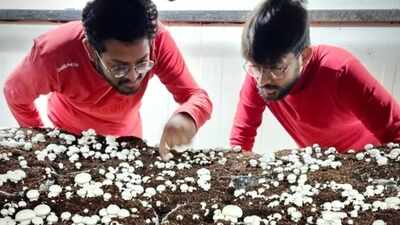
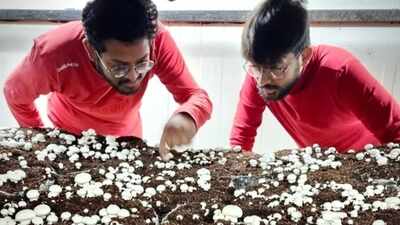
The Gupta brothers’ journey didn’t begin with mushrooms. First, they tried growing English cucumbers under a polyhouse structure. The experiment was decent, but it drilled in one challenge: if you rely on seasonal vegetables, your income swings up and down with the weather. They wanted something steadier. That’s where mushrooms came in.Ayush had tested a little trading business with mushrooms in Delhi before, buying from farmers, packaging, and selling. It wasn’t a full-scale operation, but it sparked an idea. Together, the brothers dove into online research, talked to international growers, and studied how to get consistent harvests using controlled environments — all the places where temperature and humidity aren’t at the mercy of the Indian sun.Their first batch was humble, with just 20 compost bags of button mushrooms, started in late 2021. When those worked out, confidence grew. They took the plunge, built specialized cold rooms, set up facilities for preparing compost and sorting, and expanded from there. By April 2022, their mushroom empire started to take real shape under the names A3R Mushroom Farms and Gupta Organic Farms.
From English cucumbers to mushroom farming: Scaling up and building A3R mushroom farms
Now for the numbers that make you sit up: every month, the Gupta brothers’ farms produce around 40 tonnes of mushrooms and another 45 tonnes of vegetables across about two acres. That isn’t backyard farming anymore. Their output includes about 16 kinds of mushrooms and vegetables, all cultivated either in polyhouse conditions or under tight environmental controls.And there’s an interesting system, too. They grade their mushrooms: Grade A for the top-looking ones that make it to the best stores, and Grade B, which head off for processing and canning. Almost nothing goes to waste. That’s a big reason their business consistently brings in around Rs 7.5 crore a year in revenue.As for their buyers, it’s a mix of local businesses in Agra and big-city shops in Delhi, along with a decent chunk of home cooks who want fresh, chemical-free greens and mushrooms. The brothers have stuck firmly to growing their produce organically, and they steer clear of chemical fertilizers and pitch the freshness of their crops as a selling point.
What sets their success apart
This isn’t just another story about someone making a living off the land. It’s proof that farming can pay, and that there’s room for modern ideas and new technology where many people still see tradition, risk, and low returns. The Gupta brothers didn’t wander into farming because they ran out of options. They wanted to create something that mixed their family’s old dreams with what they’d learned abroad: an agricultural business that runs like any well-researched startup, with careful attention to market needs, technology, and scalable systems.Along the way, they’ve managed to challenge two big myths: that farming is just about luck and guesswork, and that you have to head overseas to find real financial success. Their journey hasn’t been about abandoning ambition, but about shifting it to something few people expect, and proving that sometimes the odd detour leads to a place where both growth and pride are possible.In short, for every relative and neighbor who thought trading in city suits for Agra’s farmland was a step down, Rishabh and Ayush Gupta now have a thriving Rs 7.5-crore business enterprise, and a fine story to serve up alongside their fresh mushrooms.So, next time someone from the extended family comes at you with an example of ‘Gupta Ji ka Beta’, maybe get back to them with the examples of the mushroom brothers?