
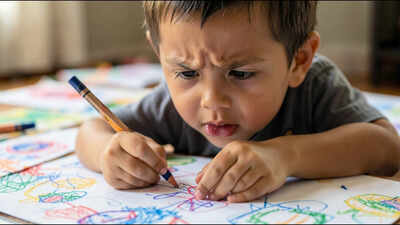
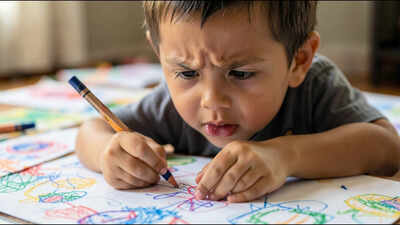
Have you ever watched your child spend 30 minutes drawing a picture, only to see them tear it apart because one line did not turn out as expected? Or seen them erase an entire page of homework because of one incorrect answer? To you, the mistake may seem insignificant. To your child, however, it may feel like the entire effort has gone to waste.It is easy to dismiss such reactions as childhood frustration or stubbornness. But when they become repetitive, parents may need to look a little deeper. Sometimes, what appears to be an inability to accept mistakes could point towards perfectionistic tendencies.Childhood perfectionism is not simply about wanting to perform well. It can involve setting unrealistically high standards, being excessively critical of oneself and developing an intense fear of making mistakes.
When one small mistake overshadows everything
Imagine a child who has completed a school assignment with 19 correct answers out of 20. Instead of feeling happy about getting most of them right, the child focuses entirely on the one incorrect response. This is where the difference between healthy ambition and perfectionism becomes important.Children who strive for excellence enjoy improving their abilities. Those struggling with perfectionistic concerns may find it difficult to accept anything less than flawless performance.A 2020 meta-analysis involving 21,272 participants found that the self-critical dimensions of perfectionism were associated with poorer academic outcomes, academic stress and burnout. This highlights how an excessive fear of mistakes can affect a child’s relationship with learning.
The child may start avoiding things they cannot do perfectly
Perfectionism does not always manifest through repeated erasing or tearing up drawings. Sometimes, it appears as avoidance.A child may refuse to participate in a competition because they fear losing. Another may abandon a new activity because they are not immediately good at it. Some children may hesitate to answer questions in class because they are worried about being wrong.When children begin associating mistakes with failure, trying something unfamiliar can become frightening.Research involving 203 children aged eight to 12 found that parental expectations were associated with children’s tendency to set high standards, while parental criticism was associated with the more self-critical dimension of perfectionism.
Could parental expectations be adding to the pressure?
Parents naturally want their children to succeed. However, the way expectations are communicated can influence how children perceive their achievements.A meta-analysis examining 46 studies involving 13,364 participants found associations between parental expectations and different dimensions of perfectionism. Parental criticism was particularly associated with socially prescribed perfectionism, where individuals feel pressured to meet expectations imposed by others.This does not mean parents alone cause perfectionism. Temperament, school experiences and peer comparisons can also play a role.However, repeatedly comparing children with classmates or focusing only on their mistakes may reinforce the belief that their efforts are never good enough.
Five signs parents should watch out for
Parents should pay attention when certain behaviours become frequent:1. Repeatedly restarting work: The child keeps erasing or rewriting assignments over minor imperfections.2. Extreme reactions to mistakes: A small error triggers disproportionate anger, crying or frustration.3. Avoiding challenges: The child refuses to try unfamiliar activities for fear of failure.4. Constant comparisons: They dismiss their achievements after looking at someone else’s work.5. Harsh self-criticism: Statements such as “I am not good enough” become common after setbacks.One isolated incident does not indicate perfectionism. The frequency and intensity of these reactions matter.
What should parents say when children make mistakes?
Instead of immediately saying, “Your drawing is beautiful, don’t tear it”, parents can acknowledge the child’s feelings.Try asking: “What is bothering you about this part?” or “Would you like to correct it or try something different?”Appreciate the effort rather than focusing exclusively on the outcome. Allow children to make manageable mistakes and work through them without immediately stepping in to fix everything.If these behaviours begin affecting their education, relationships, or emotional well-being, seeking guidance from a qualified child psychologist may help.
Children need to know that imperfect is not the same as unsuccessful
A drawing with an uneven window can still be beautiful. A homework sheet with one incorrect answer can still reflect hard work. A child who does not win a competition can still have something to celebrate.The objective is not to discourage children from aiming high. It is to help them understand that mistakes are part of growing up.So, the next time your child tears up a drawing or erases an entire page over one small error, pause before calling it a tantrum.Sometimes, children do not need to be told how to make things perfect. They need to learn that they are good enough even when things are not.