
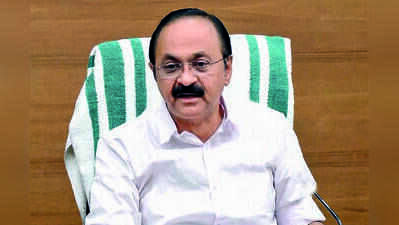
Thiruvananthapuram: Govt will remain focused on people’s welfare and development and cannot be pressured through controversies, chief minister V D Satheesan said, while asserting that it would not compromise on secular and democratic values.“Those who create controversies may continue to pursue them. Govt’s focus is on people’s welfare and development. We welcome constructive criticism and have no hesitation in correcting mistakes. But no one should think that govt can be put under pressure through controversies,” Satheesan said in a statement.He said development must be pursued without weakening the environment or destroying people’s lives and livelihood. Govt’s vision was to create a “new Keralam” that included everyone and made the best use of the state’s opportunities within its geographical limitations. Keralam should aim to create models that attract global attention, he said.Satheesan said govt had completed six months in office and was implementing its promises one by one. He cited the decision to provide free travel for women in KSRTC buses and increase the honorarium of ASHA workers, anganwadi employees, cooking staff, pre-primary teachers and helpers. He also said the schemes announced under the 100-day action programme had been implemented within the stipulated time.Outlining govt’s development plans, Satheesan said Keralam’s 600km coastline, two international ports, a container terminal and 19 non-major ports offered significant opportunities for economic growth. The proposed Mission Samudra would seek to transform Keralam into a network of port cities and create lakhs of jobs by 2031, he said.At least 50% of the freight currently transported by road should eventually be shifted to waterways, he said. Cruise shipping would be taken up in the second phase, while the third phase would explore the potential of tourism based on interconnected rivers. Keralam, which has four international airports, should also be developed as a major aviation hub, he said.Satheesan said the state had the potential to emerge as a leading centre for education and healthcare. Govt would establish internationally benchmarked educational institutions, introduce programmes suited to changing employment conditions and expand job-oriented training. It would also strengthen public healthcare and reduce treatment costs so that no one was denied medical care for lack of money.The number of nursing seats in the state would be increased by 50% from the next academic year, he said. Kerala would also seek to attract students from other states and countries while ensuring that its own students could complete their education and find employment within the state.He said govt’s senior-citizen department, the first of its kind in the country, was intended to ensure care, protection and social inclusion for older people. Govt would promote a “silver economy” by using the skills and experience of senior citizens in different sectors, he said.Satheesan said govt would support SC/ST communities, fisherfolk and other sections that had been neglected as govts shifted their focus from planning to large projects. A special housing scheme had been launched for SC/ST and fisher families. Housing assistance for SC families and fisherfolk had been increased from Rs 4 lakh to Rs 6 lakh, while assistance for ST families had been raised from Rs 6 lakh to Rs 8 lakh.He also said govt would adopt a zero-tolerance approach towards the drug mafia. On revenue, he said the policy was to increase state income without raising the tax burden. Keralam’s GST collections had grown by 27% year-on-year in Oct, reaching Rs 3,689 crore, compared with the national average growth of 13%, he said.Satheesan said greater investment and more industries were needed to improve state revenues. The recently passed Saral Keralam Bill would help free entrepreneurs from red tape, provide transparent and lawful facilitation and encourage innovative businesses, he said.Keralam must also take the lead in emerging technologies such as artificial intelligence, quantum computing, machine learning and robotic computing, he said. The state should attract data centres, semiconductor facilities and global capability centres, while building on its legacy as a pioneer in the country’s information technology sector.He said growth must be accompanied by a governance system that remained attentive to the difficulties faced by individuals. Freedom could not be restricted to a few, and no one should be kept in the dark on the basis of religion or caste. Constant vigilance and a firm commitment to secularism and democracy were essential, he said.