
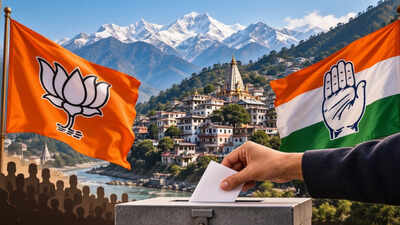
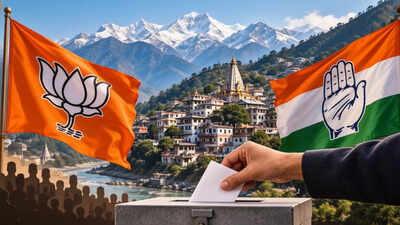
“If you know the enemy and know yourself, you need not fear the result of a hundred battles. If you know yourself but not the enemy, for every victory gained you will also suffer a defeat. If you know neither the enemy nor yourself, you will succumb in every battle.”The ‘Art of War’ by Sun Tzu seems to perfectly encapsulate what Congress needs to understand for the upcoming Uttarakhand assembly elections.The BJP, led in the state by chief minister Pushkar Singh Dhami, is seeking a historic third consecutive term. At a recent event in Dehradun, Union home minister Amit Shah set an ambitious target of winning more than 65 of the state’s 70 assembly seats. The Congress, meanwhile, hopes to capitalise on dissatisfaction with the government and return to power after a decade in opposition.On paper, the Congress has a substantial list of issues to take to voters. The BJP, too, faces the challenge of defending its record in a state where the pendulum of power had previously been in constant swing.But the electoral arithmetic presents a more complicated picture as we saw in 2022. BJP can lose ground and still win comfortably; Congress can make gains and still remain distant from power.So, can Congress turn voter dissatisfaction into a legitimate political direction, or will it simply reiterate its criticisms and fail to make waves?
A state that once voted out its governments
Since the state was formed in 2000, its first four assembly elections produced a change of government every five years. The Congress won 36 seats in 2002, the BJP secured 35 in 2007, the Congress edged ahead with 32 against the BJP’s 31 in 2012, and the BJP swept to power with 57 seats in 2017.And then came 2022, an election that broke the pattern and highlighted BJP’s growing strength in the state. BJP won 47 of the state’s 70 seats, becoming the first party to secure consecutive terms since Uttarakhand’s formation.But Congress had also made gains. Compared to 2017, its performance had improved from 11 seats to 19, while its vote share rose from approximately 33.5 per cent to nearly 38 per cent.The 2024 Lok Sabha election reinforced the challenge, with the BJP winning all five parliamentary constituencies in Uttarakhand. More significantly, Congress trailed in 63 of the state’s 70 assembly segments, including 14 of the 19 constituencies it had won in 2022.Following the defeat, the Uttarakhand Pradesh Congress Committee tasked former minister Nav Prabhat with assessing the party’s performance. The preliminary assessment identified a familiar set of problems: infighting, poor communication and a lack of coordination among party leaders.Congress had conducted similar reviews after its defeats in the 2014 and 2019 Lok Sabha elections and the 2017 and 2022 assembly elections. Yet the organisational weaknesses identified in those exercises continued to surface.
The Harish Rawat question
Harish Rawat remains one of Congress’s most recognisable figures in Uttarakhand, but his prominence has also been tied to the party’s internal power struggles.Rawat was overlooked for the chief minister’s post in 2002, despite the party emerging as the largest formation. After returning to power in 2012, Congress was hit by a major crisis in 2016, when nine MLAs rebelled against his government, triggering President’s Rule and a prolonged political and legal battle. Several rebels later joined the BJP.The mistrust has persisted in the run-up to 2027. The controversy involving Gaurav Kumar, an alleged conman posing as Rahul Gandhi’s private secretary, exposed tensions within the state unit. Bhavna Pandey alleged that Kumar demanded Rs 2–3 crore, claiming the central leadership wanted state president Ganesh Godiyal replaced. Godiyal alleged a conspiracy, while Rawat denied any political plot and called for a police probe.Personal rivalries, including Rawat’s falling-out with former aide Ranjeet Rawat, have added to the uncertainty. The November reshuffle distributed key responsibilities among senior leaders, but whether it can contain competing ambitions remains unclear.Congress’s challenge is to draw on Harish Rawat’s experience and support base without allowing the campaign to become another contest over leadership.
Congress has plenty of issues, but no clear message
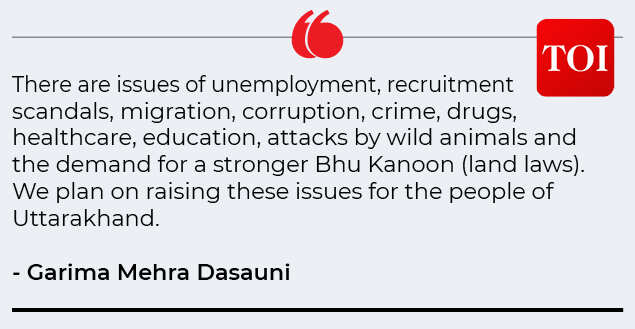
The Congress has sought to make women’s safety and accountability central to its criticism of the government. Garima Mehra Dasauni, the party’s chief spokesperson in Uttarakhand, said Congress has compiled a list of alleged crimes against women involving senior BJP leaders in the state.
.
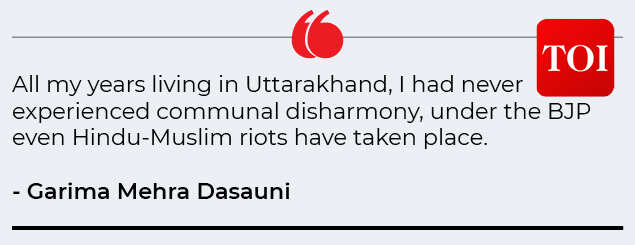
Dasauni also argues that the BJP’s electoral success cannot be understood simply through its development claims.In her assessment, religious and communal mobilisation, alongside welfare measures, has helped the party consolidate support. She also points to the political value of ration distribution and other welfare schemes, particularly among economically vulnerable households.
.
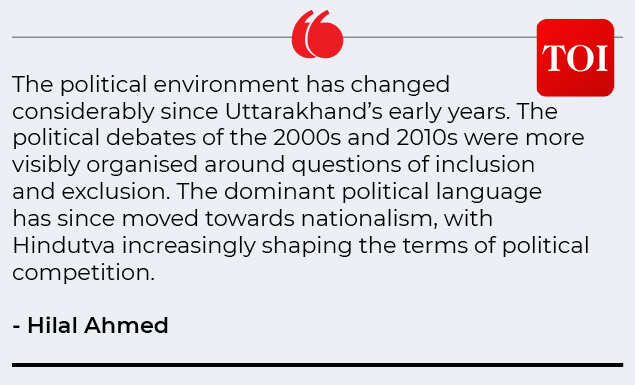
This raises an important question for the Congress: how does it challenge welfare politics without appearing to dismiss the benefits that people receive?Welfare politics is not new to the Congress either. The National Food Security Act, which made access to subsidised foodgrains a legal entitlement, was enacted in 2013 under the Congress-led United Progressive Alliance government. However, the BJP has made welfare delivery a key component of its electoral strategy, raising questions about how the Congress can distinguish its own welfare agenda from that of the ruling party.The challenge for Congress, political observers suggest, is not a shortage of issues to raise but the absence of a common thread that ties them together and presents voters with a clear alternative.Political scientist Hilal Ahmed explains:“The Congress is raising all these issues but they lack a narrative between them. What connects their concerns? BJP can easily answer all these separate claims.”
.
For the Congress, this creates a difficult strategic choice. It must distinguish itself from the BJP, but it cannot assume that voters will automatically respond to a campaign built around governance failures and economic grievances.Ahmed describes the Congress as having “a little bit of a victimhood mentality” and calls it “intellectually weak”. He also warns that its response to the BJP remains fragmented rather than forming a coherent and constructive critique.His assessment of the potential electoral consequences is stark: “BJP might not win but neither will Congress.”
The BJP’s advantage
The BJP’s position in Uttarakhand is stronger than the Congress’s current organisational condition. Combining the appeal of PM Modi, CM Dhami’s work on ground and the promise of continuity through the double-engine government, it seeks to retain its position.The BJP will also seek to hold together a broad social coalition, while appealing to women, young voters, ex-servicemen and the Sikh community. Its reported plans for younger candidates and greater emphasis on local feedback suggest an effort to refresh its organisation.At the same time, the party is linking voter-list revision to its rhetoric around identity and belonging. At a Dehradun meeting, BJP leader Bhatt urged workers to remove those described as “infiltrators”, saying: “Only the original people of Devbhoomi should decide the government.”
The economic question
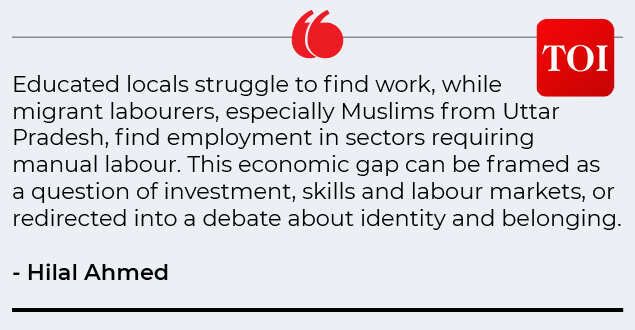
One of the most important arguments in Ahmed’s analysis concerns the state’s economic and social structure.Migration is not simply a consequence of unemployment; it also reflects the concentration of education, healthcare, transport and jobs in towns and the plains.
.
Ahmed argues that Congress has failed to develop a convincing response to the BJP’s rhetoric around identity. It could challenge the government’s economic priorities and what he describes as a decade of policy paralysis, but must offer more than general claims about unemployment.
The BJP’s vulnerabilities, and Congress’s opportunity
The Dhami government’s record offers Congress several openings: the Ankita Bhandari case and continuing questions over the alleged VIP angle, recruitment paper leaks, unemployment, migration, land rights and allegations of corruption.But identifying these vulnerabilities is easier than turning them into electoral support. Congress must show how it would address them, particularly concerns over employment, regional inequality and the protection of local land rights. The Uttarakhand Kranti Dal’s attempt to revive the politics of statehood could also put pressure on Congress to articulate a stronger regional agenda.The party has begun preparing through leadership meetings, multiple Parivartan Yatras, village outreach and a campaign against the government’s record.
Share your thoughts in the comments
Be respectful · TOI community guidelines
As Ahmed argues, Congress also has a lot of “professional politicians” — leaders who pursue political stature and may abandon Congress in the face of defeat, a scenario reminiscent of 2016.
What will decide 2027?
The BJP is approaching the election with the advantages of incumbency and a well-established organisation, but it is not without vulnerabilities.The Congress, meanwhile, has a substantial list of issues with which to challenge the government. But none of these issues will automatically produce a victory.The Congress needs to answer three questions.Who leads the party in Uttarakhand?What is its political alternative?Can it rebuild its organisation?The art of war is also the art of elections. The Congress is yet to demonstrate that it understands both itself and its electoral ‘enemy’.