

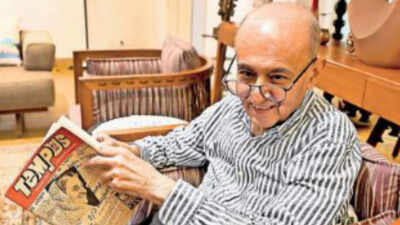
Amit Khanna, lyricist and well-known Bollywood personality, reveals how he came to write the songs of ‘Chalte Chalte’ and why poet Harivansh Rai Bachchan was disappointed that his son had left a decent jobNEW DELHI: In the late 1960s, New Delhi’s young and restless lived in divergent worlds. Some grooved to trendy pop drifting from coin-guzzling jukeboxes and gawked at scruffy, matted-haired hippies in Connaught Place.A few, seduced by Mao’s heady dictum, “Power flows from the barrel of a gun,” took a night train to the boondocks of Bihar to wage a class war. As a teenager, Amit Khanna had a less thrilling but quite challenging pursuit.Along with a friend, he would edit and publish a monthly magazine, ‘Tempus’, the Latin word for time, carrying articles as diverse as “The World of Plastic” and “Beethoven’s Music.”When the teenage editor came to know that Dev Anand, the OG of aura then, was at the capital’s Oberoi hotel, he managed to get an appointment with the debonair film star.“Dev saab was staying in a duplex suite. He opened the door himself and seemed surprised to see someone so young,” remembers Khanna, now 75, reliving the past in his Defence Colony living room.The two, Khanna says, chatted for an hour. Two articles emerged from the interview.One for ‘Tempus’, and another for ‘Century’, an avant-garde weekly, brought out then by polymath VK Krishna Menon. A few weeks later, he would receive a hand-written letter of praise from the actor, then working on the war drama, ‘Prem Pujari.’Little did the St Stephen’s sophomore know the meeting would lead to an enduring association.In the coming weeks, Khanna would meet the film star again and end up doing a bunch of odd jobs for him — serving Chivas Regal to an assemblage of noted industrialists, bureaucrats and senior cops in his Oberoi room; accompany him to Jan Sangh (later BJP) leader Vijay Kumar Malhotra’s residence to obtain a tax-exemption for ‘Prem Pujari’; even fly alone to Kathmandu, where ‘Hare Rama Hare Krishna’ was being lensed, carrying Rs 1 lakh (roughly Rs 60 lakh today).Khanna’s father, a radio engineer, wasn’t enthused by his offspring’s engagements at a time when the Indian middle-class largely viewed the celluloid business with unease.But when an offer came from Dev Anand’s production house, Navketan, the college student took the plunge.“In the winter of 1971, just a few days after the Bangladesh war was over, I flew to Bombay and formally joined Navketan for a salary of Rs 1,200 per month. I later learnt that nobody working there received more than Rs 1,000! In a couple of years, I became its de-facto head,” he recalls.In his autobiography, ‘Romancing with Life,’ Dev Anand describes Khanna as Navketan’s “blue-eyed executive.”In time, Khanna would set up Plus Channel, a top tv content creator in the 1990s, and become founder-chairman of Reliance Entertainment.Not many know he also wrote the dialogues of ‘Saaransh’ and was the executive producer of films like ‘Sardari Begum’ and ‘Is Raat Ki Subah Nahin.’However, most remember Khanna as a songwriter, thanks to Vividh Bharati and Radio Ceylon’s listeners’ request programmes where a lyricist’s name would be announced along with the composer and the singer.As a lyricist, Khanna eschewed set phrases while incorporating sensibilities more attuned to the urban young.In ‘Des Pardes (1976),’ a film on illegal immigrants set in London, his lyrics captured the commonalities and contrasts of cross-cultural tenets.No surprise, he was the chosen one to write songs for Indian albums based on tunes of Boney M and Abba, two popular pop groups in 1980s India.Khanna further demonstrated his versatility in three Basu Chatterji films, each as different as oil, mercury and water.“Kaa karoon sajni” for ‘Swami’ encapsulated the romantic sentiments of Saratchandra’s early 20th century classic.He also penned “Uthe sabke kadam” for the urban romedy ‘Baton Baton Mein’ and used pure Sanskritised Hindi, “Charu chandra ki chanchal chitwan” in ‘Man Pasand’, which was based on GB Shaw’s Pygmalion.Khanna’s debut as a lyricist in ‘Chalte Chalte’ (1976) happened by chance. He had recommended Bappi Lahiri, then a struggling music director, to the film’s producer-director Bhisham Kohli who had been waiting for months for Laxmikant-Pyarelal to provide the score.During a sitting with Lahiri, Khanna wrote a few lines as a fill-in-the-blanks. “Kohli then asked me to write the lyrics. He thought I’ll come for free,” he laughs.The debutant’s first song started with the sensuous line, “Door door tum rahe pukarte hum rahe aaj ki raat tum jao na.” Khanna was advised to write a back-up line in case the singer Lata Mangeshkar, occasionally known to refuse risqué words, objected.“But she let it pass. I wrote the film’s five songs in three days,” he remembers, adding, “I wrote fast and seldom wrote songs at home.”In 1995, he received the national award for best lyricist for the song, ‘Kuch is tarah’, for ‘Bhairavi’ though it’s ‘Chalte Chalte’ that continues to be mandatory in every farewell party 50 years on.Khanna recalls that during his school days at St Columba’s, his interest in Hindi poetry was restricted to listening to ‘mushaira’ recordings made by his father.“After Class 9, I never studied Hindi as a student,” he says. At Stephen’s, however, he was the secretary of Urdu Society and the president of Sanskrit-Hindi Sahitya Sabha.“Harivansh Rai Bachchan was our chief guest once. Chatting in the taxi with us, he expressed disappointment that his son had given up a good job and was trying his hand at cinema. Many years later, after Amitabh had become a big star, I reminded him of the conversation. He laughed,” says Khanna, nowadays in relaxation mode and reading a horror novel.The novel could bring back some memories. Old-timers would remember he also wrote songs for the Ramsays, the hauntsmen of desi horror.