
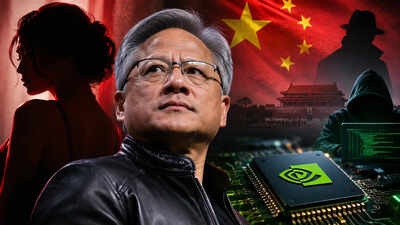
In the world of espionage, the most dangerous spy is not always the one breaking into secret facilities or stealing classified files. Sometimes, it is the person who gets close enough to make powerful people let their guard down.If ‘Dhurandhar’ brought the world of undercover agents and intelligence games back into popular conversation, the allegations surrounding former Nvidia chief Jensen Huang could easily pass for a plot from a spy thriller. An extramarital affair, a Singapore-based chip company and suspected links to Chinese intelligence have turned a corporate controversy into a national security question, bringing Huang’s three-decade reign at the world’s most influential AI chipmaker to an end.But beyond the personal drama lies a bigger concern for Washington: How far might Beijing go to get its hands on America’s most valuable technology secrets?
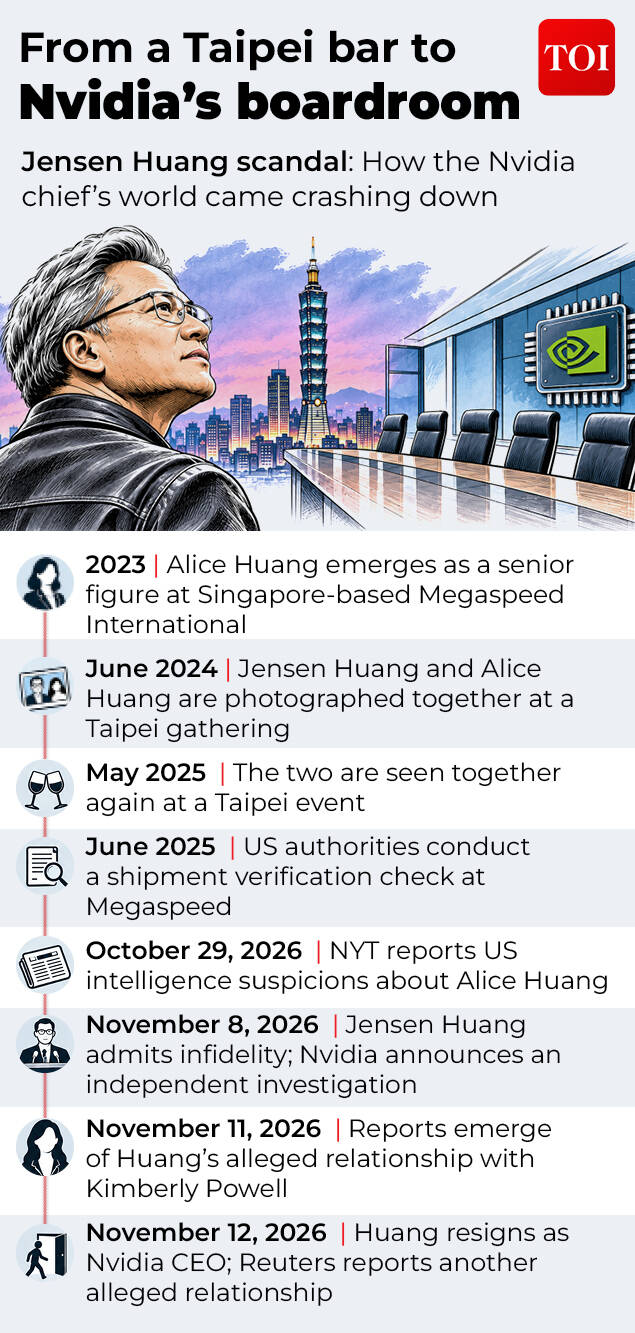
Huang’s alleged links to a woman suspected of Chinese intelligence connections have triggered US national security concerns.
From honey traps to cyberattacks, China’s methods of spying have evolved over the years. The Nvidia controversy offers a look at how China’s intelligence agencies operate and why American technology companies have become key targets.
An old trick with a new target
Honey traps are hardly a new invention. During the Cold War, the Soviet KGB used attractive female agents, nicknamed ‘ravens’ and ‘swallows’, to compromise Western diplomats and officials. East Germany’s Stasi had its so-called Romeo spies, who cultivated relationships with secretaries working in sensitive West German government offices. The objective was simple: obtain information through intimacy, trust or blackmail that conventional espionage might struggle to access.China has its own history with the tactic. One of the best-known American cases dates back to the 1990s. The FBI believed it had recruited a Chinese agent named Katrina Leung under an operation code-named ‘Parlor Maid’. Instead, Leung seduced two of her FBI handlers and passed agency secrets to Beijing, according to David Wise’s book Tiger Trap: America’s Secret Spy War with China.The Nvidia controversy has brought this old playbook into the age of artificial intelligence. Former CIA station chief Keith Riggin, who later advised American businesses on Chinese intelligence threats, has warned executives about precisely this vulnerability. His advice to American businessmen travelling to China was blunt: “You don’t get any better-looking when you go to a place like China.”Riggin told Foreign Policy that he knew of at least 20 other executives who had fallen victim to similar operations. His former colleague Rudy Guerin, who led FBI China counterintelligence, said most executives they briefed did not take the threat seriously.That may be the oldest vulnerability in intelligence gathering. Firewalls can be strengthened, passwords changed and sensitive networks isolated. Human vanity, however, is considerably harder to patch.There is, however, an important distinction between an affair and an intelligence operation. It remains unclear whether Alice Huang was recruited before becoming close to Jensen Huang, whether Chinese intelligence discovered the relationship later and exploited it, or whether she independently approached the agency. The possibility that she was pursuing her own commercial interests alongside any alleged intelligence activity has also been raised. None of these explanations has been established publicly.
Inside China’s spy machinery: The MSS and its cyber army
To understand why the Huang affair has caused such alarm, it helps to understand that China does not operate through one giant spy agency with a single switchboard connecting every intelligence operation. Its intelligence machinery involves civilian agencies, military intelligence organisations, cyber units and provincial-level operations, sometimes with overlapping responsibilities and competing interests.The most important civilian organisation is the Ministry of State Security, or MSS. Established in 1983, it is responsible for foreign intelligence, domestic intelligence, counterintelligence and counterespionage. Its work includes monitoring foreign governments, collecting political and economic information, identifying threats to the Chinese Communist Party and pursuing intelligence opportunities overseas.For years, the MSS was associated with a relatively cautious approach to intelligence gathering. Its methods were described as ‘a thousand grains of sand’, the idea being that countless small pieces of information could eventually produce a useful picture. Former US officials have told Foreign Policy that the agency became considerably more aggressive and willing to take risks, particularly after 2005, when it reportedly designated the United States as its principal adversary.
But the MSS is only one part of the picture
China’s People’s Liberation Army (PLA) has historically maintained separate military intelligence and cyber capabilities. Before its major organisational restructuring in 2015, the PLA’s Second, Third and Fourth Departments had distinct responsibilities. The Second Department handled foreign intelligence and military reconnaissance. The Third Department, commonly known as 3PLA, was responsible for signals intelligence and communications monitoring, making it comparable in some respects to America’s National Security Agency. The Fourth Department was associated with electronic warfare and computer network attacks.The former Third Department was particularly significant. A Wall Street Journal investigation by Paul Mozur and James Areddy described an organisation with operational units spread across China. Foreign experts estimated that it employed more than 100,000 hackers, linguists, analysts and intelligence officers across multiple bureaus and research facilities. Some facilities were reportedly positioned around Shanghai, including locations close to major communications infrastructure connecting China with the US.The system is not necessarily a perfectly coordinated machine. Australian security researcher Tobias Feakin, in his study Enter the Cyber Dragon, noted that China lacks a formal central mechanism equivalent to Australia’s national intelligence assessment system for bringing information collected by different agencies together into one consolidated assessment. Provincial agencies also have their own networks, interests and capabilities.That leaves room for competition, miscommunication and even freelance intelligence entrepreneurs who may pursue their own commercial interests alongside state objectives. It also makes the task of understanding exactly who is responsible for a particular operation considerably harder.
From hacking computers to entering boardrooms
China’s interest in cyber espionage can be traced back to a military awakening during the 1990-91 Gulf War. Watching American forces use computers, precision weapons and real-time intelligence to defeat a largely Soviet-equipped Iraqi military made Chinese strategists recognise how technology could reshape warfare.The lesson was that a weaker power did not necessarily have to match America’s conventional military superiority. It could exploit the vulnerabilities created by America’s dependence on technology, communications and information systems.In 1999, two Chinese military colonels published Unrestricted Warfare, a book exploring how weaker powers could use unconventional methods to challenge stronger adversaries. Cyber capabilities, economic pressure and other asymmetric tools featured prominently in this thinking.The subsequent growth of Chinese cyber espionage demonstrated how those ideas could translate into practice.In 2013, the security firm Mandiant exposed a Chinese military-linked unit that had been hacking The New York Times. The newspaper had published an investigation into the wealth accumulated by relatives of then premier Wen Jiabao. Hackers were suspected of trying to identify the sources behind the reporting.The commercial world was not spared either. Networks belonging to mining companies BHP Billiton and Rio Tinto were reportedly penetrated by Chinese hackers during discussions surrounding a proposed merger. The episode raised concerns that commercially sensitive information could be exploited to influence a major business transaction.“Foreign intelligence services have discovered that unclassified US government and private sector information, once unreachable or requiring years of expensive technological or human asset preparation to obtain, can now be accessed, inventoried, and stolen with comparative ease using computer network operations tools,” a report titled Capability of the People’s Republic of China to Conduct Cyber Warfare and Computer Network Exploitation, had warned in 2009.“China’s development of its computer network operations capability extends beyond preparations for wartime operations. The PLA and state security organizations have begun employing this capability to mount a large scale computer network exploitation effort for intelligence gathering purposes against the US and many countries around the world, according to statements by US officials, accusations by targeted foreign governments, and a growing body of media reporting on these incidents,” the report added.Chinese intelligence gathering has not been limited to military secrets or government communications. It has also sought economic, technological and commercial information that could give Chinese businesses and the state an advantage.
Washington’s missing alarm bells
Perhaps the most troubling part of the affair is not what happened in Taipei, but what may have happened in Washington.According to Foreign Policy, US officials had been investigating Chinese dealings involving Nvidia for at least two years. The New York Times reported that President Donald Trump was personally briefed about Huang’s vulnerability around a year ago. Secretary of State Marco Rubio also reportedly helped circulate an interagency warning this spring.Yet Huang continued to enjoy a close relationship with Trump and accompanied the president to Beijing for his May summit with Xi Jinping.Trump subsequently said he did not remember receiving the earlier warning.
Why the threat may not be over
The first reason is that the investigation remains unfinished. The US Justice Department has not publicly established that Alice Huang was a Chinese intelligence operative. The extent of any damage, if there was any, is still unclear.The second is that Nvidia’s problems extend beyond its founder. Huang’s departure leaves a company that has become almost synonymous with the AI boom under interim leadership. Its November 17 earnings announcement will be closely watched as investors and regulators assess the implications of the leadership change.The third is that the alleged operation, if confirmed, would highlight a vulnerability shared by technology companies worldwide. AI, quantum computing, biotechnology and advanced semiconductor research are all potential targets for foreign intelligence services. Not every route into a sensitive company involves a sophisticated cyberattack. Sometimes it begins with a conversation, a business introduction or a personal relationship.The popcorn moment may be over, but the investigations are only beginning. Congress, the FBI, Nvidia’s board and a growing number of lawyers will now try to establish what happened, what was known and whether anything was lost.