
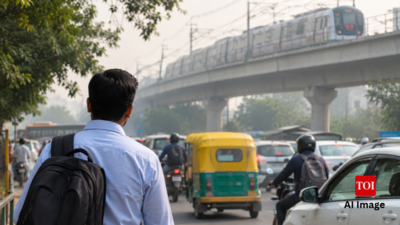
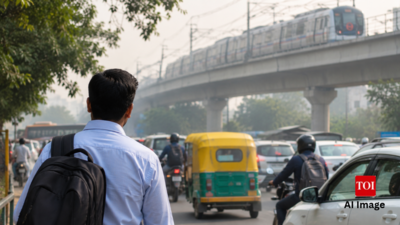
NEW DELHI: For commuters affected by GRAP curbs, getting to work has become a trade-off between money, time and convenience.Crowded metro coaches, poor last-mile connectivity and longer journeys often leave them dependent on app-based cabs and autos. As TOI’s Ishita Jairath finds out, many have been forced to rework their daily budgets and routines.
Three colleagues, one carpool, Rs 15,600 extra
Brajesh Sharma, who travels from Sector 78 in Noida to Asiad Village in Delhi, has carpooled with two colleagues for years.Usually, the daily petrol bill is around Rs 550 per person. But their vehicle does not meet BS-VI emission norms, forcing them to switch to app-based services. The result: Their daily commuting expense has nearly doubled to Rs 1,200.Over 24 working days, the monthly bill rises from Rs 13,200 to Rs 28,800, an additional Rs 15,600. “For middle-class salaried employees, this is a substantial financial burden,” Sharma says.The metro is not an easy alternative because of last-mile connectivity problems. The trio has occasionally borrowed BS-VI-compliant cars from friends. Sharma suggests regulated carpooling arrangements or exemptions for verified office commuters.
‘My commuting expenses have doubled’
Asfaq Khan is responsible for overseeing the operations of some of the trains at New Delhi Railway Station along with his team.Reaching work on time is essential for him. His 32km one-way commute from Sector 78, Noida, earlier cost Rs 350 by car. But his BS-IV vehicle is affected by the restrictions, forcing him to depend largely on private cabs costing around Rs 700 one way.Cab availability and peak-hour congestion have added to his difficulties. He occasionally takes the metro, depending on his work schedule and physical energy, but says it is not always practical given the demanding nature of his responsibilities.Khan points to the irony of railway employees responsible for keeping trains running smoothly struggling to reach their workplace. He says pollution control needs to go beyond restrictions and include reliable public transport and practical arrangements for essential-service personnel.Traffic teams should also focus on managing congestion and facilitating smoother movement, rather than just issuing challans, he adds.
A 76km commute, Rs 30,000 extra a month
A Ghaziabad resident working in Vasant Kunj has rented a one-bedroom flat near his office to avoid his 76km daily round trip. Congestion and delays caused by checks made the journey increasingly difficult.The commuter, who did not wish to be named, now stays near his workplace four days a week and returns to Ghaziabad over the weekend. The arrangement costs him around Rs 30,000 extra every month. It also means spending most working days away from his family.
Working from home, but cabs remain costly
Another commuter has been working from home to avoid the restrictions. Returning to office would mean spending around Rs 530 on a daily cab ride, compared with an estimated monthly fuel bill of Rs 4,500 using a personal vehicle.Having never travelled to work by metro, she says driving is more convenient. Cab availability is another concern, with some drivers refusing to travel to Delhi. Repeated bookings waste time and add to the inconvenience.
Longer journeys, higher costs
For Jitendra Kumar, commuting between Noida and Delhi has become slower and expensive. His expenses have nearly doubled, while travel time has increased from 1 hour 15 minutes to 2-2.5 hours.He attributes the delay to queues at DND toll plaza, where vehicles registered outside Delhi are being checked. Vehicles often wait with their engines running, adding to pollution, he says.
Metro-cab combination pushes daily expenses to Rs 1,000
Alok’s monthly petrol expenditure was earlier Rs 11,000-12,000. He now spends Rs 800-1,000 daily on commuting. His work involves meeting govt officials across Delhi.He takes the metro to central Delhi and uses cabs for local travel. Depending on his schedule, he sometimes takes a cab for the entire journey or uses the metro while returning home late. Earlier, driving to office took him 40-45 minutes. The metro now takes an hour, excluding additional travel for meetings.
Six buses parked, Rs 84,000 a day at stake
Bus contractor Anil Dixit has six buses operating on Delhi routes sitting idle. Each bus generates around Rs 14,000 daily. With all six off the road, potential daily receipts of Rs 84,000 are at stake, while investments in the vehicles remain tied up.Dixit says recurring restrictions make it difficult to recover losses during periods when buses can’t operate. Prolonged downtime, he adds, is affecting the business’s viability.
A new car, despite the old one working fine
Vineet, 56, who has recently dealt with heart problems, says going out for simple chores has become a task as he cannot use his car and pollution is at its peak. His dilemma highlights another consequence of the curbs.While the aim is to keep older, polluting vehicles off roads, owners who need personal transport may feel compelled to buy new cars even when their existing vehicles are in working condition.