
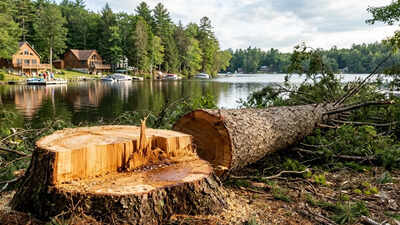
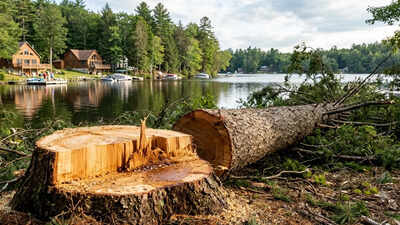
A retired US Navy SEAL commander who faced two felony charges for removing a tree along a shared property boundary in New Hampshire has paid a $1,000 fine after both charges were dropped. Michael Hayes, 55, pleaded guilty to a non-criminal trespassing violation in a court hearing on October 23.According to AOL.com, the case began after Hayes removed a hemlock tree standing along the boundary between his lakefront property and a neighbouring property owned by Stacey Nath-Vinick and Michael Vinick. The neighbours had valued the removed tree and a nearby stump at $11,259, according to a report by the Valley News.A Sullivan County grand jury indicted Hayes on May 27 on charges of criminal mischief and timber-harvesting trespass. Both offences carried possible prison sentences of up to seven years. However, prosecutors agreed to drop the two felony charges during the October hearing.Hayes accepted a lesser trespassing violation and paid the $1,000 fine at the court clerk’s office before leaving. Judge James Kennedy presided over the hearing at Sullivan Superior Court in Newport. Hayes was represented by attorney Jason Casey of Hinckley Allen.
Why Hayes removed the boundary tree
The hemlock stood on the shared boundary between Hayes’s lakefront property and the neighbouring lot to the south. The Vinicks own the adjoining property.Hayes said he feared the tree was dead or dying during the summer of 2025. He also pointed to an earlier incident in 2017, when a falling tree destroyed a family vehicle. A letter from Mercedes-Benz documenting the incident was obtained by the Valley News.On June 11,Hayes emailed the Vinicks to ask whether the hemlock could be removed. This was a day after Michael Vinick’s father died. Nath-Vinick later told the court that she responded by saying the family was dealing with a death.The tree was removed a few days later. A four-foot stump from another hemlock, which the Vinicks had cut in 2019, was also removed. Hayes had claimed that the neighbours cut the earlier tree without his permission.According to court filings described by the Valley News, an arborist hired by Hayes for a drainage project had told him that the hemlock was dying. The tree was also leaning towards the neighbours’ house and was likely to fall soon.The Town of Sunapee’s tree-cutting request form lists the removal and replacement of decaying trees and shrubs among activities that do not require a permit.
Neighbours valued the trees at $11,259
About a month after the tree was removed, the Vinicks hired arboricultural consultant Brian Beaty to assess the damage. Beaty was registered with the American Society of Consulting Arborists and the International Society of Arboriculture.He rated the hemlock’s condition at 53% on a scale ranging from 10% to 100%. His assessment placed the replacement value of the removed tree and the neighbouring stump at $11,259.Beaty also noted that the stump had supported a hammock regularly used by Michael Vinick.After the grand jury indicted Hayes, he hired Jeffrey Coombs, president of Ossipee Mountain Land Company, a forest management and firewood business. Coombs examined photographs of the trees and gave a different assessment.He described two remaining hemlocks along the boundary as being in “an advanced state of decline”. He also said they had “no positive market value”.The difference between the two assessments became an important part of Hayes’s defence. His lawyer argued that Beaty’s report calculated the cost of replacing the tree rather than its market value.In a July memo to County Attorney Christine Hilliard, Casey said this difference weakened the state’s claim about the financial loss caused by the removal. He also argued that Hayes had not acted recklessly and described the incident as “a good-faith misunderstanding regarding authorisation”.
What the two felony charges involved
The charges against Hayes were based on two New Hampshire laws concerning damage to property and unauthorised tree removal.Under state law RSA 227-J:8-a, cutting or destroying trees on land belonging to another person without permission can amount to a criminal offence if the action is reckless. The offence becomes a class B felony when the market-value loss exceeds $1,000. A lower loss can result in a misdemeanour charge.The second charge, criminal mischief under RSA 634:2, applies when a person purposely causes or attempts to cause financial loss. It becomes a felony when the loss exceeds $1,500.The state would have had to establish the required financial loss and intent or recklessness to secure felony convictions under the respective laws.New Hampshire also has a separate civil provision for cases involving trees cut without permission. Under RSA 227-J:8, a person who negligently cuts a tree on someone else’s property may have to pay between three and 10 times the tree’s market value to the affected owner.The Valley News did not report whether the Vinicks had filed a separate civil claim.Hayes told the Valley News that he accepted responsibility for a violation rather than a criminal offence because he wanted the matter to end as quickly as possible.In June, he had also said that he was not contacted before the charges were filed. He described this as “most regrettable and concerning”.