
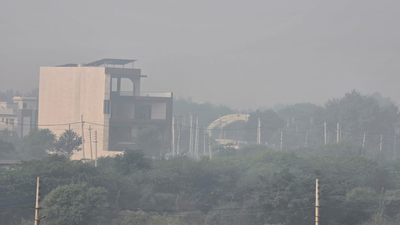
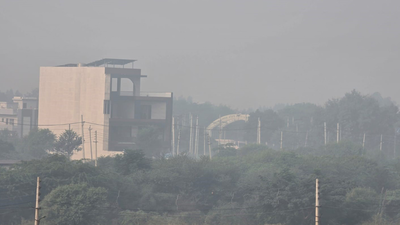
JHAJJAR/CHARKHI DADRI/ROHTAK: Air pollution levels surged to alarming levels across Delhi-NCR and several cities in Haryana following widespread firecracker bursting on Diwali night. On Monday, Charkhi Dadri in Haryana recorded an Air Quality Index (AQI) of 402, making it the most polluted city in the country. Bahadurgarh recorded an AQI of 397, the highest in Delhi-NCR, while Rohtak ranked second in the region with an AQI of 384. Bhiwani recorded an AQI of 358.Smoke from firecrackers, coupled with existing pollution, pushed air quality in several cities into the ‘very poor’ and ‘severe’ categories. Visibility was also affected in several areas on Monday morning. The post-Diwali pollution spike has posed a major challenge for administrative agencies.Among other Haryana cities, Sirsa recorded an AQI of 362, Panchgaon 359, Kaithal and Faridabad 338 each, Ballabhgarh 334 and Jind 310. Delhi recorded an AQI of 370, while Khoda in Uttar Pradesh registered 400.An AQI between 301 and 400 falls in the ‘very poor’ category, while readings between 401 and 500 are classified as ‘severe’.
Four FIRs registered in Jhajjar; construction activities restricted until November 20
The Jhajjar district administration has adopted a stringent approach to curb air pollution. Four FIRs have been registered so far against activities contributing to pollution, with surveillance and enforcement measures stepped up across the district.Deputy Commissioner Varsha Khangwal said that, in accordance with directions issued by the Commission for Air Quality Management (CAQM), demolition activities generating dust and open construction activities would remain completely prohibited until November 20, 2026.She has directed all concerned departments and agencies to ensure strict compliance with the orders. Water is being regularly sprinkled on roads in Jhajjar, Bahadurgarh and Beri to prevent dust particles from becoming airborne.Regional Officer Sunil Sheoran said eight water-sprinkling tankers, one truck-mounted anti-smog gun and one mechanised road-sweeping machine had been deployed in Jhajjar and Bahadurgarh. These vehicles and machines are being used for road cleaning, water sprinkling and dust suppression.Rohtak Deputy Commissioner Satvir Singh said the municipal corporation had deployed eight anti-smog machines across the city to control pollution. He said stubble-burning incidents had remained relatively low in the district this year, although cases had been registered against two farmers for allegedly burning crop residue.He said the administration was taking strict measures to prevent stubble burning and that action would be taken against anyone found violating the directions.However, open waste burning has emerged as another concern in Rohtak. Garbage was seen burning at several locations in the city on Sunday and Monday mornings. Stubble burning was also reported in one or two villages in the district. Smoke released from open waste burning is further adding to the pollution burden.Repeated attempts to contact Rohtak Regional Officer Dinesh Kumar for his response were unsuccessful. He neither answered phone calls nor responded to WhatsApp messages.
95% of mining operations halted in Charkhi Dadri; power connections disconnected
Strict measures have also been taken against mining activities in Charkhi Dadri to control pollution. Sachin Yadav, SDO of the pollution control department in Charkhi Dadri, said nearly 95% of mining operations in the district had been suspended and electricity connections at the concerned sites had also been disconnected.Charkhi Dadri recorded an AQI of 402, the highest in the country, while neighbouring Bhiwani registered 358.Repeated attempts were made to contact Ajit Singh, the Regional Officer responsible for Charkhi Dadri and Bhiwani, to seek his response on pollution-control measures and the prevailing situation. However, he neither answered phone calls or WhatsApp calls nor responded to WhatsApp messages.
Pollution poses serious risks to patients with respiratory and cardiac diseases, cancer and TB
Dr H.K. Aggarwal, Vice-Chancellor of the health university in Rohtak, expressed serious concern over the deteriorating air quality and its impact on public health.He said polluted air posed a serious threat to people suffering from respiratory and cardiac diseases, allergies, cancer and tuberculosis (TB).He cautioned that rising pollution levels could aggravate existing health conditions, making patients with such illnesses particularly vulnerable. Children and elderly people should also avoid prolonged exposure to polluted air.