
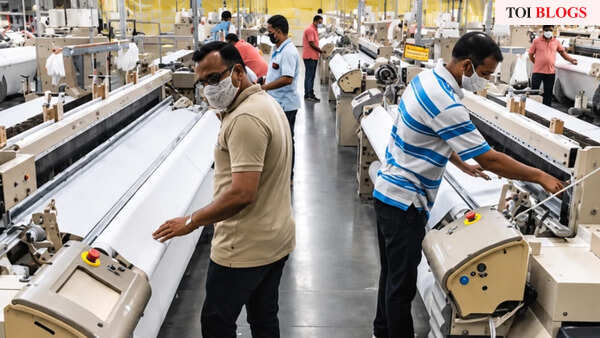
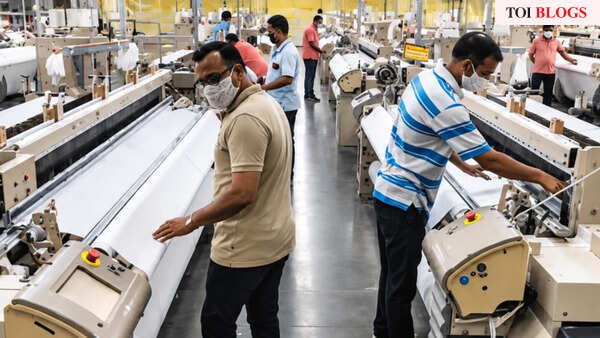
The global textile industry is entering a phase in which the lowest factory price may no longer represent the lowest cost to a buyer. Tariffs, inventory risk, markdowns, delivery speed and traceability increasingly determine the economics of sourcing. For India, this is an opportunity, but also a warning: orders attracted by shifting trade relationships will not stay unless the manufacturing ecosystem can deliver consistently.Discussions at the ITMF Annual Conference 2026 in Fortaleza, Brazil, captured this shift. The central reality is clear: the next competitive advantage will be built as much beyond the factory gate as within it.Orders can move quickly. Ecosystems cannot.Brands can reallocate orders within a season; a dependable textile ecosystem takes years to establish. ITMF data show that around 95% of new short-staple spindles shipped globally in 2025 went to Asia and Oceania. Even as buyers diversify their supplier base, capital continues to favour locations with established industrial depth.This distinction matters. A tariff advantage may open the door, but it is reliable fabric availability, processing capacity, quality, logistics and execution that keep it open. A factory may be efficient in isolation and still be commercially uncompetitive if the system surrounding it is fragmented, slow or expensive.
The real price is the total cost of sourcing
The traditional comparison of free-on-board prices remains necessary, but is no longer sufficient. Retailers also pay for excess inventory, delayed replenishment, lost sales and end-of-season discounting. A supplier that can shorten lead times and adjust volumes to actual demand may create more value than one offering a lower initial price.This is why speed must be understood as a value-chain capability, not a promise made by a garment unit. Faster sewing cannot compensate for delays in spinning, weaving, processing, approvals or movement of goods. India should measure competitiveness not only by cost per unit, but also by end-to-end lead time, delivery reliability and the cost of working capital across the chain.
A broader fibre and product strategy
The fibre landscape is changing just as rapidly. Conference observations place synthetics at roughly 69% of global fibre output, with polyester accounting for close to 59%. Cotton retains a vital role, but its share faces structural pressure. India should resist a false choice between cotton and man-made fibres.The imperative is to improve cotton productivity, quality and traceability while building globally competitive man-made fibre, filament, processing and downstream capabilities. Greater value will increasingly come from functional fibres, technical textiles and engineered products that offer performance, not simply a lower price per kilogram.
Technology must solve operating problems
Artificial intelligence is entering textiles most usefully through planning, quality inspection, forecasting, process optimisation and inventory management. These applications may be less visible than fully automated production lines, but their impact on defects, waste, machine utilisation and cash conversion can be substantial.For MSMEs in particular, digitalisation should be a productivity programme, not a procurement exercise. Shared solutions, reliable data and practical training matter more than isolated pilots. India’s ambition should extend beyond being a major market for textile machinery to becoming a global centre for textile engineering, technology development and manufacturing innovation. Collaboration among manufacturers, machinery companies, technology firms and research institutions will be essential to that transition.
Compliance is becoming part of the product
Traceability, environmental disclosures and supply-chain documentation are increasingly relevant to access in major export markets. The challenge is not simply to meet another buyer checklist; it is to build the ability to substantiate product claims consistently and at scale.Because large exporters depend on networks of smaller suppliers, the answer cannot be firm-by-firm compliance alone. Textile clusters need accessible testing, common documentation standards and affordable digital traceability tools. A supply chain that can prove what it makes, how it makes it and where inputs originate will be better positioned to retain demanding customers.
Policy certainty is an economic input
India’s competitiveness will ultimately depend on how effectively large enterprises and MSMEs reinforce each other. Scale brings capital, technology and access to global customers; smaller firms bring specialisation, flexibility and employment. Integrated clusters and common infrastructure can convert those complementary strengths into a national advantage.Policy must support that long investment horizon. A textile project is planned over years, while export prices are committed months ahead. Predictability therefore affects both the cost of financing and the ability to quote competitively. Three principles stand out:Neutralise embedded taxes and levies. RoSCTL for apparel and made-ups, and RoDTEP for other eligible textile products, serve the fundamental principle that exports should not carry domestic embedded taxes and levies. They are not substitutes for productivity; they allow productivity to translate into competitiveness. Their effectiveness depends on appropriate coverage, evidence-based rates, timely realisation and policy continuity.Give exporters multi-year certainty. Rates notified for a defined multi-year period, with advance consultation before any revision and no retrospective change, would let exporters price orders and investors commit capital with confidence.Secure competitive raw-material access. A rational and stable approach to cotton import duties, together with efficient logistics, trade facilitation and technology-ready industrial infrastructure, is essential to keep Indian mills on a level footing with global peers.None of these measures alone creates competitiveness; together they determine whether private investment can achieve it.
From installed capacity to enduring capability
India has an extensive textile value chain, a substantial domestic market and an entrepreneurial manufacturing base. The question now is how to turn these advantages into a more responsive, technologically capable and globally connected production system.New investments should therefore be judged not only by capacity added or capital deployed, but by the capabilities created: higher productivity, shorter lead times, deeper value addition, stronger upstream linkages, greater MSME participation and readiness for emerging market requirements.India must distinguish between capturing orders and building enduring competitiveness. The first can be done in a quarter. The second takes a decade. Scale will remain essential. But scale without competitiveness will become harder to sustain. The next textile race will not be won simply by building more factories. It will be won by building the capabilities that make those factories globally indispensable.Source note: Spindle shipment data are from ITMF statistics presented at the ITMF Annual Conference 2026, Fortaleza, Brazil (14–15 October 2026). Fibre-share estimates are conference-reported figures compiled by Wazir Advisors. Interpretations and recommendations are the author’s.
Disclaimer: Views expressed above are the author’s own.