
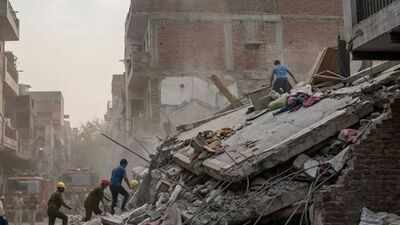
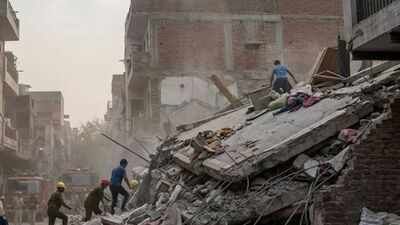
NEW DELHI: A series of building collapses across Delhi this year has once again brought construction safety, unauthorised structural modifications and enforcement of building regulations under scrutiny. TOI recalls some of these incidents.A multi-storey building collapsed in Satya Niketan area, killing seven people. The building, which housed a boys’ paying guest accommodation near Delhi University’s South Campus, collapsed while repair and construction work was in progress.An old two-storey building collapsed during demolition work in Karol Bagh’s Regarpura. Police said no permission had been obtained for the demolition. In July, two adjacent under-construction four-storey buildings collapsed in Rohini Sector 16 amid heavy rainfall. Structural and plumbing work was examined as a possible contributing factor.A four-storey building collapsed in Saidulajab, near Saket, while additional floors were being constructed. The debris fell onto an adjoining student canteen, killing six people. Three people were arrested in connection with the incident. They emphasize the importance of conducting regular safety audits to prevent future collapses.A residential building near Idgah Machhli Mandi in northeast Delhi’s Seemapuri collapsed, killing four people, including a pregnant woman. The structure, according to officials, had developed cracks following earthquake tremors. The building owner was subsequently arrested.The same month, an old structure at Milan Garden in Harsh Vihar gave way while an additional floor was being constructed, killing a 60-year-old man and his 33-year-old son. Police added a charge of culpable homicide not amounting to murder against the accused Tuesday. The family of the deceased men had alleged the building owner locked the entrance gate after the collapse, which occurred around 5pm, and fled after misleading locals into believing that the building was unoccupied.Expert calls for regular safety auditsAn expert outlined several reasons for building collapses.One obvious reason is a bad foundation, while another can be a foundation that’s not suitable for the ground conditions. Even with a well-designed foundation, the structure above may not be designed to bear the load, leading to a collapse.The expert also emphasised the role of ageing, noting that natural deterioration over time can compromise a building’s integrity. Additionally, he stressed that the quality of construction plays a crucial role in determining a building’s safety. To mitigate these risks, he recommended that building owners conduct regular security audits.It is essential that potential threats like structural and non-structural cracks are identified in a timely manner. Structural cracks, if ignored for long, can also lead to collapse. They must be repaired properly before any tragedy occurs.Chawri Bazar building collapse highlights risks of unauthorised constructionThe concerns over building safety in Delhi resurfaced on November 5 after a three-storey under-construction building collapsed in the congested Chawri Bazar area of Old Delhi, killing two people and injuring five others.The incident occurred at property number 4548 in Gali Sheesh Mahal, near Ajmeri Gate, at around 10.30am. According to a preliminary inquiry by the Municipal Corporation of Delhi (MCD), unauthorised construction on the second and third floors allegedly triggered the collapse.The inquiry revealed that the building owner had been issued an advisory by the MCD on April 28, asking him to undertake structural strengthening under the supervision of an empanelled structural engineer. However, the advisory did not grant permission for fresh construction or reconstruction.Despite this, the owner allegedly proceeded with extensive reconstruction and added additional floors under the pretext of carrying out minor repairs. A preliminary assessment suggested that the shuttering of a newly cast third-floor lintel was hurriedly removed, causing the uncured slab to collapse and bringing down the entire structure.The narrow lanes of Chawri Bazar also posed significant challenges for rescue operations. The building was located in a dead-end lane barely three feet wide, making it inaccessible to heavy rescue vehicles and machinery. Rescue personnel and civic workers had to remove much of the debris manually.Following the incident, Delhi Chief Minister Rekha Gupta ordered the suspension of the area’s Assistant Engineer and Junior Engineer and directed officials to register an FIR against the building owner and contractor. She also ordered safety audits of adjoining properties and action against unauthorised construction across the capital.The incident has once again highlighted concerns over civic oversight, illegal structural modifications and the need for regular building safety inspections in Delhi’s densely populated neighbourhoods.