
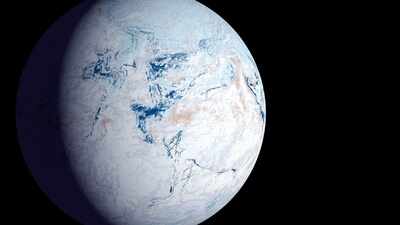
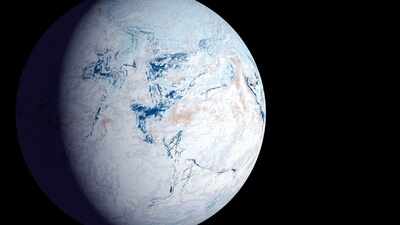
For ages, the Arctic was heading for a colder future. On Baffin Island in northern Canada, what’s left of the mighty Laurentide Ice Sheet, known as the Barnes Ice Cap, was starting to grow again. It was as if the planet was inching toward the slow beginning of another glacial era. But then, things flipped. Human activities flooded the atmosphere with greenhouse gases, and global temperatures rose. Instead of building up, the ice started vanishing, detouring from a path set by natural rhythms over thousands of years.In October 2026, a study, published in Science, shook up how we see all this. The study suggests that human-caused global warming may have halted the early development of the next glaciation. For the study, scientists used radiocarbon dating on ancient plants (mosses, shrubs — the kind of stuff glaciers usually crush) buried under the shrinking ice. They pieced together the timeline: about 2,000 years ago, the Barnes Ice Cap started expanding again, gathering momentum, until the 1960s, when warming from human activity stopped that growth cold.Sue, the discovery offers a striking illustration of how profoundly humans are altering Earth’s climate. However, it’s important to note that this isn’t proof that the next Ice Age was knocking at our door. No one’s saying sprawling glacial sheets were about to cover North America and Europe again. What the research shows is more subtle, but still pretty dramatic: human-caused warming has the power to override natural climate cycles, changing what would have happened, had the planet been left to itself.
How did scientists catch wind of this hidden history?
For starters, the researchers stuck to Baffin Island in Canada’s Nunavut territory, where the Barnes Ice Cap survives as the last relic of the Laurentide behemoth. Notably, this is the last surviving remnant of the Laurentide Ice Sheet, which once covered vast areas of Canada and the northern United States, extending as far south as present-day Illinois during the last major glacial period.Led by Nicolás Young and others from Columbia University, the team hunted for signs that the ice wasn’t always growing. Usually, glaciers erase their own history: the ground they move over gets chewed up. But as the ice retreated in modern times, it revealed long-dead plants, perfectly preserved. By dating when these plants died, the team mapped out when ice came and went.Turns out, around 3,000 years ago, the ice cap was at its smallest. Then, about 2,000 years back, it began its slow advance, until rising greenhouse gases overwhelmed the trend and kicked off a rapid retreat in the 1960s. This kind of evidence is rare, as you can usually see when ice sheets are at their peak, not when new ones are just starting to grow.
What caused the ice cap to grow, and why did it stop?
As for the forces driving that ancient growth, they’re tied to Earth’s natural wobbles: shifts in orbit and tilt that change how sunlight hits the planet, making some summers too cool to melt all the winter snow. Over time, ice stacks up, reflecting more sunlight, and encourages even more cooling, in a slow-motion feedback loop.When summers become cooler, winter snow is more likely to survive into the following year. Over time, this allows ice to accumulate, potentially triggering feedback mechanisms that encourage further growth. Expanding ice reflects more sunlight back into space, helping maintain cooler conditions.The researchers believe that these natural processes contributed to the Barnes Ice Cap’s renewed growth over the past two millennia. But from the mid-20th century onwards, the rapid increase in greenhouse gases from burning coal, oil and natural gas began to exert a stronger warming influence.Carbon dioxide traps heat in the atmosphere, raising global temperatures and reducing the ability of snow and ice to survive summer. In the case of the Barnes Ice Cap, this warming eventually overwhelmed the cooling influence of natural orbital changes.Now, human activity (mostly burning coal, oil, and natural gas) supercharged the amount of carbon dioxide in the air. This trapped extra heat, tipped the scales, and erased the cooling advantage. That’s why, according to Columbia University’s account of the research, since 1960 or so, the Barnes Ice Cap has been shrinking, and fast.
Does all this mean we dodged an Ice Age?
Not necessarily. And the distinction between a glacial period and an ice age is important.Scientists use the term ice age to describe a prolonged period when Earth has persistent ice sheets. As per that, Earth is technically still in an ice age, known as the Late Cenozoic, that began 34 million years ago; just not a glacial period.Right now, we live in an interglacial, the Holocene, which started roughly 11,700 years ago. The new research says we might’ve seen the first hints of another glaciation in the far north, but that’s a long way from a planet-wide deep freeze.Another study published in Communications Earth & Environment in December 2025 ran climate models and found that the next big, ice-spreading glaciation probably wouldn’t come for about 50,000 years naturally, even without our emissions. Double the carbon dumped so far, and the next glaciation could be postponed another 50,000 years on top of that. So the timing depends on many things: the definition of a “glacial inception,” how much more carbon we emit, and all the unpredictable feedbacks between atmosphere, oceans, and ice.
What does the discovery mean for climate change?
In the end, the real takeaway isn’t that we “saved ourselves” from another Ice Age. What matters is that humans now shape Earth’s long-term climate in ways that dwarf anything before. The Barnes Ice Cap might melt away entirely, and once it’s gone, that’s one more door closing on the planet’s natural rhythms, at least in that region.These results aren’t just another climate statistic. They show that the things we’re doing, like burning fuel and changing landscapes, can reach deep into systems that would otherwise wind and unwind over tens, even hundreds of thousands of years. Standing in the present, it’s a bit sobering. What we’ve unleashed can steer the destiny not just of this century, but of countless centuries to come.