
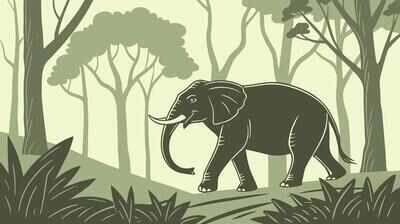
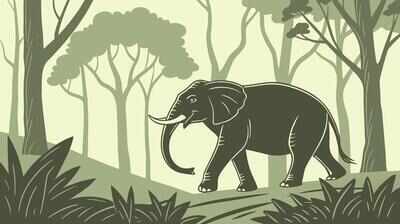
DR TV SajeevWhen a wild tusker killed a tribal farmer in Idukki, his neighbours did not just ask for compensation. They demanded the removal of illegal resort fences blocking the elephant’s path—and proved a vital ecological truth: Wildlife needs the freedom to move.On the morning of Sept 23, 2026, a 47-year-old tribal farmer from the Panthadikkalam settlement near Chinnakkanal in Kerala’s Idukki district stepped onto the road outside his workplace shed. The previous night, the formidable wild tusker locally known as Chakkakomban had entered his farmland, prompting the forest department’s rapid response team (RRT) to warn residents to stay indoors. Believing the elephant had retreated into the forest by daybreak, the farmer ventured out. Instead, he walked straight into Chakkakomban. Before he could flee, the tusker charged and trampled him to death.In the hills of the Western Ghats, such tragedies usually follow a familiar bureaucratic script: Officials arrive, announce modest solatium, promise to chase the animal back into the woods, and remove the body. At Panthadikkalam, however, the victim’s neighbours and relatives refused to let the authorities take his body. For five hours, tribal residents held their ground. Alongside compensation and livelihood support for his bereaved family, they made a demand that cut to the ecological core of the crisis: Dismantle the illegal solar fences, steel cables, and resort enclosures that had choked the elephants’ traditional movement routes.That five-hour protest at Panthadikkalam should force a national reckoning with how India understands human–elephant conflict. We habitually frame this crisis as a story of wild animals trespassing into human settlements. Yet as the events in Chinnakkanal reveal, the conflict is equally a consequence of human infrastructure that fragments habitats, severs historic migratory corridors, and traps wide-ranging animals inside lethal cul-de-sacs.A Landscape Carved into TrapsTo understand why Chinnakkanal has become a crucible of human–elephant conflict, one must look at both the casualty ledger and the map. Official data compiled by the Idukki district administration shows that between 2015–16 and 2026–27, human–wildlife conflict across the district claimed 81 human lives and left 486 people injured. Crucially, while annual fatalities hovered between four and ten over the decade, non-fatal encounters surged dramatically in the years immediately preceding the Chinnakkanal intervention—rising from 28 injuries in 2019–20 to 79 in 2023–24 (when deaths peaked at 10) and 103 injuries in 2024–25. Within the first nine months of 2026–27 alone, five people were killed and 13 injured in the district.In ecology, a sharp spike in human injuries alongside persistent fatalities is a classic symptom of spatial compression: Humans and elephants are colliding with growing frequency in shrinking, overlapping spaces. Chinnakkanal panchayat—a 66.74-square-kilometre mosaic of tea estates, eucalyptus coupes, cardamom plantations, tribal hamlets, and booming high-range tourism resorts—sits wedged between the Anamalai hills and the Mathikettan Shola National Park.Over recent years, private resorts and estate encroachers erected a labyrinth of high-voltage solar fences, trenches, and even heavy steel wire ropes strung between giant trees across govt and revenue land. According to the forest department, three primary natural elephant passages in Chinnakkanal had been obstructed: The route linking Mathikettan–Thondimala to Chinnakkanal, the passage from Shankarapandyamettu to the PPK Estate, and the link between Devikulam and Old Devikulam.Because of these barriers, Chakkakomban had been unable to exit the Chinnakkanal pocket for a year and a half. The famous 2023 capture and translocation of another Chinnakkanal tusker, Arikomban, had already shown the futility of removing individual bulls without fixing a broken landscape. Blocked from returning to the contiguous forests of Mathikettan Shola, Chakkakomban was effectively corralled among tribal settlements and estate lanes—turning every dusk and dawn into a game of Russian roulette for local residents.The Intervention and the Proof in the FootprintsConfronted with the Panthadikkalam protest on Sept 23, Idukki district collector, acting as chairperson of the district disaster management authority (DDMA), ordered the forest department and local authorities to clear unauthorised structures, steel ropes tied to trees, and illegal fences obstructing elephant movement paths in identified hotspots. Five days later, on Sept 28, the collector issued a companion advisory through plantation inspectors in Munnar, Peermade, and Udumbanchola, instructing estates in conflict hotspots to halt worker movement and plantation operations between 6pm and 6am when RRT warnings are active. A four-member expert committee was also appointed to recommend long-term solutions.Acting on the directive, forest department teams dismantled an unauthorised solar fence installed on encroached revenue land near the RS Estate close to Panthadikkalam, cleared an encroachment blocking elephant movement near the Anayirankal reservoir, and removed a barrier along National Highway-85 between Mathikettan and Chinnakkanal.What happened next offered a striking field test of the tribal residents’ ecological hypothesis. As has been documented, once the unauthorised fence near RS Estate was dismantled, Chakkakomban—which had been stuck in the human-dominated pocket for 18 months—walked straight through the reopened natural passage into the Mathikettan Shola National Park. In the immediate aftermath of the barrier’s removal through early Oct, officials reported a halt to the daily conflict encounters that had plagued the settlement.Scientific honesty requires us not to overstate this outcome as a permanent “zero-conflict” miracle. The initial post-intervention observation window was barely a fortnight, tracked through field sightings rather than satellite telemetry, and by Oct 10 the forest department had to issue legal notices to 16 violators who brazenly re-erected illegal fences and solar barriers across the Chinnakkanal corridor. Yet Chakkakomban’s immediate departure into Mathikettan Shola once the fence came down demonstrated a vital mechanism: The tusker was not lingering in Panthadikkalam out of malice, but because its exit had been walled off.How Misinformation Clouded an Ecological DebateRather than welcoming the reopening of a blocked passage, powerful commercial, agrarian, and political lobbies erupted in protest, fuelled by a wave of social-media distortion. Three misleading narratives dominated the backlash.First, viral social-media posts, local merchant associations, and political leaders—including the local member of Parliament—claimed or expressed alarm that the collector had imposed a blanket 6pm to 6am night curfew across the entire Idukki district, violating citizens’ fundamental freedom of movement. On Sept 30 and Oct 2, the district collector and a local MLA publicly refuted this falsehood: The Sept 28 letter to plantation inspectors was strictly a safety advisory limited to designated conflict-hotspot plantations during active wildlife alerts, with zero restrictions on public night travel in the district.Second, leaders of major political parties, local MLAs, various farmer associations, and representatives of local religious bodies alleged that the administration was demolishing protective solar fences on farmers’ legal patta (title-deed) lands while locking citizens indoors. Both the collector and the govt chief whip clarified that farmers retain every right to protect legal patta holdings with solar fences; the demolition drive targeted only illegal fences, steel tree-ropes, and unauthorised resort structures on encroached govt and forest land.Third, a district-level leader of a major political party argued that the collector was inventing “non-existent elephant corridors,” pointing out that the Union govt’s 2023 “Elephant Corridors of India” report lists 150 corridors nationally (and six in Kerala) but none in Idukki. It was argued that elephants enter Chinnakkanal solely because forests lack food and water. While it is true that the 2023 central inventory does not list a macro-corridor in Idukki, using that administrative omission to deny local elephant movement routes is ecologically fallacious. Macro-surveys map narrow bottlenecks between major forest divisions; within a fragmented forest-plantation mosaic like Munnar–Chinnakkanal, elephants rely on fine-scale functional passages to move between shola patches, grasslands, and reservoirs. The forest minister stood at the forefront to demolish this false narrative.The Science of the Freedom to MoveDecades of peer-reviewed research on Asian elephants (Elephas maximus) explain why blocking these local passages is disastrous. An elephant’s home range in the Western Ghats spans 100 to over 600 square kilometres. Elephants do not use space randomly; they follow multigenerational spatial memory along topographical contours—gentle valley gradients, saddle points, and riparian strips—to track seasonal forage, minerals, and water while avoiding human disturbance. As famously said, elephants are not forest species, they are landscape species.Not every fence is harmful. Properly designed community solar fencing that rings a compact human hamlet or legal homestead—while leaving adjacent valley passages open—can protect lives and crops. Conflict explodes when resorts, large estates, and encroachers erect uncoordinated, linear barriers across valley floors and ridge saddles. In landscape ecology, this creates a “funnel” or “pinball” effect: An elephant encountering an electrified wire or steel cable along its traditional path is deflected laterally into the path of least resistance—which is frequently a public road or an unfenced tribal settlement like Panthadikkalam.This brings us to a deeper ecological truth that conventional wildlife management routinely misses. Public debate in Kerala endlessly repeats the cliché that elephants leave the forest only because they lack food and water inside. Invasive weeds like Senna spectabilis and Lantana camara, along with colonial eucalyptus monocultures, have undoubtedly degraded forage quality in our forests. Yet even where food and water exist, a wide-ranging herbivore cannot survive in a gilded cage. Elephants require landscape connectivity to rotate across seasonal feeding grounds, prevent localised overbrowsing, regulate social and musth dynamics among bulls, and escape human stressors. Providing food patches or waterholes inside a fragmented pocket cannot compensate for severing the corridors that allow animals to navigate the wider landscape.Two Lessons from PanthadikkalamThe Chinnakkanal intervention is still fragile, as the rapid re-erection of barriers by 16 violators in Oct shows. Yet those few days in late Sept offer two indispensable lessons for Indian conservation policy.First, we must learn from the people who know the forest. When political parties and commercial lobbies demanded that wildlife be “confined to forest limits” or translocated, it was the tribal residents of Panthadikkalam who stood beside their neighbour’s body and diagnosed the actual structural cause of their vulnerability. Their lived familiarity with terrain and animal behaviour identified what years of administrative inertia had overlooked: That illegal resort barriers were trapping Chakkakomban in their midst. Indigenous and local ecological knowledge should not require a funeral and a five-hour road blockade to be heard; tribal communities must have a permanent, statutory seat at the table when land-use and conflict-mitigation decisions are made.Second, wildlife needs room to move. You can fill a forest with waterholes and bamboo, and you can ring every estate with high-voltage wire, but a landscape stripped of connectivity will always bleed conflict. For a creature built by evolution to walk across mountain ranges, food and water keep the body alive, but movement is what keeps the ecosystem whole. Conservation is not the art of walling nature into shrinking reservations; it is the courage to step back, pull down our illegal fences, and restore to wild creatures the ancient freedom to move.(The author is chief scientist at Kerala Forest Research Institute. Views are personal)