
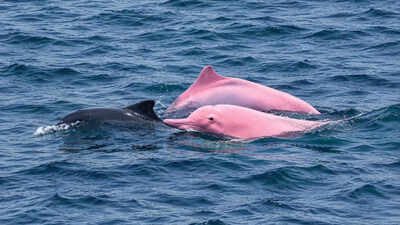
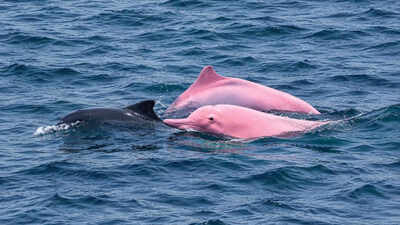
Beachgoers near Muscat got a surreal surprise recently when a pale pink dolphin surfaced just a few meters off the coast, gliding through the water alongside a small pod of darker grey companions.Footage of the sighting quickly went viral, leaving people guessing what kind of dolphin it actually was and how on earth it ended up with that cotton-candy hue.While marine biologists haven’t officially identified the animal yet, the internet was quick to jump to conclusions. Most people naturally think of the famous Amazon River dolphin when they picture a pink marine mammal. But those are freshwater creatures living thousands of miles away in South America, making it virtually impossible for one to randomly show up in the Gulf of Oman.
So, why would an ocean-dwelling dolphin turn pink?
It turns out there are a couple of grounded, scientific reasons for it. First, certain species like the Indo-Pacific humpback dolphin naturally lose their dark pigment as they age. Their skin turns a pale, off-white color, and because their blood vessels sit so close to the surface, they flush pink when they get warm or swim hard. It’s basically the marine equivalent of a person getting flushed cheeks after a solid run – the harder they work, the brighter they glow.Another candidate scientists have tossed around is Risso’s dolphin. These deep-water swimmers start life dark grey or brown, but as they grow older, they collect heavy scarring from fights with squid and other dolphins. Over time, those scratches and scrapes cover so much of their body that they look almost entirely white or soft pink from a distance.There is also a slim chance the animal simply has albinism or leucism, rare genetic traits that strip away natural skin tones entirely.Still, local experts are urging caution before jumping to any conclusions. The Indian Ocean humpback dolphins typically found in these waters almost always stay a solid, muddy grey their whole lives. Until researchers can get a closer look at the fin shape, study its surface markings, or grab clearer high-res photos, the mystery stays open.Whatever the reason behind the strange shade, it was a lucky day for anyone sitting on the beach in Muscat with a phone in hand, catching a glimpse of a genuine ocean anomaly.