
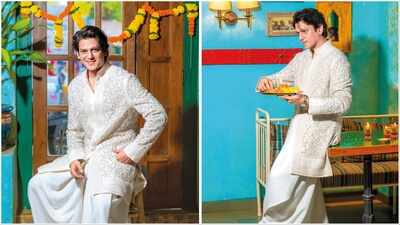
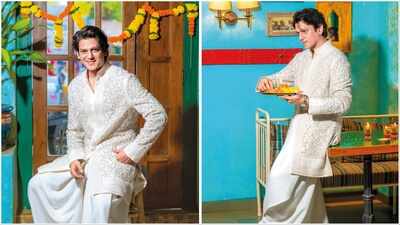
Dussehra is a celebration of the triumph of good over evil, a theme that resonates as much in our epics as it does on screen. This year, Vijay Varma celebrated the festival exclusively with Bombay Times, bringing a touch of tradition to the occasion as he arrived dressed in traditional attire. In a conversation with us, he recounted childhood memories of Dussehra, reflected on the timeless significance of the festival, and shared his thoughts on what it takes to be the new-age leading man.‘I have two distinct memories of Dussehra’Sharing his memories from Hyderabad and Rajasthan, Vijay says, “I have two distinct memories of Dussehra, each rooted in a different place. One is from Hyderabad, where I was born and raised. We would go to a mela held on a massive ground near the Old City, where they would burn the effigy of Ravana. It used to be incredibly crowded, and I remember sitting on my father’s shoulders to get a better view of the ceremony. That image has stayed with me. My second memory is from Rajasthan, where I lived with my grandmother for a few years. The Ramleela performances there were beautiful.”‘My understanding of grey helps me understand both white and black’Reflecting on Dussehra’s age-old theme of good triumphing over evil, the actor believes that human nature cannot always be separated as black and white. He says, “I find humanity in everything. You may disagree with a lot of things about people, and some people may be terribly wrong, but as an artiste, my job is to investigate those who are seemingly discarded as bad people. If there is no representation of different kinds of personalities, our collective understanding of them remains limited.”The actor, who headlined the series Matka King this year, one of the highlights of his career, adds, “Great drama lies in conflict, and conflict cannot exist only in white; it has to have shades of grey. My understanding of grey helps me understand both white and black. I don’t see white and black as complete in themselves. Any flaw in a character becomes an opportunity for me to understand him. I cannot understand a flawless person. My job is to shed light on these complexities and portray them truthfully so that the story works.”‘Every new character pushes me to break my inhibitions’He adds that every role pushes him to confront his own inhibitions and prejudices. Citing Matka King, he says the character’s honesty in a corrupt system made him particularly fascinating to explore. He says, “Every new character pushes me to break my inhibitions and set aside my personal biases and prejudices. In Matka King, I found a fascinating character in a man whose superpower is his honesty. In a system where people can be bought and manipulated, an honest person becomes dangerous.”‘Ultimately, the pursuit is to become a better version of yourself’The burning of Ravana’s effigy represents the destruction of negativity. Reflecting on the personal and professional obstacles he has overcome, the actor says learning to rise above failures and self-doubt has been an important part of his journey. “As artistes, we have to go deeper, overcome our inhibitions, biases and prejudices, and work on the obstacles that hold us back. I spent years with no recognition, success, work or money, and no certainty about tomorrow. The biggest challenge was to keep going with hope, without letting my spirit break. Failures can bring you to rock bottom, but they also help you rediscover your strength and improve yourself. Ultimately, the pursuit is to become a better version of yourself.”‘I feel like I’m the face of a new kind of Bollywood’From playing Moeen, the drug peddler in Gully Boy, Hamza, the abusive husband in Darlings, to Anand Swarnakar, the serial killer hiding behind the facade of an ordinary family man in Dahaad, the characters he portrays are flawed, morally complex and far removed from the traditional leading man. Does he believe he is part of a new generation redefining what it means to be a hero?He explains, “I feel like I’m the face of a new kind of Bollywood, because the traditional kind of films that used to be made are not being made now. In fact, they are not making those films even with younger stars. Where is Jaane Tu… Ya Jaane Na? Where is a film like that? Where are the films that Shahid Kapoor starred in during his earlier days? That switch has happened. I am just fortunate to be in this place where stories that I like are being made. There are actors who are very good at bringing people to the theatres, but I think I am an actor that will make sure that people will not leave the theatre. An actor’s job is to capture them and give them an immersive experience where they don’t even want to look at their phones.”‘I have portrayed my own versions of Ravana’Talking about being a part of Ramleela on stage, he shares, “I have been part of a Ramleela during my time at FTII. Jaideep Ahlawat played Ravana, another friend played Ram, Sunny Hinduja was Hanuman, and I played Jatayu. Later, I even played Sita in one of the short films we made as students. I have never played Ravana on screen, but I have portrayed my own versions of the character in different ways.”