
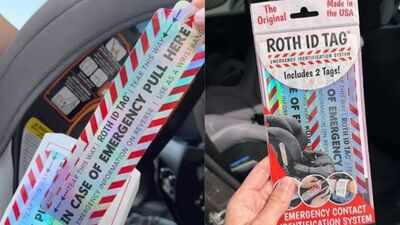
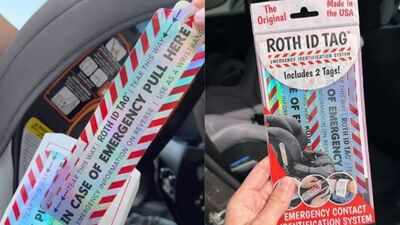
When a serious road accident happens, first responders must make urgent decisions while dealing with injured people, damaged vehicles and incomplete information. For children who cannot explain who they are, even basic details such as their names, allergies and emergency contacts can become crucial.That concern inspired the Roth ID Tag, a child-safety product designed to keep important information close at hand. Attached to a child’s car seat, the tag can be removed and converted into an identification wristband for use during an emergency. Its purpose is simple: help responders identify a child and access essential information when a parent or caregiver cannot speak for them. Behind the product is a deeply personal story involving a devastating road crash, two young survivors and a family determined to prevent another child from facing the same uncertainty.
A winter crash exposed a painful gap
On December 23, 2022, a major multi-vehicle collision on the Ohio Turnpike left families dealing with the consequences of a severe winter-weather incident. Among those caught in the crash were Julie Roth and her two children, Ayla and Rory. According to the account behind the product, Julie died, while both children survived. In the confusion that followed, emergency crews faced the difficult task of helping injured people and moving survivors to medical care. The children were secured in their car seats, but with their mother unable to provide information, responders struggled to establish who they were.The problem did not end when they reached the hospital. Staff needed to identify the children and determine important details about their medical needs and family contacts. The account says hours passed before their identities could be confirmed and their father could be contacted. For the family, the experience highlighted a vulnerability that can arise during large-scale emergencies. A young child may be unable to communicate, a parent may be critically injured, and identification documents may be difficult to locate amid the wreckage. In such circumstances, even a small, accessible record of information could help reduce confusion. Julie’s sister turned that experience into the idea for the Roth ID Tag, aiming to make a child’s essential details easier for emergency personnel to access.
How the Roth ID Tag works
The Roth ID Tag is designed to remain attached to the fabric of a child’s car seat. Before using it, a parent or guardian fills in the designated area with relevant emergency information. Depending on the product’s instructions, this may include the child’s name, emergency contacts and important medical details. If a crash or another emergency separates a child from their caregiver, a first responder can remove the tag and use its tear-off section to create an identification wristband. The wristband is intended to keep key information with the child as they are moved between responders or taken for medical treatment.This matters because information written on a loose piece of paper can be misplaced, while details stored only in a caregiver’s phone may be inaccessible if that phone is missing or the adult cannot be reached. Keeping identification attached to the car seat gives responders a visible place to check. The product also includes a QR code. If the family has registered the child through the Roth ID Tag website, scanning the code can provide access to additional information. The usefulness of that feature depends on registration, connectivity and the information made available through the system, so it should complement rather than replace the details written on the tag.The idea is not to replace emergency medical procedures or official identification systems. Instead, it offers an additional tool that may help responders establish a child’s identity and contact family members during a chaotic situation.
Why a small piece of information can matter
Emergency teams routinely work under pressure, especially when several vehicles and multiple casualties are involved. Identifying a child quickly can help staff match the child with family members and communicate more effectively with caregivers. Accurate information about allergies or other medical concerns may also be relevant to care, although treatment decisions must still be based on professional assessment. Captain Wilhelm of the Bellevue Fire Department in Ohio has praised the concept, saying, “I can recall countless situations where the Roth ID Tag would have made the scenario more manageable.”The endorsement reflects a practical concern for emergency personnel: small measures that make information easier to find can be useful when time and attention are limited. However, a tag cannot guarantee faster identification or a particular medical outcome. Its value depends on whether it has been completed accurately, remains attached and can be read when needed.The product’s design has reportedly received attention from child passenger safety technicians associated with Safe Kids Worldwide, along with recognition for addressing a specific safety need. The supplied account also says that law-enforcement and fire departments, highway-safety organisations and transportation agencies in several states have endorsed it. Families considering the product should check the current details of any endorsement and follow the manufacturer’s instructions for safe attachment and use.
Turning grief into a practical safeguard
The Roth ID Tag grew from a family’s experience of loss and the frightening uncertainty that followed for two surviving children. Rather than allowing that experience to remain only a painful memory, Julie Roth’s sister used it to develop a product aimed at helping other families prepare for emergencies. Its central principle is straightforward: when children cannot identify themselves, their information should be accessible to the people trying to help them. A clearly completed tag cannot prevent a crash, and it should never be treated as a substitute for a properly installed car seat, emergency planning or medical care. But it may provide first responders with a useful starting point when every detail counts.For parents and caregivers, the story is also a reminder to keep emergency contacts and essential medical information current, make sure trusted adults know where to find them, and ensure that children’s safety equipment is used according to its instructions. Sometimes, a small preparation made long before an emergency can help reduce confusion when a family needs answers most.