
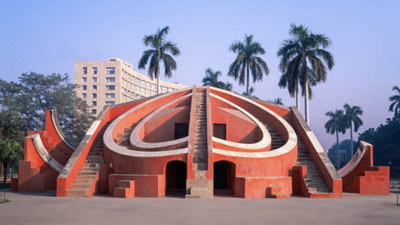
For years, people have come to Delhi’s Jantar Mantar carrying placards, raising slogans and hoping someone in power will listen. Now, with the site no longer designated for protests, the landmark on Parliament Street is back in the news for a different reason. But beyond the headlines, there is another side to this familiar Delhi address that many visitors barely notice.Look past the crowds and the photographs, and you will find giant stone triangles, bowl-shaped structures and open-air cylinders that look more like modern art than centuries-old scientific instruments. They were not built as monuments to admire. They were designed to measure the sky.Jantar Mantar was constructed in 1724 by Maharaja Sawai Jai Singh II, who wanted to improve astronomical observations. Its unusual structures helped observers study the Sun and other celestial objects using geometry, shadows and carefully marked scales. The site is now surrounded by the traffic and buildings of central Delhi, but its scientific ambition remains visible in every strange angle and curve.So, if you are visiting Jantar Mantar, do more than take a photograph and move on. Here are five things to look for and why they are far more interesting than they first appear.Here are five details worth slowing down for.
1. Samrat Yantra : The giant triangle that reads the Sun
The first thing likely to catch your eye is the enormous triangular structure rising above the observatory grounds. It looks almost like a ramp built for giants, but the Samrat Yantra is an enormous sundial.Its central triangular wall is aligned parallel to Earth’s axis. Curved scales on either side allow an observer to read the movement of its shadow and calculate local solar time. The basic principle is familiar: a sundial uses the Sun’s apparent movement to mark time. The striking difference here is the scale at which the idea has been built.Instead of checking a watch, imagine reading time from a shadow cast by a structure taller than many buildings. The details of the markings are easy to miss when visitors focus only on the monument’s size.What to look for: The curved graduated scales on either side of the central wall, where the shadow falls. The instrument was built for measurement, not merely to make an impressive photograph.
2. Jai Prakash Yantra : A bowl that turns the sky into a map
The Jai Prakash Yantra looks like a giant bowl sunk into the ground. Its curved surfaces are marked with lines and divisions, making it one of the observatory’s most unusual structures.The Delhi instrument’s bowl is about 27 feet across at the rim, according to the specialist Jantar Mantar observatories website. Its shape is not decorative: the curved surface helps translate observations of the sky into measurements.What to look for: The engraved divisions inside the bowl and the way the steps and segments are arranged. It is easier to appreciate the instrument when you think of it as a three-dimensional map rather than a sunken courtyard.
3. Ram Yantra: Two open cylinders with a job to do
The Ram Yantra consists of two circular, open-air structures, each with a pillar at its centre. From above, the design looks like a geometric puzzle. From the ground, it is easy to mistake the cylinders for architectural curiosities.Their purpose was to measure the altitude and azimuth of celestial objects. In simpler terms, these are ways of describing where something appears in the sky: how high it is above the horizon and the direction in which it lies.The walls and floors carry graduated markings. An observer could line up a celestial object with the central pillar and use the corresponding point on the marked surfaces to take a reading. The paired design also allowed observations to continue across different sections of the instrument.The specialist Jantar Mantar guide explains how the arrangement works.What to look for: The relationship between the central pillar, the open spaces and the markings on the floor and walls. The empty space is part of the design; the observer needed room to move and take measurements.
4. Misra Yantra: A collection of instruments hiding in one structure
The Misra Yantra is easy to overlook if you are busy photographing the observatory’s more dramatic shapes. But its name offers a clue: misra means mixed, and this structure combines several instruments.According to the Government of India’s Incredible India guide, the instrument was used for astronomical observations, including identifying the shortest and longest days of the year. Its components served different purposes, from working with the Sun’s position to determining the meridian.The larger point is that Jantar Mantar was not one giant sundial. It was a collection of instruments designed to tackle different measurement problems. Understanding that makes the site far more interesting than simply ticking off its most photographed structures.What to look for: The different shapes and measuring surfaces grouped together. Rather than viewing the structure as one object, try to spot how its components appear to perform separate tasks.
5. Agrasen ki Baoli: A different kind of geometry a short walk away
Once you have explored the observatory, head towards Hailey Road to find Agrasen ki Baoli, a historic stepwell tucked among modern buildings near Connaught Place.Its long, symmetrical staircase descends between high stone walls, with rows of arched niches creating a pattern that becomes more striking as you look down. Unlike Jantar Mantar, which uses geometry to observe the sky, the stepwell’s design draws the eye through repeated arches, changing levels and deep shadows.The contrast makes it a worthwhile addition to a central Delhi outing: one site turns mathematical ideas into astronomical instruments; the other shows how geometry can shape a space built around water. Its exact origins are not firmly established, so it is better to appreciate the surviving architecture than repeat popular legends as settled history.For visitors who enjoy unusual structures, photography or simply finding a quieter corner amid central Delhi’s busy streets, it makes a natural companion to Jantar Mantar.What to look for: The repeated arches, the descending steps and the way light changes as you look towards the lower levels.
Why Jantar Mantar deserves a slower visit
Jantar Mantar was built at a time when astronomers relied on carefully observed celestial movements and mathematical calculations. Jai Singh commissioned large masonry instruments because he wanted more precise measurements than existing instruments could provide. The observatory was part of a wider network of similar sites, including Jaipur, Ujjain, Varanasi and Mathura.Yet the site has a modern limitation. Delhi Tourism notes that tall buildings around the observatory now interfere with accurate astronomical observations. The structures remain remarkable examples of scientific design, even though the surrounding urban landscape has changed.There is also a distinction worth remembering amid recent discussion about Jantar Mantar’s role as a protest venue: the historic observatory and the surrounding streets used for public gatherings are not the same thing. A change in the designation of a protest site does not alter the purpose of the astronomical instruments inside the monument.So, the next time you visit, resist the urge to walk through quickly, take a few photographs and leave. Look at the shadows, trace the markings and study the shapes. The real surprise is that these monumental structures were not built simply to be admired. They were built to help people understand the sky.