
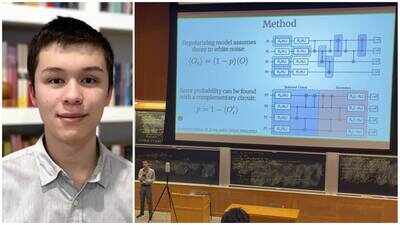
An 18-year-old student from Irvine, California, has been named a 2026 Davidson Fellow and awarded a $25,000 scholarship for developing a quantum computing error mitigation method that could help make quantum computers more reliable and practical for real-world applications, including drug development and materials science, according to his profile on the official Davidson Fellows website.Alexander Miller, who will begin his freshman year at Stanford University this fall, plans to major in computer science and physics. His research project, titled “Universal Quantum Error Mitigation via Random Inverse Depolarizing Approximation,” introduces a method called RIDA, which aims to improve the accuracy of quantum computing results despite the high error rates of current quantum hardware, according to his profile on the official Davidson Fellows website.
Research aims to tackle a major challenge in quantum computing
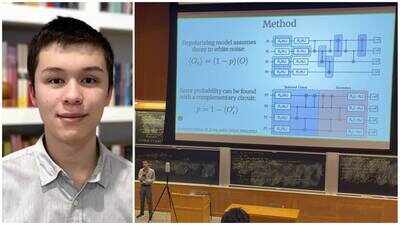
Quantum computers have the potential to accelerate scientific research by performing certain complex calculations that are extremely difficult, or practically impossible, for conventional computers. Their potential applications include simulating chemical systems, supporting the development of new medicines and advancing materials science.However, errors in present-day quantum devices remain a major obstacle to making these capabilities useful on a larger scale. Miller’s research focuses on quantum error mitigation, an approach that attempts to estimate more accurate results from computations affected by hardware errors.His method, Random Inverse Depolarizing Approximation, or RIDA, assumes that errors can be modelled as white noise added to a computation’s result. It estimates the noise rate by rerunning half of the original calculation and reversing the computation. In an ideal, error-free scenario, the process would return to its starting point. The deviation from that point is then used to estimate the noise and calculate an approximation of the error-free result.According to Miller’s project description, RIDA consistently produced lower errors than two leading methods across 100,000 test cases. If its approach proves useful across a wider range of quantum computing applications, it could contribute to efforts to make quantum algorithms more reliable.
Six months of trial and error led to the breakthrough
Miller’s path to developing RIDA involved months of experimentation and refining ideas. He said the greatest challenge was identifying a viable approach that had not already been discovered or outperformed by existing research.During his junior year of high school, he spent six months developing ideas, testing them, analysing unsuccessful results and using what he learned to formulate new approaches.He worked closely with Dr. Soley, who helped him evaluate his ideas against existing error mitigation techniques, navigate scientific literature and refine his testing methods, mathematical derivations and research paper.Miller’s interest in quantum computing research began during his sophomore year of high school, when he joined the Soley Research Group at the University of Wisconsin–Madison. His initial work involved improving an algorithm that enables quantum computers to simulate different chemical states.That experience helped him recognise a central limitation of the technology: despite its promise, quantum computing’s capabilities are constrained by errors in existing hardware. He subsequently focused on developing an algorithmic method to estimate more accurate computational results.
A future at the intersection of computer science and physics
Miller’s academic achievements extend beyond his research. He was named a Regeneron Science Talent Search Scholar for his quantum computing work, earned a bronze medal in the USA Physics Olympiad and reached the Gold Division of the USA Computing Olympiad.He also led his school’s computer science club, where he taught competitive programming and organised practice sessions and events for fellow students.At Stanford, Miller plans to continue exploring the intersection of computer science, mathematics and physics. He hopes to develop algorithms in quantum computing or other fields where these disciplines overlap.His long-term ambition is to help make quantum algorithms more practical, particularly for scientific applications that require sophisticated simulations. More accurate quantum computations could eventually support research into new drugs and materials by allowing scientists to study complex physical systems more effectively.
Miller on being named a Davidson Fellow
Reflecting on the recognition, Miller said he was honoured to be named a Davidson Fellow and viewed the scholarship as an opportunity to showcase his research and connect with other young scientists.“This is an incredible opportunity to showcase my work and be part of a community of other young and motivated scientists,” he said, adding that the projects undertaken by fellow recipients were inspiring and that he was excited to join the community.