
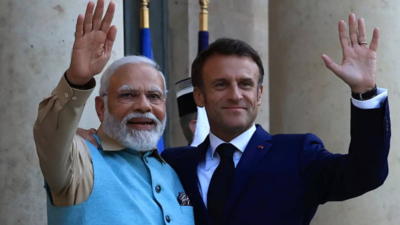
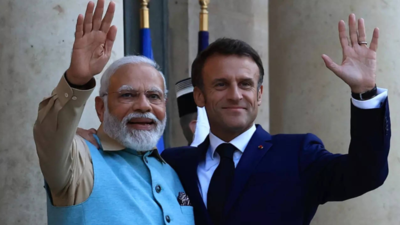
France will ease visa procedures for Indian students and scale up enrolment to 30,000 by 2030, French President Emmanuel Macron said on Wednesday, tracing a reset in how Paris approaches student mobility with India. Speaking at an event at the All India Institute of Medical Sciences, Macron said France currently receives around 10,000 Indian students each year. “We have decided to increase this number to 30,000 by 2030,” he said, positioning students at the centre of the bilateral agenda. The announcement was accompanied by a visa-free transit facility and a commitment to simplify long-term student visas.
Visa rules to match academic timelines
Macron said France will align long-term visas with the full duration of academic programmes, including doctoral studies. “If a PhD takes three years and I give a visa for one year, that is not practical,” he said. “So on the French side, we will clearly streamline this approach in order to have something which meets the expectations and is much more practical for the students and the schools.” The message was administrative rather than symbolic. The focus is on reducing renewals, easing documentation cycles and making France more predictable for students planning multi-year degrees. Macron acknowledged that India was not always a primary source of students for France. “In India, 10–15 years ago, it was not the number one source of students. Let’s be honest,” he said. “So I want our universities and high schools to do much more, but we will do as well much more in terms of administrative facilities.” The recalibration signals competition as well as partnership. As more Indian students look beyond traditional destinations, visa policy becomes a recruitment tool.
AI cooperation shapes the education agenda
Macron’s visit also underlined expanding cooperation in artificial intelligence. Along with Union Health Minister Jagat Prakash Nadda, he inaugurated the Indo-French Campus on AI in Global Health at the All India Institute of Medical Sciences. The campus is designed to promote research and innovation in AI-based healthcare. Macron said India and France want to build their own artificial intelligence models rather than depend entirely on the United States or China. He stressed the need for investment in computing power, talent and capital. He also referred to the AI Impact Summit in New Delhi, saying responsible and ethical use of artificial intelligence can support disease detection, energy transition and productivity gains.
What this means for students
The headline number is 30,000 by 2030. The operational shift is in visa processing and administrative ease. If implemented as described, longer-duration visas could reduce annual renewal pressures for doctoral and postgraduate students. A visa-free transit facility may ease travel logistics. Closer institutional links could expand recruitment networks in India. For Indian students weighing options, the offer is structured around predictability and scale. The policy details will determine how quickly the target of 30,000 becomes a pipeline rather than a promise.