
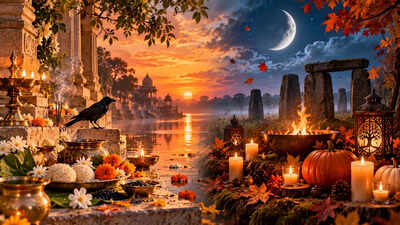
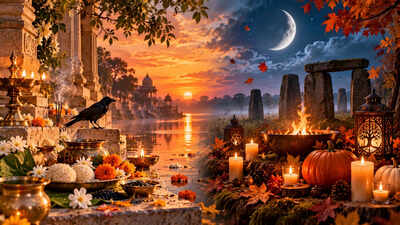
Something happens across the world as summer fades. The harvest comes in. The days shorten. And in culture after culture, people turn their thoughts toward those who came before them.India will soon finish one of these seasons. Mexico, Ireland and many other places are about to begin theirs. Here’s a look at how different traditions honour their ancestors in the same few weeks of the year.
Pitru Paksha: India’s Fortnight for the Ancestors
Pitru Paksha means “the fortnight of the ancestors.” In 2026, it will run from late September to October 10.For these fifteen days, Hindu families offer water mixed with black sesame seeds to departed relatives. They prepare simple vegetarian meals and set aside portions for cows, dogs and especially crows. Crows are believed to carry food to the ancestors. If a crow eats the offering, many families take it as a sign the ancestors are pleased.The final day, Sarva Pitru Amavasya, honours all ancestors at once. Families who don’t know the exact date of a relative’s passing perform rituals then.And the very next morning, Navratri begins, a nine-night festival honouring the Divine Mother. So India moves straight from mourning into celebration, from remembering the dead to welcoming the goddess.
Pchum Ben : Cambodia’s Festival of the Dead
Around the same time, Cambodia observes Pchum Ben, a 15-day Buddhist festival. Families visit pagodas with offerings of rice and sticky rice balls for spirits of the deceased.Some believe that wandering spirits without families also come looking for food during this time. So offerings are made for them too, not just for one’s own relatives. It’s a quiet, generous idea: no soul should go hungry.
Samhain: The Celtic Thinning of the Veil
Samhain, pronounced “sow-in,” falls on October 31 into November 1. Originally, it was a Celtic festival to mark the end of the harvest season and the beginning of winter.The ancient Celts believed the boundary between the living and the dead grew thin at Samhain. Spirits could cross over more easily. Families set extra places at the table and left food out for ancestors who might visit.Many modern Halloween customs come from Samhain. Costumes were once a way to disguise oneself from wandering spirits. Today, many pagan and spiritual communities still celebrate Samhain as an ancestor festival.
Día de los Muertos : Mexico’s Joyful Reunion
On November 1 and 2, Mexico celebrates Día de los Muertos, the Day of the Dead. It’s not a sad holiday. Families build ofrendas, home altars covered in photos, candles, sugar skulls and the favourite foods of loved ones who have died.Bright orange marigolds line the paths to the altars. Their colour and scent are believed to guide spirits home. Here’s a lovely link: marigolds are also used heavily in Hindu rituals, strung into garlands for temples and festivals across India.
All Saints’ and All Souls’ Days
In many Christian traditions, November 1 is All Saints’ Day and November 2 is All Souls’ Day. Families visit cemeteries, clean graves and light candles. In parts of Europe and Latin America, entire cemeteries glow with candlelight on these nights.
What These Traditions Share
Look closely, and the same ideas appear again and again.Food comes first. Whether it’s rice balls in Cambodia, sesame water in India, pan de muerto in Mexico or a plate set aside at a Samhain supper, feeding the dead is a near-universal gesture of love.Nature plays a role too. Crows in India. Marigolds in Mexico and India both. The harvest’s end in Ireland. These traditions are tied to the turning of the seasons.And names matter. In every one of these practices, ancestors are remembered by name. Speaking a name keeps a memory alive.
A Simple Way to Honour Your Own Ancestors
You don’t need to belong to any of these traditions to borrow their spirit.Pick an evening this season. Set out a photo of someone you’ve lost. Light a candle beside it. Cook a dish they loved, even something simple, and set a small portion aside.Then say their name out loud and share one memory with your family. Kids especially love hearing stories about grandparents or great-grandparents they never met.It takes fifteen minutes. And it connects you to a practice humans have shared for thousands of years.