
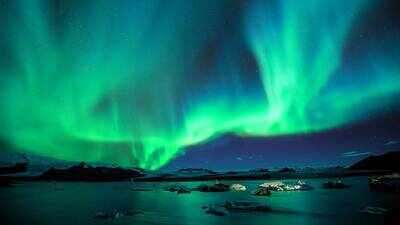
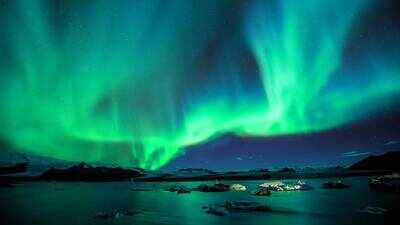
The northern lights could put on another show across parts of the United States and Canada this week as a coronal mass ejection (CME) linked to a long-duration M1.4 solar flare heads toward Earth.NOAA’s Space Weather Prediction Center has issued a G2 (moderate) geomagnetic storm watch for October 9, forecasting G1 (minor) to G2 conditions as the CME reaches Earth. The eruption originated from active region AR4549 on the Sun on October 6.The forecast could give skywatchers another opportunity to see the aurora borealis, particularly across northern parts of the US and Canada. However, visibility will depend on the strength and timing of the storm, local weather and darkness.
CME from M1.4 solar flare heads toward Earth
The solar activity began with a long-duration M1.4-class flare from AR4549 on October 6. NOAA’s forecast discussion said the flare was accompanied by a Type II radio sweep and a CME first observed in imagery from the Solar and Heliospheric Observatory.The Solar Influences Data Analysis Center said the CME was detected as a faint, almost full-halo eruption and estimated its projected speed at about 560 kilometres per second. The centre said preliminary analysis indicated an Earth-directed component, with an expected arrival on October 9.NOAA subsequently issued its G2 storm watch, saying G1 to G2 geomagnetic storms were likely on October 9 because of the CME associated with the M1.4 flare.
When could the northern lights appear?
Current forecasts point to the most promising period being overnight Thursday, October 8, into Friday, October 9.NOAA’s forecast indicates geomagnetic activity could begin increasing around 11 p.m. ET Thursday, with conditions potentially reaching G2 levels around 5 a.m. ET Friday.The exact arrival time of a CME can change as scientists receive additional solar-wind observations, so the forecast should be treated as a window rather than a guaranteed schedule.A G1 storm generally favours higher-latitude regions, while a G2 storm can push the auroral oval farther south.
Which US states could see the aurora?
Under weaker G1 conditions, the best opportunities are expected across Alaska, Canada and the northern tier of the US, including states such as Washington, Idaho, Montana, North Dakota, South Dakota, Minnesota, Wisconsin, Michigan, Maine, Vermont and New Hampshire.If geomagnetic activity reaches G2 levels, the aurora could potentially become visible farther south, with forecasts including areas of Oregon, Wyoming, Nebraska, Iowa, Illinois, Indiana, Ohio, Colorado, Pennsylvania and New York among the possible viewing regions.The farther south the auroral oval expands, however, the more important darkness and clear skies become.
Why does a solar storm create the northern lights?
The aurora borealis occurs when charged particles from the Sun interact with Earth’s magnetic field and upper atmosphere.As these energetic particles collide with gases in the atmosphere, they transfer energy to atmospheric atoms and molecules. When that energy is released, it produces the glowing colours associated with the northern lights.Green is the most commonly observed colour, although stronger displays can produce red, pink, purple and other hues.Whether those colours are visible from a particular location depends on the storm’s strength, the position of the auroral oval, cloud cover, light pollution and the darkness of the sky.
How to watch the northern lights
For anyone hoping to catch the display, the best strategy is to get away from city lights and find a location with a clear view toward the northern horizon.A dark location is especially important because weaker auroras can be difficult to see with the naked eye even when they are present.Skywatchers should also monitor NOAA’s real-time aurora forecasts and local weather conditions before heading outside. The forecast can change as the CME approaches and interacts with Earth’s magnetic field.The Weather Network also noted that the timing of the predicted storm could favour parts of Canada, although cloud cover will ultimately determine whether observers can see anything.
Your smartphone could capture what your eyes miss
You do not need professional photography equipment to photograph the aurora.A smartphone’s Night Mode can sometimes capture colours that are difficult to distinguish with the naked eye, particularly during weaker geomagnetic storms. A tripod or other stable surface can help because night photography often uses longer exposures.For cameras with manual controls, increasing exposure time and keeping the device steady can improve the chances of recording faint auroral activity.Still, the most important ingredient is location: a dark sky with a clear northern horizon gives observers the best chance of seeing and photographing the show.For the latest conditions, skywatchers should continue checking NOAA’s aurora and space-weather forecasts as the October 8-9 CME encounter approaches. The CME’s precise arrival and the resulting geomagnetic response remain subject to change.