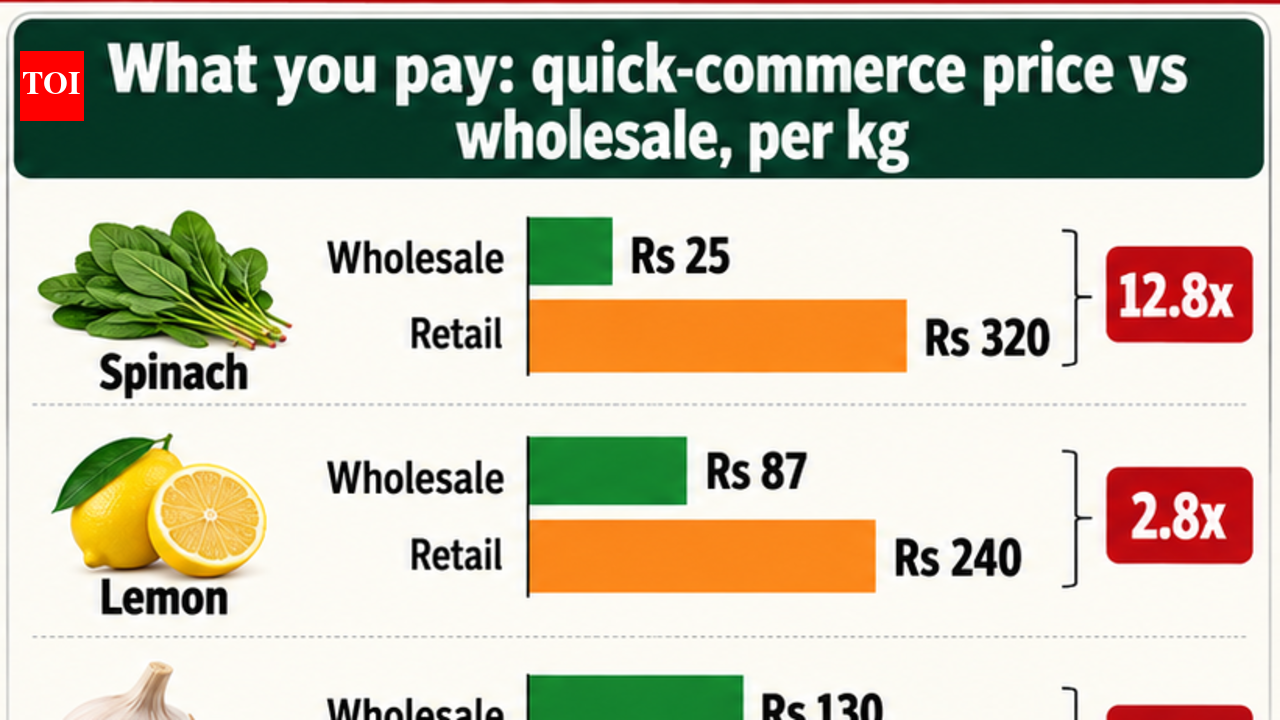
Nagpur: Vegetable prices have skyrocketed in the city as scanty rainfall has hit yields, widening the demand-supply gap. According to traders, prices of some vegetables have risen by over 250% compared with the same period last year at Nagpur’s wholesale market.With middle-class incomes barely rising in single digits, the sharp increase in vegetable prices is burning a hole in the common man’s pocket.An analysis of average prices at Kalamna’s Nagpur Agricultural Produce Market Committee (APMC) for Sept this year and last year showed a sharp increase, driven by the supply squeeze caused by poor rainfall.Traders said the situation could worsen if the water shortage persists. “These are the initial days of drought, and we are witnessing a drop in supply. If water scarcity worsens, supply will shrink further, leading to higher inflation,” a wholesaler told TOI.The wholesale price breakdown shows onion rising from Rs 14 to Rs 46 a kg, a 229% increase. Garlic has risen from Rs 52 to Rs 130, up 150%, while lemon has jumped from Rs 24 to Rs 87 a kg, a 263% increase.“There was less water due to scanty rain this year in major producing belts, reducing crop yield. Even local suppliers are not able to provide sufficient stock. Current supplies are down by half compared with last year,” said Mohd Aquil Khan, a Kalamna APMC trader who deals mostly in potato and onion.Khan said produce from southern states, which normally starts reaching the yard from October, is also in short supply this year. “It is coming, but in smaller quantities and of poor quality. We expect fresh stock from the southern states in the coming days, which may ease the price pressure a bit,” he said.APMC records show a fall in the supply of items sold in large volumes. Average daily arrivals of white onion dropped 28%, from 1,113 quintals to 806, while red onion arrivals fell 16%, from 1,116 quintals to 939.Khan said prices may climb further if supply stays low. “If the situation does not improve, vegetable prices will go up. Crop produce is very low in many places, and drought has worsened the situation,” he said. Akola, Khamgaon and Chhatrapati Sambhajinagar are among the worst-hit areas, he added.The jump in wholesale prices has pushed retail prices up manifold. Retailers said higher fuel prices and other expenses have raised transportation and other costs, leaving them with no option but to increase retail prices. Retail rates usually exceed wholesale rates by about Rs 10 a kg.Weekly markets across the city are also feeling the heat. Vendors said customers are reluctant to buy at high prices. “Wholesale prices are already high, and even with a minimum margin we cannot find buyers, as people come to weekly markets expecting lower prices and better deals,” said Vijay Kesharwani, a vegetable vendor.Not every item is dearer. Spinach fell 62%, from Rs 65 to Rs 25 a kg, brinjal fell 41%, from Rs 21 to Rs 13, and potato fell 23% to Rs 9.50 a kg. Khan said green vegetables such as spinach, which turn cheaper every winter, will also become dearer this year because of the lack of rain.Quick-commerce platforms in Nagpur, meanwhile, listed spinach at Rs 320 a kg on Tuesday, garlic at Rs 280, lemon at Rs 240 and white onion at Rs 116. The September wholesale averages were Rs 25, Rs 130, Rs 87 and Rs 50 respectively. Spinach costs about 13 times its wholesale rate on the apps. These rates fluctuate, and garlic, lemon and spinach were priced from 200-gram packs, which cost more per kg.Revenue minister Chandrashekhar Bawankule, who chairs the cabinet sub-committee on drought, said on Monday that soybean, tur, cotton and maize crops had been lost and that the rabi crop would not come.Staples costly tooStaples are also costlier at Nagpur’s Kalamna market. Average wholesale prices for Sept 2026, compared with Sept 2025, show tur rising 47%, from Rs 57.94 to Rs 85.43 a kg, the steepest increase among these items. Gram (chana) is up 16%, from Rs 54.61 to Rs 63.22. Among grains, local wheat has risen 14%, from Rs 23.48 to Rs 26.79, and soybean 12%, from Rs 44.09 to Rs 49.51. Sharbati wheat, the costliest variety, is up only 6%, from Rs 33.50 to Rs 35.43.Note: The rates are wholesale and exclude transport and retail margins. Because the APMC published rates on fewer days in September last year than this year, monthly averages have been used instead of a single day’s price.