
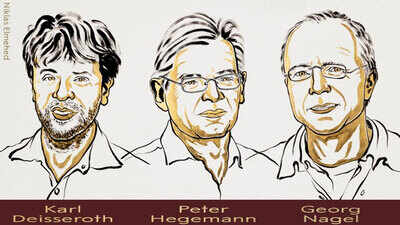
The 2026 Nobel Prize in Physiology or Medicine has been awarded jointly to Karl Deisseroth, Peter Hegemann and Georg Nagel for their discoveries concerning light-gated ion channels and optogenetics. The Nobel Assembly at Karolinska Institutet announced the award on October 5, 2026.The three scientists’ work established the foundations of optogenetics, a method that allows researchers to control nerve cells using light and investigate how neural circuits influence memories, feelings and behaviour. The prize carries an award of 12 million Swedish kronor, which will be shared equally among the three laureates.
Meet Karl Deisseroth
Karl Deisseroth, born in 1971, is associated with the Howard Hughes Medical Institute and Stanford University in the US. He is the D.H. Chen Professor and Professor of Bioengineering and of Psychiatry and Behavioral Sciences at Stanford.Deisseroth earned his Ph.D. in 1998 and MD in 2000 from Stanford University. His contribution to the Nobel-recognised work came when he introduced the gene for channelrhodopsin into rat nerve cells. By exposing the modified cells to blue light, he demonstrated that nerve signals could be triggered.In 2007, he demonstrated that the light-controlled switch could also be used in the brains of living mice.
Meet Peter Hegemann
Peter Hegemann, born in 1954, is Hertie Senior Professor of Neuroscience at Humboldt University of Berlin, Germany. He received his Ph.D. in 1984 from the Max Planck Institute for Biochemistry in Martinsried.Hegemann’s research began with a question about how the single-celled alga Chlamydomonas moves towards light. His work led to the identification of channelrhodopsin, a protein that responds to blue light by opening a channel through which charged ions can flow.The prize-recognised discoveries were made at the Max Planck Institute for Biochemistry.
Meet Georg Nagel
Georg Nagel, born in 1953, is Professor of Molecular Plant Physiology at the University of Würzburg, Germany. He received his Ph.D. in 1988 from the University of Frankfurt.Nagel worked with Hegemann on channelrhodopsin, the light-sensitive protein found in Chlamydomonas. Their research showed that the protein could make other cells responsive to light.Nagel’s prize-recognised discoveries were made at the Max Planck Institute for Biophysics in Frankfurt.
How their work changed neuroscience
The discoveries by Hegemann and Nagel provided the light-sensitive protein, while Deisseroth developed its use as a controllable switch in nerve cells. This approach became known as optogenetics.Researchers can use optogenetics to investigate neural circuits associated with specific memories, feelings and behaviours. The method is also being studied in clinical research, including attempts to restore sight in people with visual impairment.The Nobel Assembly said optogenetics has changed the study of the brain by enabling researchers to investigate relationships between nerve-cell activity and behaviour with greater precision.