
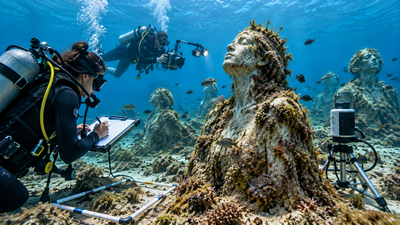
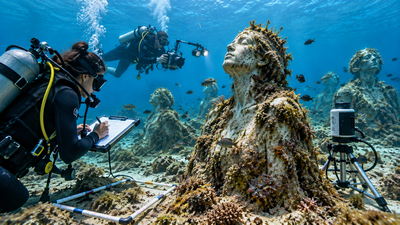
Five marble statues stand on the seabed of the Baia del Cannone, off Talamone in Grosseto, Tuscany, in the Northern Tyrrhenian Sea. They were placed there on 19 September 2024 as part of an initiative run by the association Casa dei Pesci. According to the study published in the MDPI journal titled ‘Early Biodiversity Responses to Underwater Marble Sculptures Deployed as Artificial Reefs: First Scientific Assessment of a Conservation Initiative in the Northern Tyrrhenian Sea’, underwater installations were conceived primarily to enhance habitat heterogeneity, support conservation outreach and promote community engagement. What the authors call the “first systematic scientific assessment” of an art-based marine conservation initiative. Researchers from the University of Siena and partner organisations monitored the site for one year.
How are Italy’s underwater marble sculptures becoming artificial reefs
According to the authors, Mediterranean coastal ecosystems are affected by habitat degradation and loss of structural complexity. The pressures they list include climate change, coastal development, pollution, overexploitation and destructive fishing practices. In the Talamone area, additional local pressures include episodes of illegal bottom trawling. Casa dei Pesci, a non-profit association, has deployed concrete anti-trawling blocks along the coast to deter that activity. The paper states that the marble sculptures serve a different primary function: habitat enrichment, biodiversity enhancement and environmental awareness.The bay already hosted two marble sculptures, deployed at greater depth in 2016. A further 22 underwater marble sculptures lie beneath the Rocca di Talamone and in front of the “Bagno delle Donne”, and together these installations form the local underwater museum. Earlier artistic deployments in the bay were not monitored systematically, so the new work establishes a quantitative ecological baseline. The research was funded by the European Social Fund Plus 2021–2027 under the Giovanisì programme of Regione Toscana, within the project VESPESCA.
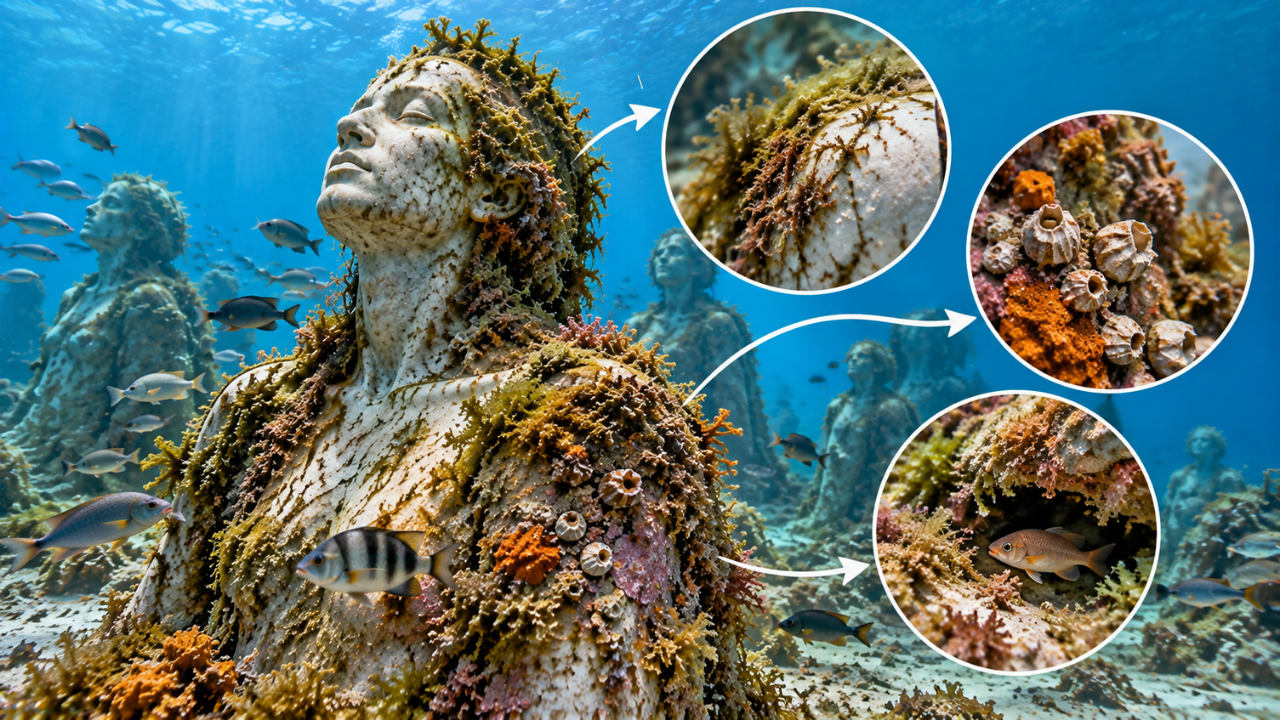
Image AI generated
How did scientists monitor Italy’s underwater marble sculptures
The five monitored sculptures are S1, “Cimitero senza nome”; S2, “Guardiano”; S3, “Sigillo”; S4, “Genesi”; and S5, “Porta per gli abissi”. According to the study, each was carved from a marble block with an approximate initial weight of 12 tonnes. They were deployed from a pontoon with the help of scuba divers and arranged in two rows, approximately 7 metres from each other. The site lies at 5.5–6.5 metres depth on soft-bottom habitat, selected to be free of Posidonia oceanica meadows.Surveys took place on 19 September 2024, then on 4 March, 19 June, 7 August and 18 October 2025. At each visit, the team laid three 20-metre transects and collected five 50 × 50 cm photoquadrats along each. Fish were counted within 3 metres on either side of every transect line, a surveyed area of 120 square metres per transect. Divers also inspected each sculpture for two minutes, covering exposed surfaces and the underside, and recorded the taxa they saw as presence-only data. Underwater visibility during the surveys ranged from 3 to 7 metres.
What marine life is colonising Italy’s underwater marble sculptures
The authors write that the qualitative surveys on the sculptures offered the most direct indication of ecological change linked to the intervention. Community composition differed according to both survey date and microhabitat, with exposed surfaces and sheltered undersides following different trajectories. On exposed surfaces, Padina pavonica, Balanus perforatus, Sertularella sp., Cratena peregrina and Arbacia lixula had become more frequent by October 2025. The study notes that the joint appearance of hydroids and the nudibranch C. peregrina suggests the surface had begun to support early trophic relationships. Sculpture S1 showed the largest increase on exposed surfaces, rising from 4 taxa in March 2025 to 15 in October 2025.Undersides changed more slowly. Their turnover was lower and driven mainly by the cardinalfish Apogon imberbis and the sea cucumber Holothuria poli. The authors point out that A. imberbis is closely associated with shaded cavities and sheltered microhabitats, and they read its later presence as a sign that the undersides had become suitable as refuge habitat. The difference between surface and underside was weak at the first post-deployment survey and became stronger from June 2025 onward. The maximum richness recorded on undersides in October 2025 was 6 taxa.
How did fish assemblages change around the underwater marble sculptures
Total fish abundance, species richness and Shannon diversity did not differ significantly among survey dates, according to the study. Assemblage composition did. The silverside Atherina hepsetus contributed most to the difference between the deployment survey and March 2025, being present at deployment and absent in March. By October 2025, the assemblage was characterised by higher abundances or the appearance of Coris julis, Diplodus vulgaris, Sarpa salpa, Mullus barbatus and Serranus scriba. On the surrounding seabed, photoquadrats showed turf, Caulerpa prolifera, bare substrate and Posidonia oceanica as the dominant components, with limited temporal change. The authors report that the sculptures did not produce detectable short-term changes in the composition of the surrounding benthic cover.The authors describe the work as a pilot-scale assessment, covering only the first year after deployment at a single site with three transects and no independent control area. They state that survey date covaries with season and time since deployment, so the fish pattern cannot be read as a response to the sculptures alone. Fish size was not recorded, and large schools were estimated visually. The paper adds that artificial reefs may also generate ecological trade-offs, including the facilitation of non-indigenous species, and that longer-term monitoring is required. The conclusions describe the marble installations as small artificial reef units capable of increasing local habitat heterogeneity in soft-bottom coastal environments.