
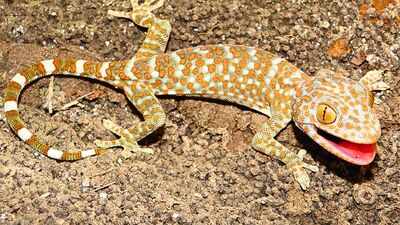
The tokay gecko is one of the largest geckos found across tropical parts of Asia. It is known for its blue-grey body marked with red or orange spots. It is a striking animal that is active mainly at night. The species lives naturally in rainforests, where it climbs trees and cliffs, but it can also adapt to rural human settlements.Tokay geckos are strong climbers and can hold their bodies against vertical surfaces with their foot pads. They feed on insects and small vertebrates and are known for a loud call that has shaped the animal’s common name. Their behaviour can be defensive, as they are generally aggressive and territorial and can deliver a powerful bite.
Tokay gecko: Size, habitat, diet and key characteristics
| Feature | Details |
| Scientific name | Gekko gecko |
| Common name | Tokay gecko |
| Distribution | Northeast India, Bhutan, Nepal, Bangladesh and parts of Southeast Asia, including Cambodia, Thailand, the Philippines, Malaysia, Vietnam and Indonesia, extending towards western New Guinea |
| Native habitat | Rainforests, trees and cliffs |
| Size | Usually 25-30 cm long, including the tail; some can reach 40 cm |
| Appearance | Blue-grey body with red or orange spots and speckles |
| Body structure | Cylindrical but somewhat flattened body, large head, muscular jaws and a semi-prehensile tail |
| Eyes | Vertical pupils |
| Diet | Insects and small vertebrates |
| Breeding | Females lay clutches of one or two hard-shelled eggs and guard them until they hatch |
| Call | Males produce a loud mating call described as ‘tokay’, ‘token’, ‘gekk-gekk’ and similar sounds |
Understanding the key features of the tokay gecko
Habitat
The tokay gecko is found across a wide part of tropical Asia. Its range includes northeast India, Bhutan, Nepal and Bangladesh, as well as several countries in Southeast Asia. It occurs in Cambodia, Thailand, the Philippines, Malaysia, Vietnam and Indonesia and extends towards western New Guinea. Its native habitat is mainly rainforest, where it lives on trees and cliffs. The gecko can also adapt to rural human settlements.
Physical features
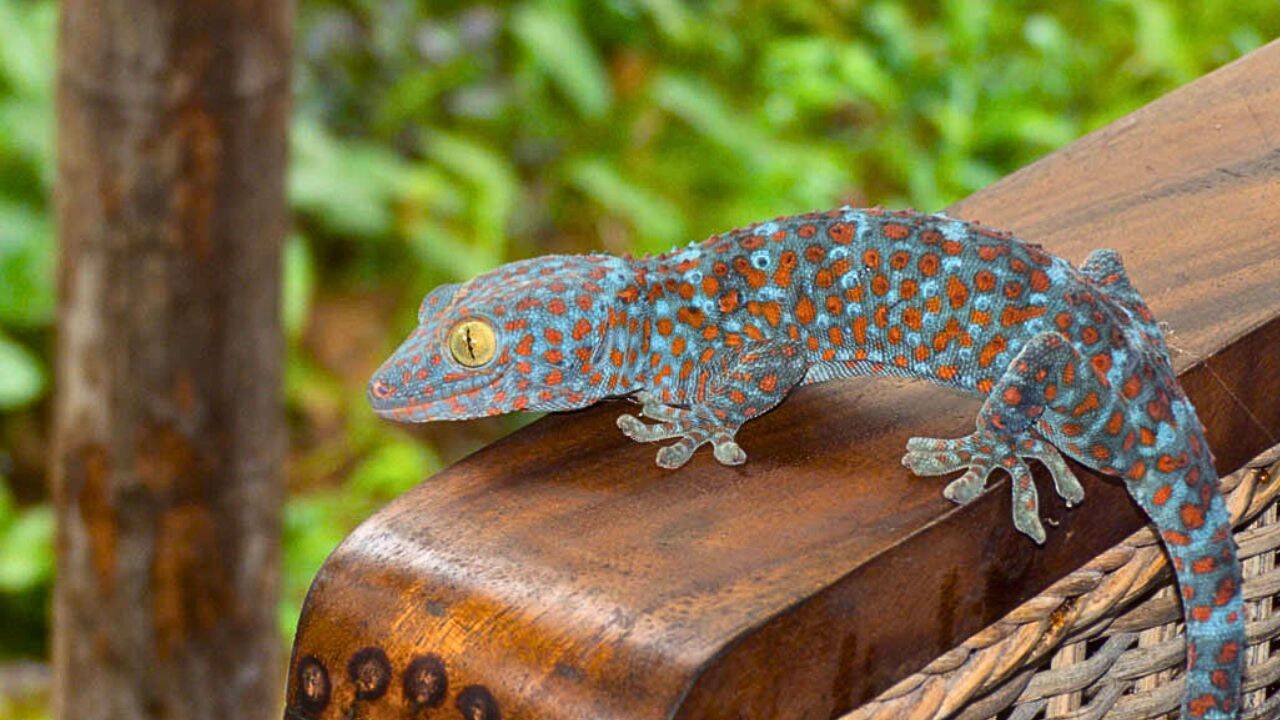
The tokay gecko is a large gecko that usually measures between 25 and 30 cm from the head to the end of the tail. Some individuals can grow to around 40 cm. Its body is cylindrical but somewhat flattened, giving it a robust appearance. It has a large head, muscular jaws, and a semi-prehensile tail. Males are generally slightly larger than females and are also more brightly coloured.
PC: Wikipedia
Colour and appearance
The tokay gecko has soft skin that is generally blue-grey and covered with red or orange spots and speckles. Its strong colour pattern makes it easy to distinguish from many other geckos. The species can also change the colour of its skin to blend into its surroundings. Males are usually more brightly coloured than females. The animal has vertical pupils and a sturdy body.
Climbing ability
The tokay gecko is a powerful climber. Its foot pads allow it to support the entire weight of its body against a vertical surface for a long period. This ability helps the animal move across trees, cliffs, and structures around human settlements. Its climbing lifestyle fits its natural rainforest habitat, where trees and other vertical surfaces provide places to move and search for food. The species also has a semi-prehensile tail, which adds to its distinctive body structure.
Diet and prey
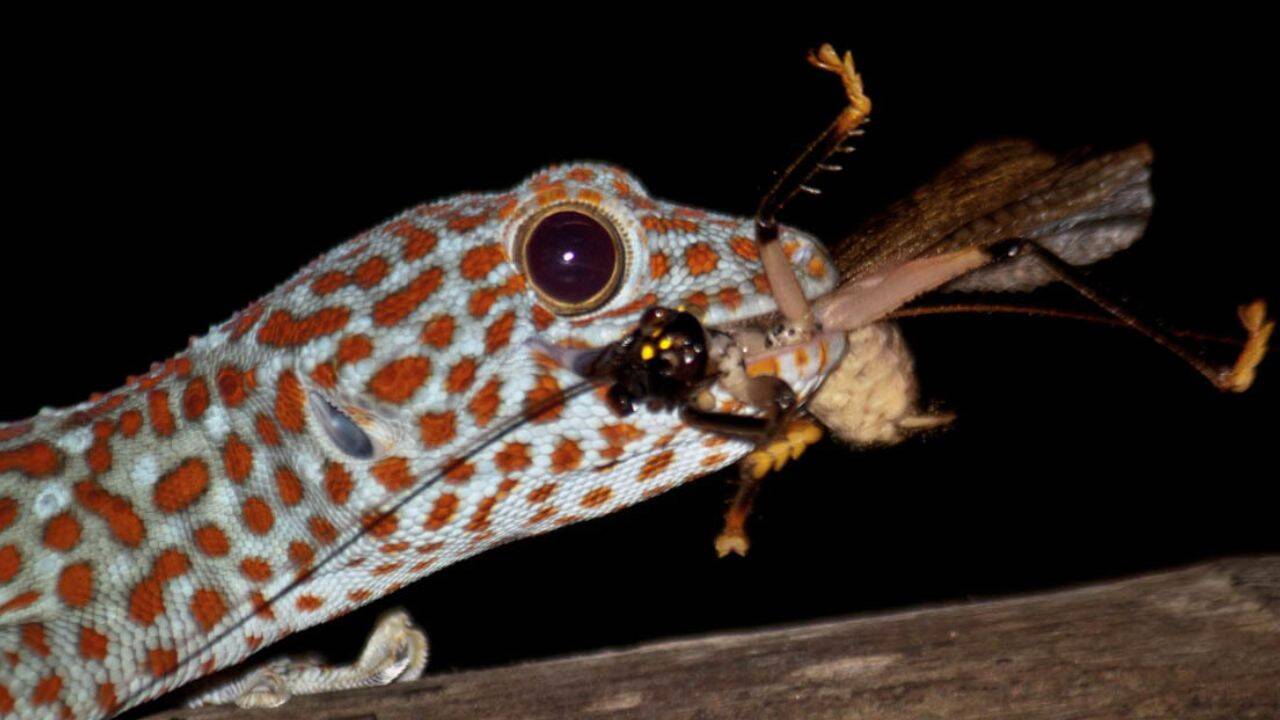
The tokay gecko feeds mainly on insects and small vertebrates. Insects are among its food, while observations have also recorded small vertebrate prey. In captivity, the species can eat springtails, mealworms, cockroaches, crickets, grasshoppers, locusts, and pink mice. In one area of Thailand, males, females, and juveniles showed little difference in their diets. In southern Florida, roaches, caterpillars, spiders, and beetles were among the prey most commonly found in their stomachs.
PC: Wikipedia
Breeding behaviour and parental care
Female tokay geckos lay clutches of one or two hard-shelled eggs and guard them until the young hatch. Communal nesting has also been observed, with several adults guarding a group of eggs. During breeding, pairs can form temporary family groups and care for their young.They can also recognise their mates and offspring by smell. Together, these behaviours show that tokay geckos have a more involved approach to breeding and caring for their young.
The strange calls tokay geckos make when mating or threatened
The tokay gecko is named after the loud mating call produced by males. The sound has been described in several ways, including ‘tokay’, ‘token’, ‘gekk-gekk’, ‘tuck-too’ and similar forms. The call is usually preceded by a quick cackling sound. When threatened, the gecko can instead produce a barking sound while taking a defensive posture.Light and temperature can affect its vocalisations. The most frequent calling occurs around dusk, with another peak around dawn.
Conservation and protection of the tokay gecko
The tokay gecko faces pressure from hunting and trade in parts of Asia. It is collected for medicinal trade and is used in traditional Chinese medicine, although the health claims associated with it are not substantiated by medical science.The species has also faced intensified poaching linked to short-lived beliefs about its medicinal value. In the Philippines, indiscriminate hunting has contributed to concern about the species. The tokay gecko is listed under CITES Appendix II, which means international trade in the species and its parts is subject to the CITES permitting system.