
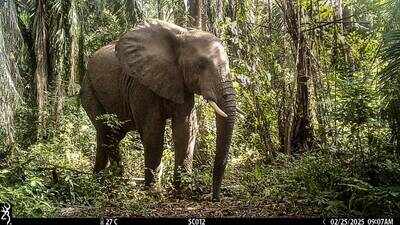
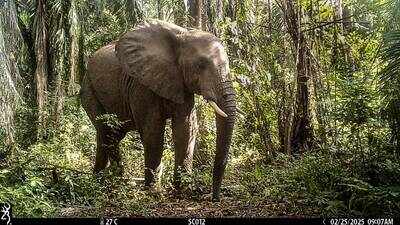
African savanna elephants in southern Tanzania are exhibiting an unusual behaviour rarely associated with the massive animals: climbing steep mountain slopes and moving between vastly different habitats in their search for food, water and seasonal resources.As many as 1,000 elephants spend part of their time in the Udzungwa Mountains, navigating steep slopes covered in lush, closed-canopy rainforest. Some also travel from the mountains across the Kilombero Valley to more typical savanna habitat in Nyerere National Park.Trevor Jones, director of strategy and development at the Southern Tanzania Elephant Program (STEP), told Mongabay that the elephants are remarkably capable climbers.“They go everywhere,” Jones said, explaining that the animals can negotiate surprisingly steep gradients and, during the rainy season, have even been seen sliding down particularly steep slopes.
Elephants move between forests, mountains and savanna
Elephants navigate steep rainforest-covered slopes reaching more than 6,500 feet above sea level. (Photo: Udzungwa Mountains National Park)
Researchers believe the elephants’ movement across different landscapes is closely linked to seasonal changes in food and water availability.Jones described the population as highly adaptive, using a mosaic of habitats that includes montane forest, lowland forest, miombo woodland and open bush in Nyerere National Park. During droughts, the mountains can provide food when lower-lying areas become too dry.One important food source is native bamboo, which grows at elevations of around 2,000 metres (more than 6,500 feet) above sea level.But the elephants’ traditional movements across the landscape have increasingly brought them into conflict with people.Around 50 years ago, the area was connected by continuous lowland rainforest. Since then, much of the forest has been cleared and the Kilombero Valley converted to farmland. Elephants crossing agricultural areas along their established routes have consequently come into conflict with farmers.
Tanzania protects first official wildlife corridor
One major response has been to restore a route between the elephants’ mountain and lowland habitats.After seven years of preparation, meetings and negotiations involving conservationists, government officials and local residents, Tanzania designated the Nyerere-Udzungwa Wildlife Corridor (NUWC) in April 2025. According to STEP, it is the country’s first wildlife corridor to receive official protection.The corridor is intended to give elephants a safer route between Nyerere National Park and the Udzungwa Mountains National Park while reducing the need for them to cross farmers’ fields.The protected route is about 14 kilometres (8.7 miles) long and only 200 metres (656 feet) wide. It stretches across the Kilombero Valley, connecting Nyerere National Park and the adjoining Magombera Nature Forest Reserve in the east with Udzungwa Mountains National Park in the west.
Hundreds of landowners compensated
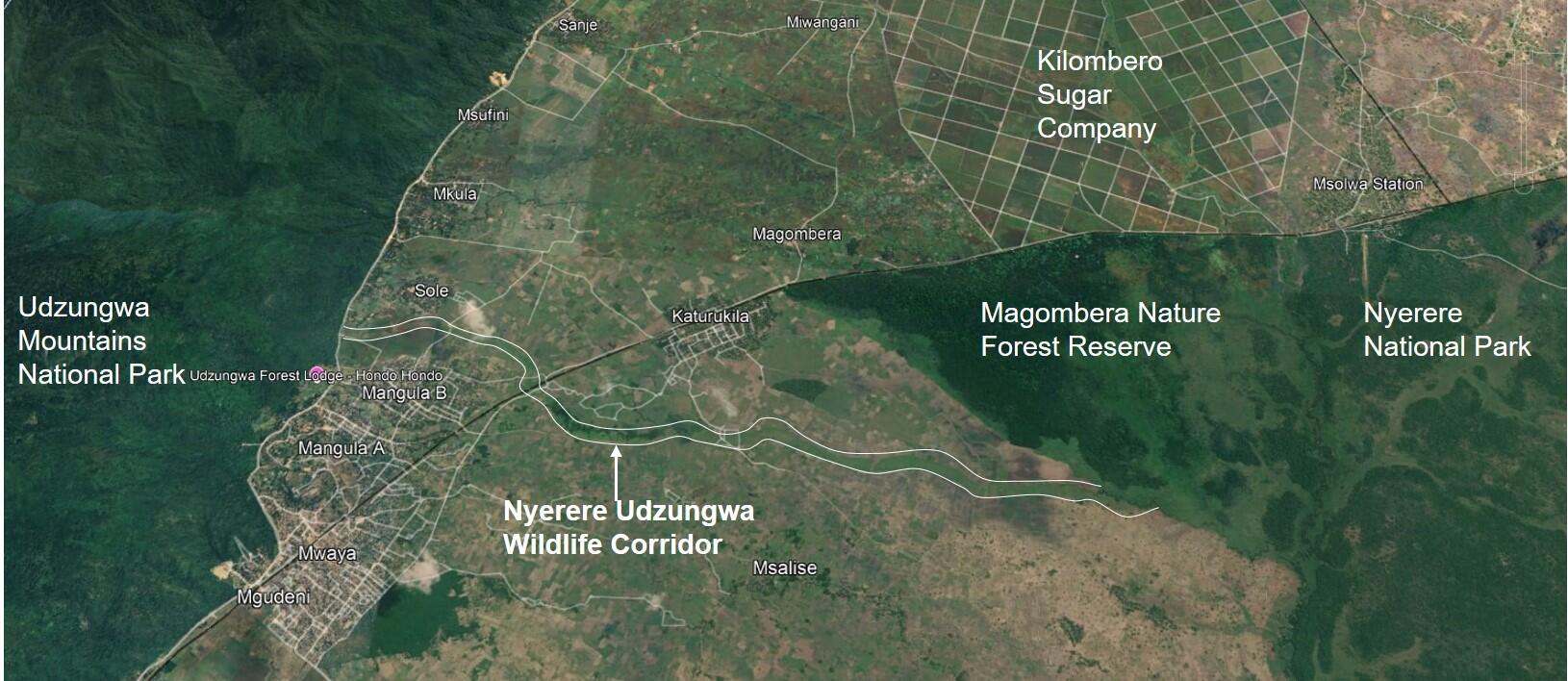
The protected corridor reconnects elephant habitats across Tanzania’s Kilombero Valley. (Photo: Reforest Africa/Google Earth)
The route was selected with input from local communities. According to STEP, 368 landowners were compensated nearly 2.2 billion Tanzanian shillings, equivalent to about $880,000 at the time, for surrendering parcels of between 1,000 and 2,000 square metres of land.The corridor is supported by conservation organisations including Italian NGO Fondazione Capellino, US-based Saving Nature and Denmark’s Hempel Foundation.Fencing is also being installed to help guide elephants into the designated route as they move between habitats.The corridor connects two important areas of elephant habitat and could help restore part of the animals’ historical range, while also creating an opportunity to rewild portions of the valley floor.
Camera traps recorded 529 elephants
Conservationists have been monitoring which animals use the newly protected route.STEP and partner organisations, including Lion Landscapes, installed 59 cameras at intervals of about 500 metres along the corridor in November 2023. During the following 15 months, the cameras recorded at least 1,440 mammals using the route, including 529 elephants, according to STEP.Other species photographed included bushbuck, buffalo, servals, honey badgers, Sykes’ monkeys, Harvey’s red duikers and Cape clawless otters.George Lohay, an ecologist and head scientist at the Grumeti Fund, said connected habitats are important because elephants rely on different areas during different seasons and know where resources such as mineral-rich salt licks are located.Elephants are capable of travelling vast distances. Lohay recalled that his doctoral research identified genetic similarities between elephants in northern Tanzania’s Tarangire National Park and those more than 700 kilometres away in Ruaha National Park, suggesting the populations were once part of a much larger connected group.
Reforestation aims to restore the valley
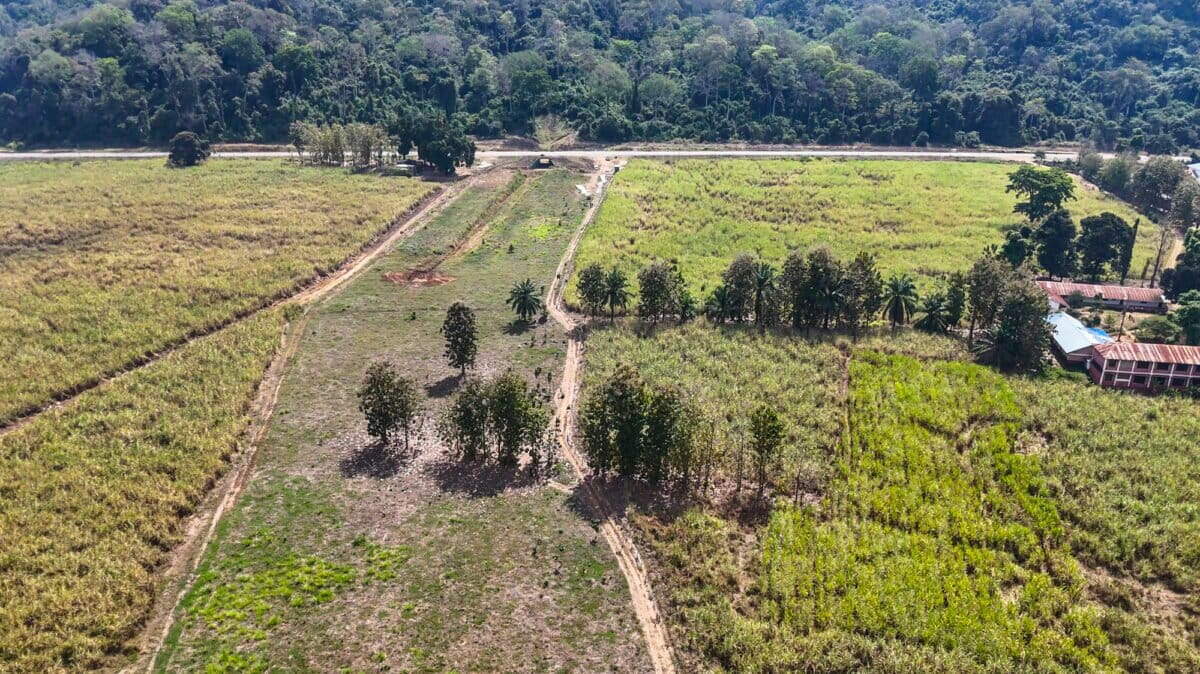
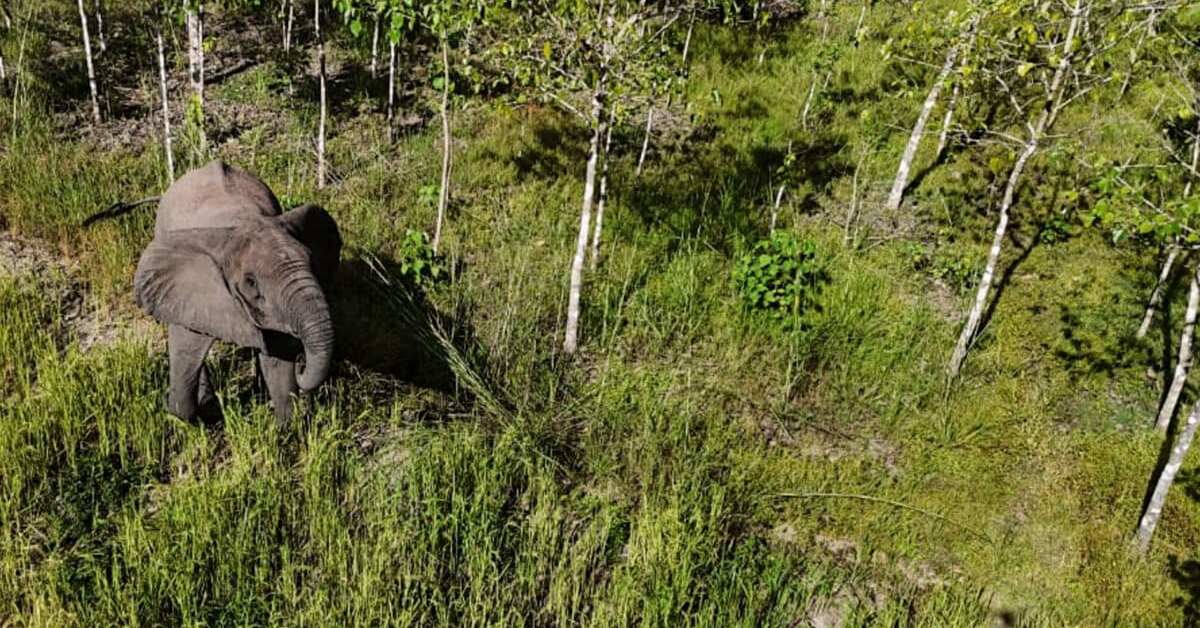
A protected wildlife corridor allows elephants to move between Tanzania’s Udzungwa Mountains and Nyerere National Park. (Photo: Southern Tanzania Elephant Program)
The corridor is not only intended to reconnect elephant habitats but also to restore native vegetation.Villagers and conservation group Reforest Africa have so far planted around 100,000 native trees representing 30 species inside the corridor. Another 50,000 trees are planned.Some areas are being planted densely to recreate closed-canopy rainforest, while others are being maintained as more open woodland.The trees were selected to resemble the valley’s former vegetation and provide food for wildlife. Species including sycamore figs and wild mangos produce fruit eaten by animals such as Sykes’ monkeys and trumpeter hornbills, which can then help disperse seeds.Some sections have deliberately been left unplanted so researchers can observe how natural regeneration develops.“The corridor aims to maximize biodiversity,” said Robin Loveridge, chief executive of Reforest Africa.
Elephants still face challenges near the corridor
The project has encountered difficulties, including elephants avoiding an underpass built beneath a major road near the southeastern edge of Udzungwa.The road was tarred three years ago and can become busy with motorists who stop to watch elephants. Crowds gathering when elephants emerge from the forest or enter the corridor can cause the animals to turn around, Jones said.Conservationists are considering installing screens around the underpass to provide the elephants with greater privacy.Development near the corridor is another concern. Jones said a petrol station was being constructed a few hundred metres away without an environmental impact assessment, while a hotel and bus station have also been proposed nearby.Local participation could play an important role in protecting the corridor from incompatible development.Astrid Matejcek, a cultural geographer at the University of Mainz who researched wildlife corridors in the Kilombero Valley, said local residents had emerged as important advocates for conservation.She noted that villagers had pushed for native tree species to be planted rather than relying on agricultural or commercial plantations that might not provide suitable habitat for elephants and other wildlife.“Entrusting [local people] with responsibility not only for their land but also for [tree] species selection and forest management offers hope for the sustainability of the corridors,” Matejcek said.
A wider conservation window is closing
The challenges facing Tanzania’s elephants extend beyond the Udzungwa and Nyerere landscapes.Across Africa, elephant populations have been severely affected by poaching for ivory and habitat loss. The African forest elephant is classified as critically endangered by the International Union for Conservation of Nature (IUCN), while the African savanna elephant is classified as endangered.Lohay said similar efforts could help protect connections between major ecosystems in northern Tanzania, where elephant corridors linking Tarangire with the Serengeti ecosystem and the Ngorongoro Conservation Area face increasing pressure from settlement and agriculture.“The window of opportunity to officially demarcate them is closing,” he said, adding that action over the next decade could determine whether some of these routes remain viable.Back in the Kilombero Valley, the reforestation effort is already beginning to change the landscape. Trees planted in late 2023 have grown above head height, and their dark green canopy is now visible in satellite images.For Loveridge, the project represents a long-term investment in wildlife and future generations. He recalled planting trees with his young son and imagining what the corridor could look like by the time his son grows up.“That’s what all this is really for,” he said. “Safeguarding the planet for the next generation.”