
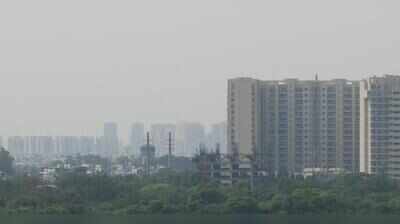
Gurgaon: The average air quality index (AQI) last month was 26% higher than in 2024 and around 35% higher than in 2025, making it the city’s most polluted Sept in three years. An analysis of daily AQI data from 2016 to 2026 shows that the monthly average rose to 114.8 this year, compared with 91.1 in 2024 and 84.9 in 2025.The rise was driven largely by a sharp decline in air quality in the second half of the month. After relatively moderate levels during the first 18 days, the city recorded a five-day spell of high pollution from Sept 20 to 24. The AQI crossed 200 on four of those days and touched the month’s peak of 242 (poor) on Sept 22.The AQI stood at 195 on Sept 20, 218 on Sept 21, 242 on Sept 22, 214 on Sept 23 and 237 on Sept 24, with the five-day average at 221.2.The month had begun on a better note, with an AQI of 94 on Sept 1. It stayed below 140 for most of the first 18 days and dropped to 81 on Sept 18. It then climbed to 120 on Sept 19 and 195 the next day.The average AQI for the first 18 days was around 90, while the average between Sept 19 and 30 was 152, showing the extent to which the late-month deterioration pushed up the monthly figure.Residents said the change in air quality was noticeable on several days, particularly in the mornings and evenings. “We have seen more dust and a layer of haze, even before the peak winter pollution season begins,” said Ashutosh Ahalawat, a resident of Sector 90.Gunjan Agarwal, a resident of Sector 53, said, “Sept used to be relatively comfortable after the monsoon, but this year the air was very polluted. With GRAP coming into force from Oct 1, residents are worried about what the coming months will bring.”Rajesh Menon, a resident of Sector 57, said the AQI readings reflected what people were experiencing on the ground. “The AQI numbers may fluctuate, but people can feel the difference. There is more dust on roads and the air feels heavier on some days. The concern is that if pollution is already rising in Sept, the situation could become much worse in winter,” he said.Air quality improved after Sept 24. The AQI fell to 140 on Sept 25, 90 on Sept 26 and 71 on Sept 27. It was 98 on Sept 28, 89 on Sept 29 and 114 on Sept 30.Despite the increase, Sept 2026 remained less polluted than some earlier years. The average AQI was 140.8 in 2023, 133.4 in 2017, 118.6 in 2022 and 117.7 in 2020. The corresponding averages were 91.9 in 2018, 70.3 in 2021, 67.7 in 2016 and 65.9 in 2019.The data indicates a reversal after two consecutive years of lower Sept AQI. The average had fallen from 140.8 in 2023 to 91.1 in 2024 and 84.9 in 2025 before rising to 114.8 this year.“The rise in Sept AQI this year suggests that Gurgaon’s air quality has weakened compared with the last two years, but it is too early to conclude that the city is heading towards an exceptionally polluted winter. Sept 2026 marks a return to the moderate category after two years of satisfactory air quality, yet pollution levels remain below those recorded in several earlier years. At this stage, deterioration appears more consistent with a return to typical pre-winter conditions, potentially influenced by weather variability, than with a clear signal of an unusually challenging pollution season ahead,” said Jinitha Varghese, programme manager, EnviroCatalysts.Air quality experts said the late-Sept spike needs to be assessed against changes in meteorological conditions and the build-up of local and regional emissions.