
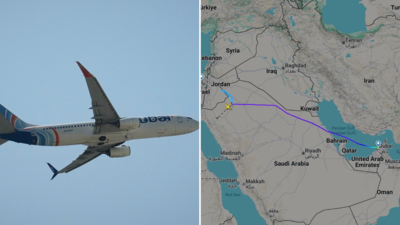
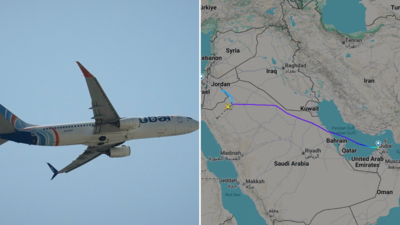
A routine flight from Dubai to Tel Aviv turned into a terrifying mid-air emergency on Wednesday after an apparent violent confrontation between the pilots of a flydubai aircraft. Flight FZ1073, carrying around 180 people, was forced to divert to Saudi Arabia after transmitting emergency signals, including the international code associated with unlawful interference.The Boeing 737 was flying towards Israel when its altitude suddenly dropped sharply. Flight-tracking data showed the aircraft descending by thousands of feet in a matter of seconds, while passengers reported hearing screams coming from the cockpit. The situation became even more alarming when the aircraft transmitted the 7500 transponder code, which is used to indicate hijacking or unlawful interference.Also read: Passengers recall harrowing ordeal on flight that nearly crashedHere is what happened:
A routine Dubai-Tel Aviv flight suddenly went wrong
Flydubai flight FZ1073 took off from Dubai International Airport bound for Ben Gurion Airport near Tel Aviv. The route is a regular one, with flydubai operating daily return services between the UAE and Israel.The aircraft was a Boeing 737 Max 8 and had around 180 people on board, according to reports. The first part of the journey appeared to be routine. But roughly two and a half hours after departure, the aircraft suddenly began losing altitude.Also read: Screams, chaos onboard as Flydubai flight takes 17,000 ft roller coaster ride mid-airFlight-tracking data showed a dramatic descent from cruising altitude, with different reports putting the fall at around 14,000 to 17,400 feet in a short period. The aircraft then changed course towards Saudi Arabia instead of continuing towards Israel.What caused the sudden descent was initially unclear. Soon, however, reports emerged that something had gone seriously wrong inside the cockpit.
Screams, blood and a fight inside the cockpit
Passengers later described a chaotic scene. One passenger, identified as Miriam, told Israeli media that passengers heard screaming before the cockpit door opened.She said they saw a large amount of blood and that one of the pilots appeared to have been injured. Another account said a man carrying a knife had forced one of the pilots to the floor.Also read: Pilot tried to crash plane, hijack code triggered – What happened on Tel Aviv flightAn Israeli official told Reuters that the pilots had been involved in a physical altercation. Later reports from Israeli officials went further, saying information gathered during the investigation indicated that the co-pilot may have tried to stab the captain.The precise sequence remains under investigation. Passenger accounts provide a picture of panic inside the aircraft, but they do not by themselves establish exactly what happened in the cockpit or why the confrontation began.
The plane suddenly plunged thousands of feet
The most alarming indication of what was happening came from the aircraft’s flight path. Tracking data showed that FZ1073 underwent a sudden and steep descent while flying over the region.One set of data showed the aircraft falling nearly 14,000 feet in less than 30 seconds, while other reports put the total descent at more than 17,000 feet in roughly two minutes.Passengers reportedly felt the aircraft dip sharply and feared that they were going to die. One passenger described the plane as being “completely out of control”.The descent occurred around the same time as the reported confrontation between the pilots. However, flight-tracking data can establish what the aircraft did, not necessarily why it happened. Investigators will have to establish whether the descent resulted directly from the cockpit struggle or from deliberate action by one of the pilots.
Why the hijack scare
The aircraft initially transmitted the 7700 transponder code, which signals a general emergency. Several minutes later, it transmitted 7500, the internationally recognised code for unlawful interference and commonly associated with hijacking.That immediately transformed the incident into a major security alert.The aircraft was travelling towards Israel, carrying a large number of Israeli passengers, and the 7500 signal raised fears that someone could have attempted to seize control of the plane.Israel responded by scrambling fighter jets as authorities tried to determine what was happening. Prime Minister Benjamin Netanyahu also held security consultations as the incident unfolded.The 7500 signal was therefore critical in triggering the response, although it remained unclear who transmitted the code and under what circumstances.Israel feared the worst, but it was not a conventional hijackingThe initial response was based on the possibility that the aircraft had been hijacked. But Israeli officials later said the incident did not appear to be a conventional hijacking.Doron Spielman, a spokesperson for the Israeli prime minister’s office, told Reuters that the incident was not believed to have been a hijacking and described it as a “different incident”.That distinction became important as more information emerged about the alleged cockpit fight.According to Israeli officials cited in later reports, the confrontation may have involved one pilot attempting to overpower the other. Some officials said they were examining the possibility that the incident was an attempted attack, while the investigation remained ongoing.
Passengers and other crew members reportedly intervened
One of the most extraordinary elements of the incident was the reported intervention of people inside the aircraft.According to Israeli reports, passengers helped restrain the pilot who was allegedly attacking the other pilot. This account has not been independently established in every detail, but officials said passengers and crew members became involved after the confrontation escalated.Reports also said there was another group of pilots travelling as passengers on the aircraft, dressed in civilian clothes. According to a Channel 12 report cited by The Times of Israel, these pilots helped prevent one of the pilots from taking over the aircraft.If confirmed, their presence would have provided an additional layer of assistance during an extraordinary emergency in which the operating flight crew had become incapacitated or involved in a physical struggle.
A second team of pilots may have helped avert disaster
The report that other pilots were travelling as passengers is particularly significant. According to Israeli media, these pilots were able to help after the cockpit confrontation and prevent the situation from becoming even more serious.A senior Israeli official was quoted as saying that without the additional pilots, the incident could potentially have resulted in a catastrophic outcome. The official compared the potential consequences to major past attacks, although that assessment remains an official characterisation rather than an established outcome.The precise role played by the off-duty pilots has not been fully detailed publicly. However, reports indicate that they helped ensure the aircraft could remain under control after the fight between the operating pilots.
Why did the aircraft land in Saudi Arabia?
Once the aircraft was stabilised, it was diverted towards Saudi Arabia rather than continuing to Israel.Flight-tracking data showed the aircraft changing course and eventually heading towards Tabuk in northwestern Saudi Arabia. It landed safely at Tabuk airport, where Saudi security forces surrounded the aircraft.The decision was logical in the circumstances because the aircraft required an immediate emergency landing after the cockpit incident. Tabuk provided a suitable airport for the aircraft to land while authorities dealt with the situation.Both pilots were later reported to have been taken to hospital after suffering injuries. The airline said all passengers were safe and accounted for and that its teams were working with the relevant authorities.
How close was this to becoming a mass-casualty disaster?
The full answer will depend on the investigation. Israeli officials have described the incident as one in which a major disaster was narrowly avoided, while some officials are examining whether the incident amounted to an attempted attack.But several elements are already clear. The aircraft suffered a dramatic loss of altitude, a fight reportedly broke out between the pilots, at least one pilot was injured, an emergency code associated with unlawful interference was transmitted and fighter jets were scrambled.Passengers also described seeing blood and hearing screams, while the aircraft had to divert to another country.What remains unclear is the motive, exactly who initiated the violence, who transmitted the emergency codes and whether the descent was deliberate. Those questions will determine how the incident is ultimately classified.
A horrific reminder
The incident has inevitably brought back memories of the Germanwings disaster, one of the most devastating cases involving deliberate action by a pilot. On March 24, 2015, Germanwings Flight 9525, an Airbus A320 flying from Barcelona to Düsseldorf, crashed in the French Alps, killing all 150 people on board.Investigators concluded that the co-pilot deliberately locked the captain out of the cockpit and initiated the aircraft’s descent, preventing the captain from regaining control.The Germanwings crash subsequently led to renewed debate over cockpit access, pilot monitoring and aviation safety procedures.The circumstances surrounding the flydubai incident are different and remain under investigation. The aircraft landed safely and all passengers survived. But the reported combination of a cockpit confrontation, a steep descent, emergency signals and alleged attempts to seize control highlights the potentially catastrophic consequences when the people responsible for flying an aircraft become part of an in-flight security emergency.