
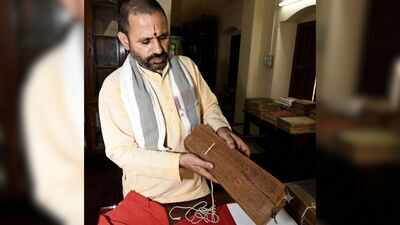
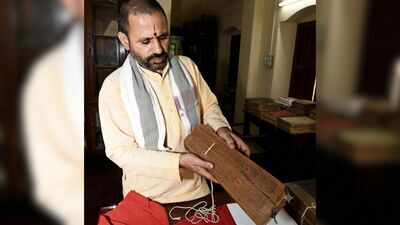
For more than a century, palm leaf manuscripts at Mysuru’s Oriental Research Institute (ORI) have carried the knowledge of generations of scholars. Now, millions of individual leaves are being cleaned, scanned and converted into digital records that can be studied without repeatedly handling the fragile originals.At the Institute, manuscript bundles are carefully opened, cleaned, documented and photographed, folio by folio. Once digitised, the images are checked, processed and linked to metadata before the originals are carefully preserved and returned to their bundles.
TIMES Special
The scale of the project, launched in 2022, is formidable: ORI has about 25,000 bundles containing nearly 70,000 titles, together accounting for around 26 lakh individual leaves, of which over 90% have now been digitised.Among the collection’s most celebrated treasures is the oldest extant manuscript copy of Kautilya’s Arthashastra, discovered in 1905 by scholar and librarian Rudrapatnam Shamasastry, who later published the text in 1909. The discovery helped bring this ancient Indian treatise back to scholarly attention. More than a century later, the manuscript is part of another chapter in its history: the creation of a digital record that can be studied without handling originals.The vast ORI repository comprises rare palm leaf and paper manuscripts, and thousands of invaluable books covering subjects ranging from science and medicine to diplomacy and governing the state.Ageing manuscripts are vulnerable to deterioration and fungal infestation, while their varied materials, scripts, sizes and formats make preservation of these manuscripts painstaking. When a manuscript is damaged, what is at risk is not merely an old document, but the knowledge contained in it. Technology has now become an important part of that preservation effort. Manuscripts are brought out of storage, opened carefully, examined folio by folio and, after processing, returned to their designated bundles and storage spaces. The mammoth exercise goes far beyond scanning. The folios are captured using high dynamic range (HDR) digital scanners. The images then undergo quality checks and processing, while metadata records details such as the manuscript’s title, script, language, and other identifying information. This makes the digital records easier to catalogue and retrieve.Women Behind ArchiveORI, as custodian of the manuscripts, facilitates access to the collection, identification and handling of manuscripts and coordination of the digitisation work. Mythic Society, its institutional partner, has funded the initiative by providing about Rs 3 crore so far.V Nagaraj, president of Bengaluru-based Mythic Society, said the initiative began after reports in May 2022 highlighted the precarious condition of manuscripts that had not been conserved. “Mythic Society works in the areas of conservation and restoration of history, archaeology, Indian knowledge system, heritage, etc. When we came to know about the poor condition of the manuscripts, we were worried. So, we decided to take up the conservation and restoration works as University of Mysore was lacking funds.“Instead of hiring an outside agency, the society decided to train local women for the task. Thirty-five local women, with schooling between classes IX and XII, were hired and trained in tasks ranging from cleaning the manuscripts to fumigation. The project was also intended to provide women with employment and specialised skills in manuscript handling and conservation. “We used this initiative for women empowerment. And they did a great job,” said S Ravi, the society’s former chairman and current honorary secretary.More than 7,000 paper manuscripts (Hastaprati) are now being digitised. “Originally, we wanted to digitise only leaf manuscripts. But now the project has been extended to paper manuscripts,” he added.Conservation A Delicate ProcessORI researcher Diddigi Vamsi Krishna said digitising such a large and diverse collection is different from scanning modern books or documents. Manuscripts are historical and cultural artefacts, and both their physical characteristics and contents have to be protected.The manuscripts vary considerably in material, size, script, foliation, and format, and require careful handling at every stage. There are thick bundles of closely written palm leaves, smaller manuscripts tied with individual cords, and larger bundles extending across considerable lengths. The writing is often tiny and densely packed, underscoring the care required while handling each folio.Preservation takes place before and alongside digitisation. Where fungal infestation is identified, paradichlorobenzene and thymol are used for treatment. Depending on the nature and extent of fungal growth, the treatment generally lasts 21 to 28 days.Fumigation helps deactivate the fungal infestation and control its spread. The visible fungal deposits are then carefully removed manually under UV lighting. “We use citronella oil and black powder to clean the leaves. The black powder helps highlight the letters carved into the folios, making them easier to read and scan,” Vamsi Krishna explained.Only after this treatment is the manuscript ready for digitisation. The diversity of Indian scripts and manuscript formats adds another layer of complexity. Different writing styles, page sizes, layouts, and physical characteristics require individual attention.The physical manuscript, meanwhile, must be restored to its original form. The folios are carefully identified, arranged in their original sequence, and returned to the appropriate manuscript bundle. Re-bundling requires considerable attention, as a misplaced or incorrectly arranged folio can affect the integrity of the manuscript.Making Manuscripts AccessibleDigitisation is also opening new possibilities for scholars examining manuscripts that were earlier difficult to read or just too precarious to handle. In palm leaf manuscripts, letters were scratched, engraved or etched directly onto dried palm leaves using a stylus. Lampblack or carbon ink was later rubbed into the grooves to make the writing visible. “Many of the manuscripts are very small and difficult to read and understand,” ORI director DP Madhusudana Acharya said.He cited a 600 to 700-year-old manuscript of Script of Sundarakanda of the Ramayana, written in Nandi Nagari script, as one example that has been digitised at the institute. The digital copy allows scholars to study the manuscript without handling it repeatedly. Scholars can request digitised manuscripts from the institute in PDF for a nominal fee, Madhusudhana Acharya said.They can also visit the institute to refer to the original manuscripts. “We are getting requests from both Indian and foreign scholars for the digitised copies. Our dream is conserving the Indian knowledge along with sharing it globally through joint initiatives and collaborations,” said Madhusudana Acharya and ORI deputy director C Parvathi.