
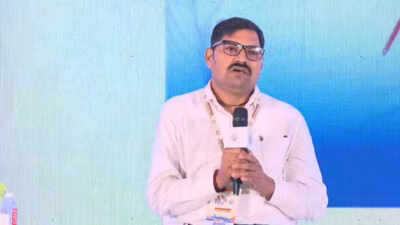
From a handful of earth to a finished work of art, Gorakhpur’s terracotta has travelled a long way. Once largely confined to artisan communities and rural workshops, the craft is increasingly presented as a distinctive product from the region, finding new markets while giving traditional craftsmen access to finance, technology and design.At the UP Transformation Dialogues – Gorakhpur Summit, organised by The Times of India, terracotta artisan Rajan Prajapati shared the story behind that transformation during a fireside chat titled “From Mitti to Masterpiece: The Story of Gorakhpur’s Terracotta.” In conversation with moderator Daksh Sethi, Prajapati spoke about his family’s craft, the challenges artisans once faced and the opportunities emerging through government-backed initiatives.
From family craft to a recognised brand
For Prajapati, terracotta is more than a traditional occupation. It has become a defining part of Gorakhpur’s identity and an example of how a local craft can develop into an organised enterprise.“This terracotta product has become a brand in Gorakhpur,” Prajapati said, tracing the change to greater institutional attention towards the craft and its potential to reach national and international markets.He recalled how artisans once struggled to access formal finance and modern resources. His father would repeatedly visit banks seeking loans, while craftsmen largely depended on traditional methods and whatever tools were available to them.The introduction of the One District One Product (ODOP) framework brought a significant change, according to Prajapati. Access to funding, training and market support gave artisans greater scope to expand their operations.
Technology meets traditional skill
While the craft remains rooted in handwork, Prajapati believes traditional expertise needs modern tools to reach its full potential.“No matter how much talent we have, we can’t manage it until we have the tools,” he said.He highlighted the importance of equipment such as improved pottery wheels, better production tools and contemporary design inputs. Training programmes have also helped artisans develop new skills, with workshops ranging from days to several months.For a craft traditionally associated with rural production, this combination of skill and technology has opened possibilities for larger-scale manufacturing without completely removing the artisan’s role.
Surviving the pandemic
The Covid-19 pandemic became one of the toughest tests for Prajapati’s business. With markets shut and movement restricted, artisans faced uncertainty over how they would sustain their families and employees.Prajapati said financial support available through ODOP helped him keep his business functioning. He opted for a loan of around Rs 30 lakh, using the capital to continue production and support his workforce during the difficult period.Today, his company employs around 25 to 30 people, while he estimates that Gorakhpur’s terracotta sector generates around Rs 10 crore in annual turnover.
Taking Gorakhpur’s craft beyond the region
Prajapati sees the next stage as expanding markets and creating more opportunities for young people. He believes the craft can provide livelihoods for people who might otherwise leave the region in search of employment.He also pointed to the importance of geographical indication recognition in giving regional products a stronger identity and protecting their association with Gorakhpur.“We are very fortunate that Gorakhpur has got the GI mark,” Prajapati said, describing it as an important step in establishing the product’s identity nationally and internationally.For Prajapati, the journey from traditional workshops to a growing commercial ecosystem shows what can happen when inherited craftsmanship meets modern finance, technology, design and market access. Gorakhpur’s terracotta may have begun with mitti, but its ambitions now extend far beyond the village workshop.