
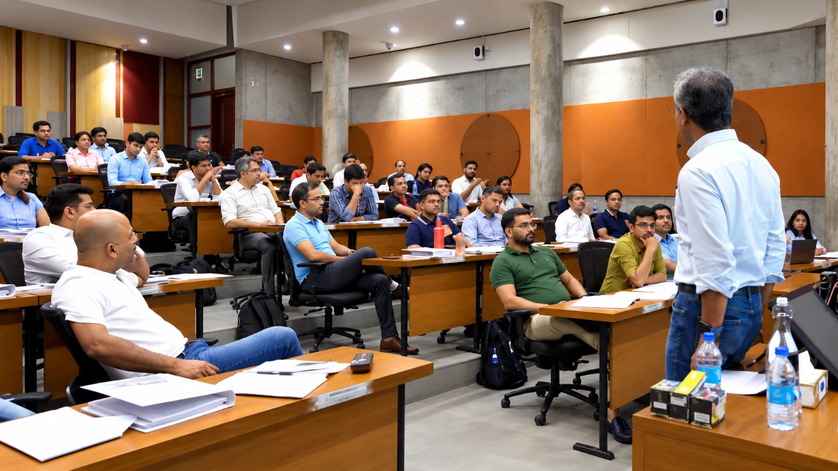
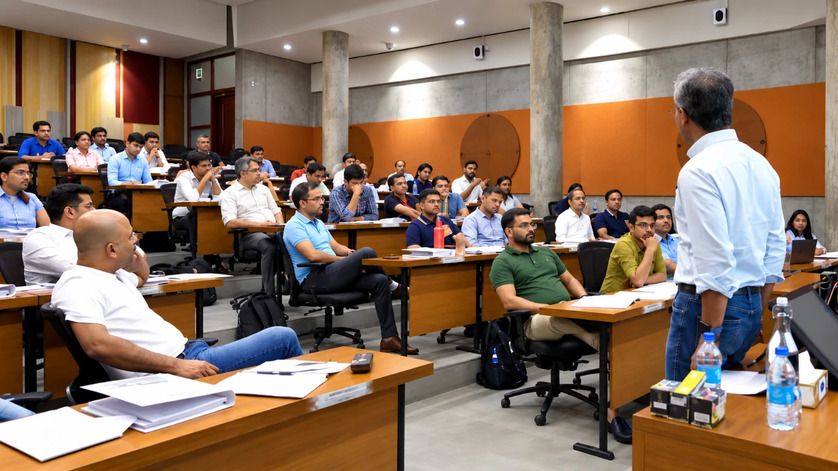
Indian businesses are expanding into new markets, technologies, and regulatory environments faster than most leadership teams are prepared for. In this environment, reaching the top of a function and leading an entire organisation have become two very different journeys. Excelling in finance, operations, or any single area builds deep credibility within that function. However, leading a business today means making decisions across finance, people, technology, and strategy, rather than focusing only on the area a leader knows best.India’s Chief Executive Officers (CEOs) are feeling the impact of changing markets. According to PwC’s 29th Annual Global CEO Survey 2026, 57 per cent of Indian CEOs report that their companies have started competing in new sectors over the last five years, up from 39 per cent just a year ago1. At the same time, 30 per cent of Indian CEOs say they are concerned about whether their companies have the right leadership team to take their organisations forward1.Organisations are growing beyond their original boundaries. The professionals leading this expansion are often the same individuals who built their careers by mastering a specific function and becoming the experts their organisations depend on. That depth is genuine and hard-earned. However, leading an organisation that is now competing in unfamiliar territory demands a broader, general management perspective, one that brings finance, people, technology, and strategy together.Bridging this gap requires structured learning through a senior management programme.How does a senior management programme guide organisations towards high growth?Guiding an organisation towards high growth means formulating a new strategy, redesigning how the organisation works, and managing change while protecting what already works well.A senior management programme builds this capability by exposing participants to strategic business challenges such as mergers, sustainability transitions, technology adoption, organisational restructuring, operational excellence initiatives, and market expansion. These are the same situations participants will navigate once they step into senior leadership roles themselves.Case-based learning and cross-industry exposure sharpen this capability further, helping participants think through strategy, structure and change with the whole organisation in mind, not just the function they know best.What does a senior management programme’s curriculum cover?At the senior level, no single function operates in isolation. A finance leader making a pricing decision needs to understand its impact on operations. An operations leader planning a sourcing decision needs to understand its impact on finance.A senior management curriculum should reflect such interconnected, cross-functional realities. Strategy, economics, digital marketing, accounting and financial analysis form the core of the curriculum. Corporate governance and people management follow, since decisions at this level affect both the organisation and the people in it. Artificial Intelligence (AI) and analytics for decision-making complete the picture, both increasingly essential capabilities for senior professionals today.How does a senior management programme sharpen an analytical mindset?At the senior level, decisions get bigger, and so do the consequences. Whether it is a merger and acquisition proposal, a restructuring of teams and roles, or a call on where to cut costs and where to invest, each one requires thinking through trade-offs across the entire organisation.A senior management programme sharpens this thinking through discussions of business cases that mirror the complexity of real business decisions. A finance professional may work through a decision from the airline industry, and an engineer may work through one from retail.Each case is worked through first, then debated in a classroom where people from different industries bring their own experience and perspective into the discussion. In such an environment, what gets built, case after case, is the ability to decide with confidence under pressure.Why does peer learning matter in a senior management programme?A curriculum can teach a framework. Only a room full of people who think differently can test it, and that is precisely what a senior management programme adds.Professionals from industries such as banking, technology, manufacturing, healthcare, infrastructure, energy, government and defence are usually part of a senior management cohort, and this range shapes how every case discussion plays out.For a healthcare leader, risk is read through patient safety and regulatory requirements. For a leader from a public sector undertaking, the same risk is read through scale and public accountability. When the two work through the same case together, each walks away seeing operational risk from a side they had never had to consider.How does a senior management programme prepare participants to anticipate the future?A senior management programme instils the habit of lifelong learning. It builds the adjacent skill sets that help leaders see where the business stands today and where the wider industry is heading next.Participants are introduced to a pedagogy built around business cases grounded in real managerial decisions. These cases are taught by faculty who bring current research into the classroom. Alongside them are peers with first-hand understanding of different industries, each bringing a perspective shaped by their own sector.Together, the case method and peer exposure prepare leaders to spot patterns across industries. Having already worked through how another industry handled disruption, they are less likely to be caught off guard when their own sector faces something similar.What sets a high-impact senior management programme apart?A high-impact programme brings curriculum, case-based learning, peer diversity and foresight together in one place. IIM Ahmedabad’s Senior Management Programme (SMP) is one such example.It gives experienced professionals a framework to structure years of accumulated knowledge into something sharper, connect the dots across organisational functions, navigate complexity with strategic clarity, and take the kind of bold career steps that functional depth alone rarely makes possible.Across 17 batches, IIMA’s SMP has brought together a broad, mixed group of experienced mid-career and senior professionals from across industries, each with years of exposure to real business decisions. This mix of industries and experience turns individual expertise into the kind of cross-functional thinking senior leadership demands.What changes when senior professionals complete IIMA’s SMP?For Rinku Agarwal, Chief Executive Officer of PeakPro Advisors and an alumna of IIMA’s SMP, Batch 2, the answer arrived as a career shift she calls rare. “SMP has opened many doors for me, but more importantly, it enabled a significant career change,” she says. “I transitioned from being a CFO to heading Sales and Customer Success, which was truly magical and rare after 15 years in a single domain.”For Vaibhav Oza, Chief Financial Officer of Shell Bitumen JV India and an alumnus of IIMA’s SMP, Batch 4, the shift was less about title and more about how he thinks. “I used to be very transactional in my views,” he says. “After attending SMP, I began to see the bigger picture. It gave me a new perspective on strategy, helping me analyse problems more deeply and find effective solutions.”Top-notch management learning, without pausing your careerIIMA’s SMP delivers the same calibre of teaching a senior professional would find on a full-time residential programme, while allowing them to acquire top-notch management skills without pausing their careers.Over 12 months, participants attend live online sessions every Saturday, facilitated by VCnow, the service provider for the programme, and learn directly from more than 15 IIMA faculty members, each bringing research and expertise from a different management discipline. Additionally, 12 days of campus immersion at IIMA add in-person case discussions and direct interaction with the cohort.Participants who complete the programmereceive a Certificate of Completion and are awarded IIM Ahmedabad Alumni Status, a mark of lifelong learning that stays with them long after the programme culminates.With more than half of India’s CEOs leading their organisations into new sectors,and three in ten CEOs evaluating whether they have the right leadership team, the gap between functional expertise and organisation-wide leadership has never been more visible. In response, SMP builds cross-functional thinking and the strategic leadership acumen participants need to lead beyond the boundaries of their own function.Admissions for SMP Batch 18 are now open.Reference:1. https://www.pwc.in/publications/ceo-survey/ceo-survey-2026.htmlDisclaimer: The article has been produced on behalf of VCnow (Unified Collaboration Services) by Times Internet’s Spotlight Team.