
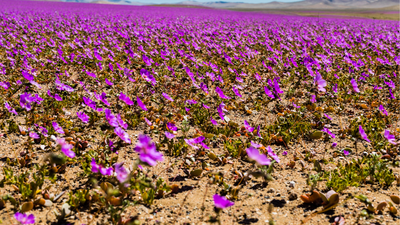
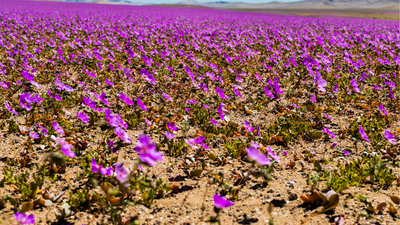
Deserts are vast stretches of sand and extremes of temperatures, where anyone would rarely expect to see flora exploding.But the Atacama Desert in Chile is just as contrary to this belief. Stretching over 1,000 kilometres along northern Chile, west of the Andes, the Atacama Desert holds the title of the driest non-polar place on the planet.So much so that it is popularly called the Valley of the Moon and Valley of Death, and it looks so alien, and the desert’s dry soil and near-total lack of microbial life have made it one of the best places on Earth to test instruments meant for Mars missions by space agencies.
Atacama Desert is called the ‘blooming desert ’ despite being the driest non-polar desert in the world
Despite this extreme dryness, life finds a way in certain corners, particularly in the lomas or the patches of vegetation kept alive by moisture-laden coastal fog known as camanchaca. These tiny pockets and patches of moisture help support the growth of grasshoppers, butterflies, hummingbirds, Andean flamingos, and even Humboldt penguins along the coast.The “desert bloom” takes place when over 200 species of flowers burst into colour across the barren landscape. It requires a very specific mix of rainfall, between 15 and 30mm, mostly in June and July; apart from this, optimum cold weather is also required to wake up dormant seeds buried in the soil. This year, due to unusually heavy rains recorded in August 2026 due to the EL Nino phenomena, Chile’s National Forestry Corporation is had predicted a historic bloom this year, potentially covering up to 15,000 square kilometres, starting in early September and peaking in the second half of October.hasAccording to a DW report and as seen on YouTube coverage by AFP, the Atacama landscape is now painted with colourful blooms where only a few species of cactus can be seen; this time, colourful purple-blue flowers have surrounded these prickly plants.This phenomenon of the ‘blooming desert’ usually occurs in gaps of nearly 5- 10 years, following unusually heavy rains in Chilean winter months running between June to August.
Atacama Desert receives very little rainfall throughout the year
The Atacama receives around 15mm of rain a year on average, compared to about 75mm in the Sahara. Some pockets of the desert get just 1 to 3mm annually, and certain weather stations in its hyper-arid core have never recorded a single drop of rain in recorded history. There’s even evidence suggesting parts of the desert may have gone without significant rainfall between 1570 and 1971, for over four centuries.The reason lies in its geographySandwiched between the Andes to the east and the Chilean Coast Range to the west, the desert is essentially sealed off from moisture on both sides. The Andes block humid air moving in from the Amazon, while the cold Humboldt Current chills the Pacific air enough to stop clouds from forming and releasing rain.As for its age, scientists long believed the desert’s hyper-arid conditions began 10 to 20 million years ago, during the Early to Mid-Miocene period. But newer research has pushed that timeline back significantly. According to Dr. Benedikt Ritter-Prinz from the University of Cologne, whose study was published in Nature Communications, the desert’s driest core may have already existed around 45 million years ago. He explained that this discovery “makes it one of the longest continuously dry regions on Earth and forces us to reconsider how and when such extreme environments develop.”