
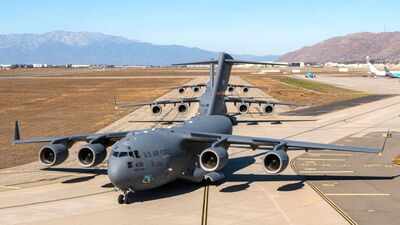
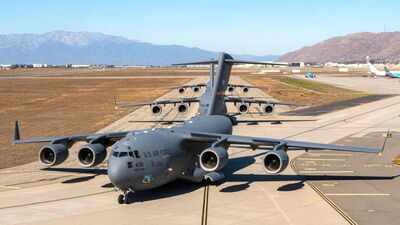
The US Air Force is examining whether Boeing’s C-17 Globemaster III production line can be revived, reopening the possibility of producing the heavy-lift aircraft more than a decade after its production ended.According to The War Zone, Air Mobility Command chief Lt Gen Daniel Tulley said the feasibility of bringing back the aircraft is being considered as part of a broader Analysis of Alternatives for the Air Force’s future airlift fleet.The review will examine whether existing C-17 production tooling, machinery and the wider industrial base can be restored, how much it would cost and whether a modernised version of the aircraft could meet future requirements.The C-17 remains one of the US military’s most important airlift platforms, capable of carrying heavy equipment, troops and vehicles while also operating from relatively austere airfields.TWZ also reported that Boeing has previously been approached by unnamed existing C-17 operators about the possibility of restarting production. Boeing has said it was encouraged by those discussions, although the identities of those operators have not been disclosed.The C-17 Globemaster III is a four-engine heavy military transport aircraft designed for both strategic and tactical airlift missions. Built by Boeing, it can move troops, vehicles and heavy equipment over long distances and can also land on relatively short and austere runways, giving it a role beyond conventional long-range cargo transport.It has a maximum take-off weight of roughly 265 tonnes and can carry a maximum payload of about 77.5 tonnes. The C-17 is powered by four Pratt & Whitney F117-PW-100 turbofan engines and can reach speeds of around 940 km/h.Why is the US looking to restart C-17 production?The main reason behind the renewed C-17 discussion is the US Air Force’s long-term airlift requirement. C-17 remains a critical part of America’s ability to move troops, vehicles, weapons and other heavy equipment rapidly across the world.The US is developing a Next Generation Airlift capability that is expected to eventually replace both the C-17A Globemaster III and the larger C-5M Galaxy. But developing, testing and deploying a completely new heavy transport aircraft could take decades. This has created a potential gap between the retirement of existing aircraft and the arrival of their successors.Instead of relying entirely on an ageing fleet until a new airlifter arrives, the US could potentially acquire additional aircraft and keep its heavy airlift capacity at the required level.The pressure on the current fleet is another factor behind the renewed C-17 debate. The US Air Force currently has 222 C-17A Globemaster III aircraft. The fleet has also seen extensive use in recent US military operations and overseas deployments, including missions in Afghanistan, Iraq, Syria, Gaza and the Middle East.The C-17 was also heavily used during the US campaign against Iran in 2026, carrying personnel, weapons and other supplies across the region.Will India be interested in acquiring more C-17s?A possible revival of C-17 production could also reopen an option for India, which operates 11 C-17 Globemaster III aircraft.In 2015, the IAF had pushed for three more C-17s to strengthen its strategic airlift fleet. However, Boeing’s production line was already being shut down, and only one additional aircraft could ultimately be secured, taking India’s fleet to 11.That means a production restart could give India another opportunity to expand its heavy-lift fleet. The C-17 has already demonstrated its usefulness for India in missions involving Leh, Thoise, Mechuka, Port Blair and overseas operations, where its heavy payload and short-field capability are particularly valuable.However, there is no confirmed Indian plan to buy more C-17s at present. TWZ has reported that Boeing has been approached by some existing C-17 operators regarding a possible production restart, but those countries have not been identified.