
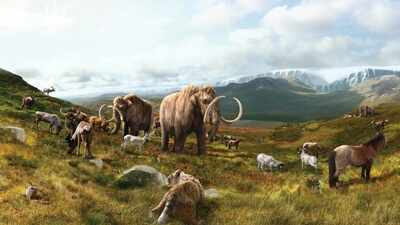
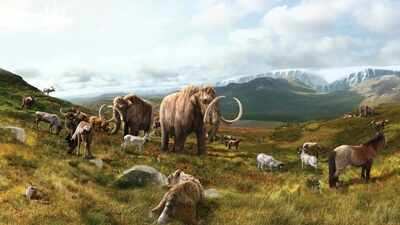
Imagine arriving in North America about 15,000 years ago and finding a landscape almost impossible to recognise today!That’s right. 15,000 years ago, North America looked like another planet. You’d have stepped out onto plains teeming with giant creatures that now feel more at home in a museum or a child’s imagination. There were hulking mammoths shoulder to shoulder with mastodons, great ground sloths grazing by the ton, camels and stag-moose weaving through the open spaces, and beavers as big as black bears paddling in the streams. Packing even more drama into the scene, huge predators prowled close by: saber-toothed cats with jaws built for ambush, dire wolves, lions bigger than any in Africa today, and short-faced bears that could stare down a double-decker bus.Then, almost all at once, by the standards of deep time, these remarkable animals vanished. It’s one of the most mysterious extinctions in the fossil record, and the question of why still sparks debate. The broad outlines are obvious: the end of the last Ice Age brought great upheaval, and humans, newly spread across the continent, were getting better at surviving and changing their environment. But the specifics and what really tipped the balance are still up for grabs.
North America: A continent of giants
Picture North America back then. It wasn’t just crowded; per History.com, it was a landscape shaped by giants. Beyond the usual mammoths and mastodons, there were two-toed camels, armored glyptodons that looked like living tanks, horses that had crossed back over from Eurasia, and the odd-looking stag-moose. These massive herbivores fed a food chain so fierce that even the biggest predators had to watch their backs. Some regions, like Ice Age Alaska, had six times as many large animals as today, with a total biomass that’s almost unthinkable now.But by about 11,700 years ago, most of these giants were gone. Some clung on a little longer, like small family bands of mammoths; for example, they survived on an Arctic island until fairly recently, but the age of giants ended fast and decisively.
Did climate change kill the giants?
The old climate-change theory has a lot going for it. At the end of the Ice Age, everything shifted quickly: glaciers retreated, temperatures leaped, entire ecosystems rearranged themselves. Lush grasslands, the staple diet for so many of the grazing giants, gave way to thicker forests and shrubs as the world warmed. Giant animals need boundless amounts of food, and as productive grassland shrank, so did the populations of the huge creatures that depended on it. Any knock-on effects took out predators, too.
Or did humans hunt them to extinction?
But the climate story isn’t neat and linear. There was the brief but dramatic cold spell called the Younger Dryas, starting about 12,900 years ago, which shook up habitats one last time before the continent tipped into our present, relatively stable climate. In places like Arctic Alaska, we can see how patchy the changes were. As the land got wetter and peatier, mammoths, horses, and bison vanished, likely because their old food sources dried up. Scientists didn’t find strong evidence that people wiped them out here, but they can’t fully rule out some last bit of hunting pressure.
A third possibility: humans changed the landscape
Speaking of humans, we come to the “overkill hypothesis”: the idea that people, spreading into North America with new tools and hunting skills, pushed these animals past the point of recovery. Early humans were absolutely capable hunters, and they did take down some big targets. The problem for mammoths and their kin? They reproduced slowly. Taking out just a few more animals than the population could replenish every year could tip an already shrinking group into collapse.Yet, the idea of humans running wild and wiping out everything in a mass bloodbath doesn’t fit all the evidence. Actual archaeological kill sites are rare and scattered. The timelines for extinction don’t always line up neatly from one species or region to another. Some recent research digs deeper, finding mixed causes: sometimes hunting led the way, sometimes climate, and often a nasty cocktail of both.And humans didn’t just hunt; they changed the landscape. People lit fires, altered plant communities, competed for resources. A study from California’s La Brea tar pits offers a glimpse of this: some megafauna started vanishing before the worst climate swings, suggesting that fires, habitat shifts, and the ripple effects from human activities were already shaking things up.
Where does all this leave us?
Well, the most dramatic theories (think the comet-impact idea, or sudden hyperdisease wiping out everything) have faded for lack of solid evidence. What’s left are two big, overlapping forces: a climate in wild flux and humans, clever and adaptable, making their own changes. The likeliest story is tangled and complex. Major climate swings began slicing up habitats and stressing animal populations. Humans arrived and added a layer of trouble: think hunting, landscape changes, competition for food. Together, the pressure grew until these fantastic species just couldn’t rebound.In the end, the story of the great Ice Age extinction isn’t just old news; it feels eerily familiar. Ecosystems can swing quickly, and disasters rarely have just one simple cause. Now, all that remains of that lost world are a few scattered bones, ancient footprints, and one very stubborn mystery: when the world changed, what finished off North America’s giants? Climate alone, people alone, or, as evidence increasingly suggests, both working together. The answer is still unfolding, one fossil and one research paper at a time.