
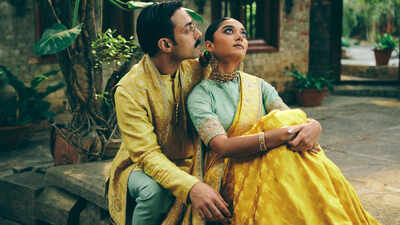
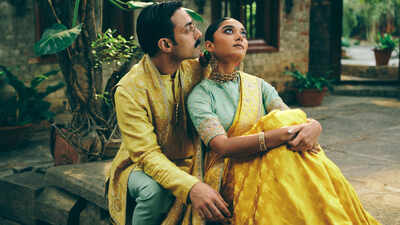
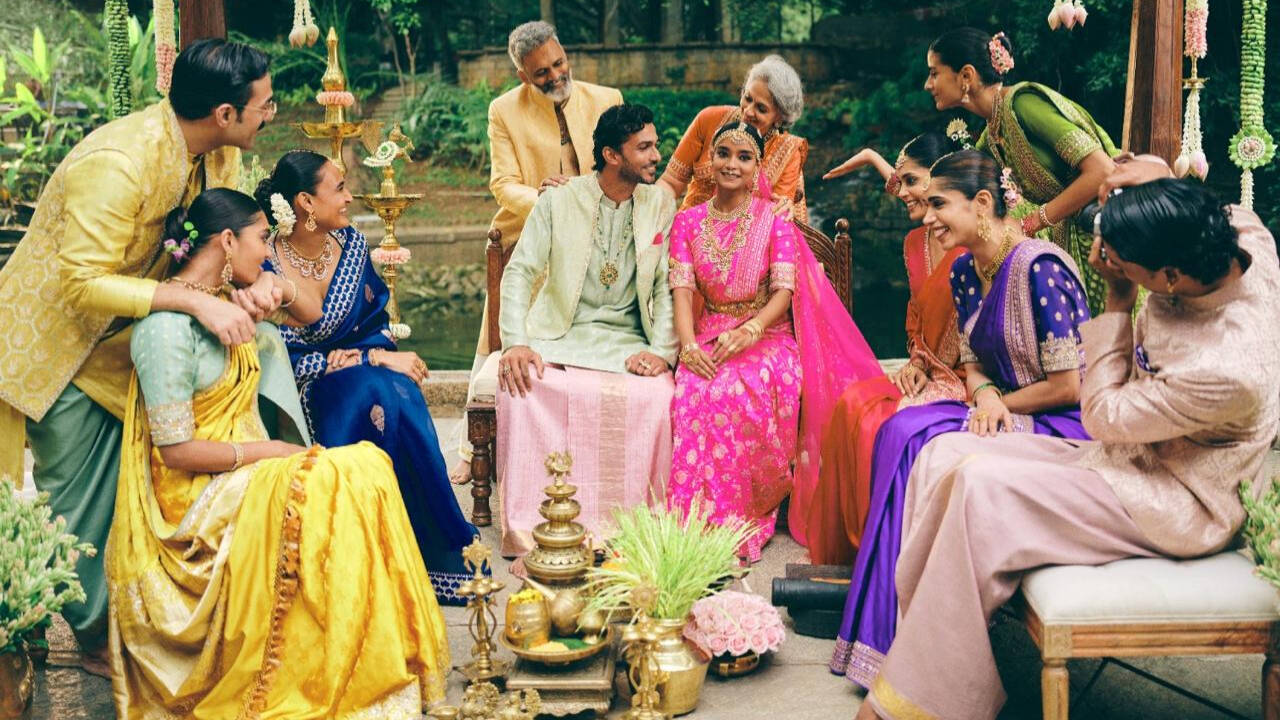
Weddings are usually told through their biggest moments – the ceremony, the elaborate outfits, the jewellery and the celebrations that continue for days. Anita Dongre’s second capsule from her Festive/Winter 2026 collection, Love is Home, takes a quieter route, looking instead at the people and relationships that surround a wedding as two families gradually move from being separate worlds to becoming part of one another’s lives.The latest offering takes its cue from the smaller exchanges that can easily get lost amid the scale of a wedding. Sisters getting ready together, a mother holding her child close, grandparents sharing stories and friends becoming so closely involved that the distinction between friend and family begins to disappear. These are the relationships through which a wedding becomes more than a single occasion.There is a strong sense of familiarity running through the collection, but tradition isn’t treated as something fixed. Instead, it moves between people and generations. A ritual can be experienced differently by a new member of the family, while an old story can take on another meaning when it is heard by someone for the first time. The latest outing builds its narrative around this gradual process of adjustment, connection and belonging.That idea also appears through the recurring visual focus on hands. They are seen reaching, holding, fixing, comforting and playing – simple gestures that reflect the everyday ways affection is expressed. At a wedding, there are always hands adjusting a dupatta, fixing jewellery, holding a child, greeting a relative or pulling someone into a photograph. The collection brings attention to these seemingly ordinary moments, allowing them to become part of its visual language.
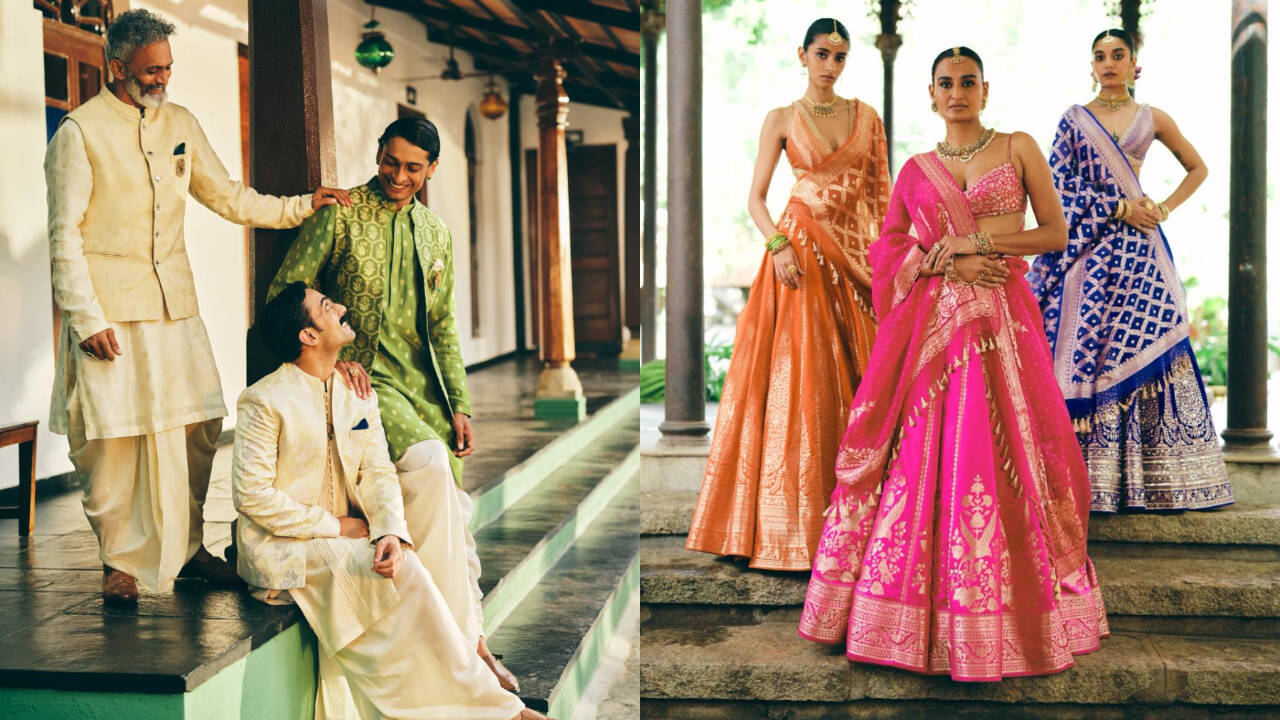
The clothes follow a similar sense of warmth and familiarity. Benarasi textiles form an important part of the offering, appearing in vivid shades of rani pink, amber and olive. The colours feel festive but don’t rely entirely on the more predictable wedding palette. Instead, they have a nostalgic quality, bringing to mind old silk sarees, family wardrobes and textiles that have been carefully stored away and passed down over the years.There is something particularly personal about the way colour works across the pieces. The shades seem less concerned with following a conventional idea of what wedding dressing should look like and more connected to the memories that certain colours can carry. Rani pink, amber and olive can recall a grandmother’s saree, a family celebration or a treasured textile seen repeatedly while growing up.Benarasi weaving gives the latest offering its strongest connection to Indian textile history. The craft has been associated with Benaras for centuries and has developed a distinctive vocabulary of silk, motifs and intricate weaving. Much of the knowledge behind the craft has traditionally been passed down through practice, with techniques learned by watching and working alongside someone who has already mastered them.That generational aspect fits naturally into the story behind the collection. Here, craft isn’t simply a technique used to create occasionwear. It becomes something that carries memory from one person to another. A textile can outlast the occasion for which it was made, moving through wardrobes and families while gathering new associations along the way.The Benarasi surfaces are populated with motifs drawn from the natural world. Birds appear across lehenga panels, while trees, flora and fauna are woven into the garments. The imagery gives the textiles a sense of movement, particularly where motifs appear to turn towards or interact with one another.There is a quiet conversational quality to these patterns. Birds seem to meet across panels, while trees lean towards one another. The imagery remains decorative, but it also ties back to the larger idea of connection running through the latest outing. Nature becomes another way of suggesting togetherness without making the symbolism feel too obvious.The loom itself offers perhaps the clearest parallel to the collection’s central idea. Warp and weft threads cross over and under one another, gradually forming a single textile. Each thread remains distinct, but the finished fabric depends on their coming together. In much the same way, the offering considers what happens when two families begin to find a shared rhythm.That doesn’t necessarily mean either family has to leave its identity behind. Instead, the collection looks at what happens when two histories and sets of traditions are allowed to exist alongside one another and eventually become intertwined. The same approach can be seen in the treatment of the textiles, where a familiar craft vocabulary is retained while the motifs and colour give it a different context.The result is occasionwear that remains firmly rooted in Indian craft without making tradition feel overly formal. The Benarasi textiles carry considerable history, while the nature-inspired imagery lends the garments a lighter quality. Saturated colours keep the pieces firmly within the festive wardrobe, while the motifs add another layer to the clothes beyond their decorative appeal.There is also a distinctly generational thread running through the latest offering. Weddings bring grandparents, parents, siblings, children and friends into the same space, with each person carrying a different relationship with tradition. For some, a ritual may be something they’ve followed for decades. For others, it may be their first experience of it. The collection reflects this meeting of perspectives through its emphasis on inherited craft and the ways traditional clothing continues to change.
At the centre of the story is the idea of home and what that word comes to mean when families change. A wedding can mark the beginning of a new household, but it doesn’t necessarily mean leaving an old one behind. People carry their memories, habits, languages, relationships and traditions with them. Over time, those things begin to make room for something new.This makes the latest outing less about the spectacle of a wedding and more about the emotional landscape around it. The clothes remain closely tied to familiar Indian craft traditions, but the narrative comes from everyday relationships – the people who help, hold, teach, laugh and stay close through the celebrations.The use of Benarasi feels particularly fitting in this context. Like family traditions, the craft survives because knowledge is passed from one generation to another. Motifs evolve, colours change and new interpretations emerge, but the connection to what came before remains.And that is where the collection finds its sense of continuity. Tradition isn’t presented as something frozen in time. It is something people carry forward, adapt and share.A wedding, after all, is much the same. Two people arrive with their own families, memories and histories. They don’t leave those things behind. Instead, they make room for another set of stories, rituals and relationships.Through its vivid Benarasi textiles, nature-inspired motifs and focus on familiar gestures, the latest offering looks at festive dressing through the people and memories that give a wedding its meaning. Two histories meet, traditions travel from one household to another, and relationships gradually create a new sense of belonging – moving, quite naturally, from yours and mine to ours.