
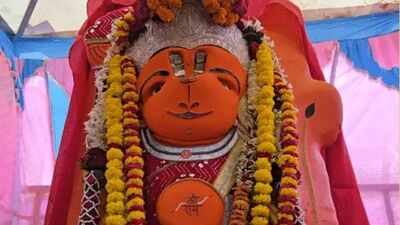
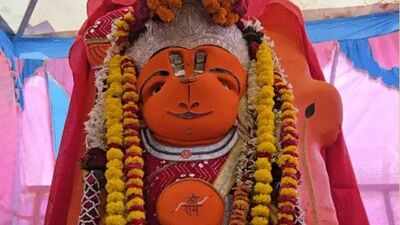
UJJAIN: In the heart of Ujjain’s bustling Bada Sarafa market, an eight-foot idol of Khade Hanuman stands under a waterproof tent, surrounded by the broken remains of the temple that once sheltered it.Around it, however, almost everything has moved on.Municipal plans call for a road between Kanthal and Gopal Mandir to be widened from 9 metres to 15 metres ahead of Simhastha 2028. Four religious structures lie along the 450-metre stretch, and the administration says all have agreed to relocate.One Ganesha temple has already been shifted.The Hanuman idol, however, remains where it has stood for generations — and has emerged as the most difficult piece in a road-widening project that was expected to be relatively straightforward.The administration has now made one thing clear: no attempt has so far been made to remove or relocate the idol, either manually or with machinery. Ujjain SDM LN Garg said misleading claims were circulating on social media about repeated attempts to shift it.Instead, officials are turning to engineers and technical experts before taking any step.The question is deceptively simple: how do you move an idol that may be structurally connected to what lies beneath it, without damaging either the idol or the heritage associated with it?
A temple gone, the idol still standing
The temple structure itself has already been dismantled. Its boundary wall and spire were carefully removed four days ago after the priest and members of local Hindu organisations gathered for a final aarti.The administration had identified a new location near an old water tank at Chhatri Chowk for the idol. According to officials, the priest had consented to the relocation and preparations for a new pedestal were under way based on instructions from the temple’s guruji.But the idol itself has not been touched.Additional municipal commissioner Santosh Tagore, who was at the site along with Garg, said the administration would wait for a technical assessment before deciding what happens next.“For the Hanuman idol, a technical team from SGSITS Indore and IIT is being called in for a proper analysis,” Tagore said, adding that the new site had already been finalised and its pedestal was being prepared.“Nothing further would be attempted until the situation is fully understood,” he said.That caution has changed the character of the dispute. What began as an infrastructure exercise has now become a question of engineering, archaeology, faith and heritage.
Is the idol rooted deeper than it appears?
One theory being examined is that the idol may have been installed using an old interlocking technique, with stones beneath it fitted tightly together.If so, what appears to be an idol standing on a pedestal may in fact be part of a much larger structure beneath the surface.Officials believe a detailed scan of the ground may be required to determine how deep that structure extends and how the idol is connected to it.Archaeologist Raman Solanki, who visited the spot as a curious resident and not in any official capacity, examined the stone at the rear of the idol and identified it as Malwa basalt.He said the idol could potentially be as much as 1,000 years old and possibly date to the Parmar era.Solanki believes that if the stones beneath the idol can be carefully separated, it may be possible to free it without causing extensive damage.That possibility, however, will have to be established through technical examination rather than assumption.
Where faith meets infrastructure
For the administration, the road project is tied to preparations for Simhastha 2028, when Ujjain will see a massive influx of pilgrims.The 450-metre stretch is being widened to ease congestion, and officials say development work cannot simply be put aside.At the same time, the administration is now emphasising that development cannot come at the cost of religious sentiment or heritage.Garg said the matter was deeply connected to the faith of devotees and that no decision would be taken without scientific and technical opinions.“While the development works for Simhastha 2028 are important, preserving Ujjain’s faith and heritage is equally significant,” he said.The administration, he added, would seek a consensus-based solution through dialogue with devotees, saints and experts.
‘Powers higher than them exist’
For temple priest Mahesh Bairagi, the uncertainty surrounding the idol has reinforced his belief that its relocation should not have been treated as a routine municipal exercise.“The setback makes it clear that no real preparation had gone into planning the idol’s move. Authorities should understand that powers higher than them exist,” he said.Religious organisations have also urged caution.Vishwa Hindu Parishad’s Khagendra Bhargava said old temples and idols should be relocated only when absolutely unavoidable, and that the complete traditional and administrative process must be followed with due respect.The question of the idol’s age, if established by experts, could make the issue even more sensitive.
The devotees keep coming
Meanwhile, the most visible part of the story is not the road, the engineers or the municipal files.It is the devotees.Even with the temple structure partly dismantled, worship has continued. Bairagi performs the morning puja amid the remains, blessing visitors with the ritual whisk as he has done before.Queues of devotees continue to form for darshan of what many now regard as a miracle — an idol that remains standing amid a road project designed to make everything around it move.Members of Hindu organisations have maintained a presence around the site, while police personnel remain stationed nearby. At times, slogans have been raised against the municipal corporation’s handling of the matter.For now, the administration has chosen caution over force.The road may need to become 15 metres wide for Simhastha 2028. The temple structure has already made way.But the eight-foot Hanuman remains exactly where generations of devotees have known him to be.And before anyone decides where he should go next, experts will first have to establish what, exactly, lies beneath his feet.